
NEWS

IITA emerges as winner at the innovation week in Tanzania
May 12, 2023

IITACGIAR won the overall best booth and the best booth under the research institutes and organizations category during the 2023 National Innovation Week held from 24 to 28 April in Tanzania’s capital, Dodoma. The Institute beat 84 other exhibitors, including NGOs, private- and public-sector enterprises across multiple sectors operating in the country.
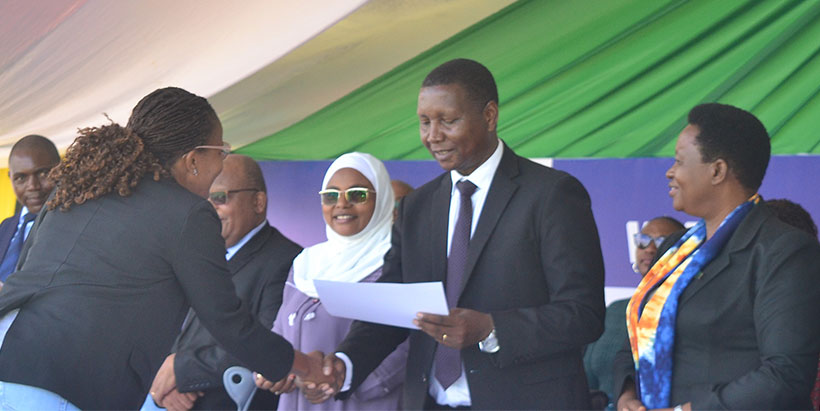
 Communication Officer Gloriana Ndibalema receiving the award for best booth of Innovation Week 2023, on IITA's behalf, from the Minister of Education, Science and Technology, Prof Adolf Mkenda. Photo: Independent photographer
Communication Officer Gloriana Ndibalema receiving the award for best booth of Innovation Week 2023, on IITA’s behalf, from the Minister of Education, Science and Technology, Prof Adolf Mkenda. Photo: Independent photographer

The National Innovation Exhibition is the platform that hosts a week-long series of collaborative events and exhibitions in Tanzania aimed at providing space to innovators, policymakers, corporate entities, development partners, researchers, and other players in the innovation ecosystem to share what they have been working on, learn from and inspire each other, collaborate across sectors, and transform Tanzania through the scaling of innovation.

IITA showcased several technologies, including digital tools (Plantvillage NuruSeedTracker, and AKILIMO), mechanical tools, and value-addition processes with the partner engagement experiences of youths and farmers. The Institute also displayed the natural aflatoxin control product Aflasafe and the Afya soil rapid test kit.
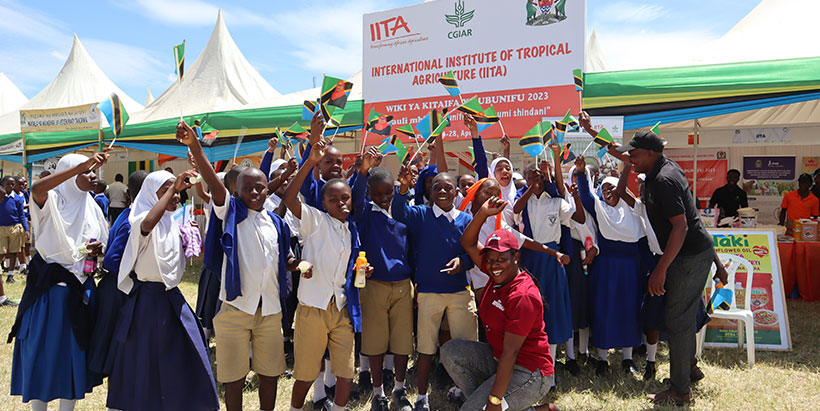
 Cheering school children after visiting the IITA booth. Photo: IITA/G. Ndibalema
Cheering school children after visiting the IITA booth. Photo: IITA/G. Ndibalema

The Minister of Education, Science and Technology, Hon Prof. Adolf Mkenda, noted that the government is committed to fostering the development of science and innovation as the key means of connecting the country with other nations. “This event is very important because if we want to build our national economy, we can’t depend on the availability of farms and their nutrient soils. We also need to use science and technology to increase productivity.” Mkenda noted.

“The government will continue emphasizing youth to study science subjects. The government has already allocated funds and has strategies for anyone who will conduct research that is recognized internationally in natural science and medicine. Every publication will win an award of 50 million Tanzanian shillings,” Hon. Mkende added.
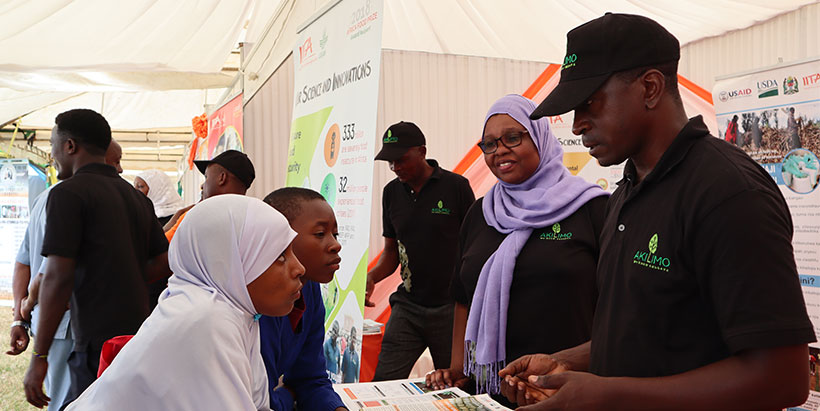
School girls keenly follow the explanation on the aflatoxin by Lab manager Jacob Njela, during the Innovation Week. Photo: IITA/G. Ndibalema

The stakeholders who visited the exhibitions applauded IITA for innovative technologies that contribute to agricultural productivity and improve farmers’ livelihoods, aligning with the year’s theme—Innovation for a competitive economy. Mariam Juma, a lecturer from Sokoine University, learned how to access improved cassava seeds and other best practices along the value chain. “Your technologies are impressive. I gained knowledge on making cassava chips and utilizing the opportunity to produce cassava floor for other consumptions,” she said.

A vendor named Innocent highlighted his positive experiences at the booth, which he visited more than twice. He was fascinated by the consistent level of customer service, the range of products displayed, and the advice provided by the IITA team. “The way you explain things to the visitors helps them to leave with so much knowledge and information. You clearly explained the technologies showcased in simple terms,” Innocent said.
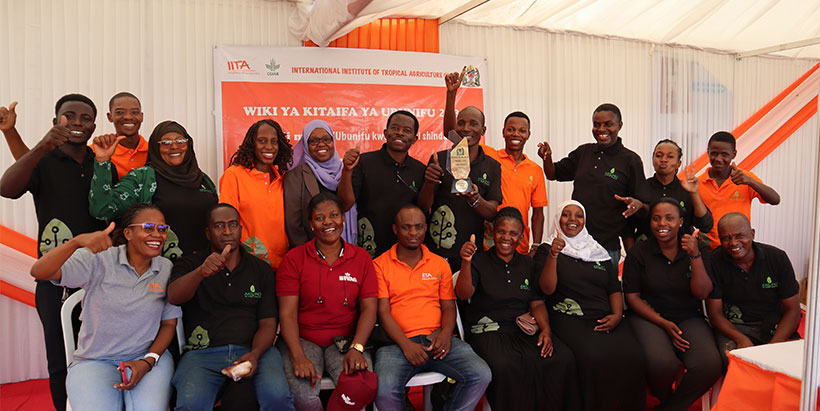
 IITA team after receiving a trophy for being the best overall booth at the 2023 Innovation Week. Photo: IITA/Lembris Laizer
IITA team after receiving a trophy for being the best overall booth at the 2023 Innovation Week. Photo: IITA/Lembris Laizer

Mzee Masoud, a resident of Dodoma, visited IITA’s exhibition on the last day, asking for cassava bread that he had bought on previous days, expressing how much he had enjoyed the unique flavor and texture of the bread baked by the IIITA youth group. “The one I bought yesterday, my grandchild ate it and wanted more. This is why I came to get them today,” Masoud said. “Where can I get this type of bread when I need them?” he asked.

This was IITA’s first win at the innovation week exhibition. The Institute was awarded the winner for both positions in recognition of the excellent arrangement of products (innovations and technologies) in the pavilion, creativity, societal impact of the research work conducted with evidence of the beneficiaries, and competence of exhibitors in disseminating information on the technologies.

Contributed by Gloriana Ndibalema


Contributed by

Recent stories

No items found

Leave a Reply

Your email address will not be published. Required fields are marked *

Scroll to Top
Olaosebikan, Olamide

Olamide Deborah Nwanze is a Senior Research Associate specializing in gender mainstreaming research to inform participatory and inclusive breeding, variety development, and seed systems policies regarding root, tuber, and banana (RTB) crops in the International Institute of Tropical Agriculture Headquarters, Ibadan, Nigeria. She is a PhD candidate at the University of Ibadan and holds an MSc and B. Agric in Agricultural Extension and Rural Development. Olamide is a fellow of the African Women in Agricultural Research and Development – Gender Responsive Agricultural Systems Policy (AWARD-GRASP) and the Gender Responsive Researchers Equipped for Agricultural Transformation (GREAT). She seeks to apply her gender-mainstreaming learnings, gender-responsive research, and policy development, and review expertise to facilitate women, youth, children, and vulnerable social group’s access to and adoption of agricultural Innovations that guarantee food, nutrition, income, and livelihood security in Africa. Her current roles include mentoring research fellows, development of guides and training manuals, implementation and adaptation of gender frameworks and tools, value chain actors’ engagement as citizen science partners, policy review and redesign, data management, and analysis. Her current research explores mixed methods and participatory and interdisciplinary approaches to capture and highlight gender dynamics, needs, preferences, and challenges stakeholders face within the agricultural livelihood value chain to prioritize gender-inclusive strategies in breeding programs, policy design, and implementation.

At IITA, she contributes to the implementation of the CGIAR Accelerated Breeding Initiative and Genetic Innovation Programs; participatory and gender research within the NextGen CassavaHarvestPlusRTBFoods, and Tricot-ClimMob 1000Farms Projects; and gender knowledge communication via the G-LENS webinar series, video documentary, policy briefspublications, and blogs.


Recent publications

de Sousa, K., van Etten, J., Manners, R. Bello, A., Teeken, B., Olaosebikan, O., et al. 2024. The tricot approach: an agile framework for decentralized on-farm testing supported by citizen science. A retrospective. Agron. Sustain. Dev. 44, 8. https://doi.org/10.1007/s13593-023-00937-1

Madu, T., Onwuka, S., Nwafor, S., Onyemauwa, N., Ejechi, M., Ofoeze, M., Ukeje, B., Eluagu, C., Olaosebikan, O., Okoye, B., 2024. Gender-Inclusive Consumer Studies Improve Cassava Breeding in Nigeria in: Frontiers in Sociology, volume 9, number: 1224504, doi: 10.3389/fsoc.2024.1224504

Olaosebikan, O.; Bello, A.; Utoblo, O.; Okoye, B.; Olutegbe, N.; Garner, E.; Teeken, B.; Bryan, E.; Forsythe, L.; Cole, S.; Madu, T. 2023.  Stressors and Resilience within the Cassava Value Chain in Nigeria: Preferred Cassava Variety Traits and Response Strategies of Men and Women to Inform Breeding. Sustainability 15, 7837. https://doi.org/10.3390/su15107837

Okoye, B., Ofoeze, M., Ejechi, M., Onwuka, S., Nwafor, S., Onyemauwa, N., Ukeje, B., Eluagu, C., Obidiegwu, J.*, Olaosebikan, O., Madu, T.* 2023. Prioritizing preferred traits in the yam value chain in Nigeria: a gender situation analysis in: Frontiers in Sociology, volume 8, number: 1232626, pages 1 – 9, ISSN 2297-7775, 2023. https://www.frontiersin.org/articles/10.3389/fsoc.2023.1232626/full

Olaosebikan, O., Bello, A. A., de Sousa, K., Ndjouenkeu, R., Adesokan, M., Alamu, E. O., Agbona, A., van Etten, J., Kegah, F. N.*, Dufour, D., Bouniol, A., Teeken, B. 2023. Consumer acceptability of cassava gari-eba food products across cultural and environmental settings using the triadic comparison of technologies approach (tricot) in: Journal of the Science of Food and Agriculture,

Teeken, B., Olaosebikan, O., Bello, A. A., Madu, T.*, Cole, S. M. 2023. Qualitative assessment on the positionality and preferences of dyads in relation to cassava-related activities: working with tricot trial citizen scientists https://hdl.handle.net/10568/138326 Type: Manual

Bouniol, A., Ceballos, H., Bello, A. A., Teeken, B., Olaosebikan, O., Owoade, D., Agbona, A., Fotso Kuate, A., Madu, T.*, Okoye, B.*, Ofoeze, M.*, Nwafor, S.*, Onyemauwa, N.*, Adinsi, L.*, Forsythe, L., Dufour, D. 2023. Varietal impact on women’s labour, workload and related drudgery in processing root, tuber and banana crops: focus on cassava in sub-Saharan Africa in: Journal of the Science of Food and Agriculture, pages 1 – 25, ISSN 0022-5142,

Bello, A. A., Agbona, A., Olaosebikan, O., Edughaen, G., Dufour, D., Bouniol, A., Iluebbey, P., Ndjouenkeu, R.*, Rabbi, I. Y., Teeken, B. 2023. Genetic and environmental effects on processing productivity and food product yield: drudgery of women’s work in: Journal of the Science of Food and Agriculture, pages 1 – 32, ISSN 0022-5142, 5

Cavicchioli, M., Zimbiti, T., Teeken, B., Nwanze, D.O., Liani, M., Parkes, E. & Bello, A. 2023. IITA-Gender Responsive Breeding Training Report. Genetic Resources Center, IITA-HQ, Ibadan, 21-23 September, 2022. Ibadan, Nigeria: IITA, (34 p.).https://hdl.handle.net/10568/131368

Agbona, A. Peteti P., Teeken B., Olaosebikan O. Bello, A. A., Parkes, E., Rabbi, I. Y., Mueller, L., Egesi, C., Kulakow, P. 2022. Data Management in Multi-disciplinary African RTB Crop Breeding Programs. In: Williamson, H.F., Leonelli, S. (eds) Towards Responsible Plant Data Linkage: Data Challenges for Agricultural Research and Development. Springer, Cham. https://doi.org/10.1007/978-3-031-13276-6_5

Lora Forsythe, Pricilla Marimo, Sarah Mayanja, Olamide D. Olaosebikan, Esme Stuart, Bela Teeken, Benjamin Okoye, Tessy Madu, (2021). Cross-product Gender Analysis of RTBfoods Step 2 Gendered Food Mapping on RTB Products. Understanding the Drivers of Trait Preferences and the Development of Multi-user RTB Product Profiles, WP1. London, UK: RTBfoods Field Scientific Report, 30 p.

Teeken, B., Garner, E., Agbona, A., Balogun, I., Olaosebikan, O., Bello, A., Madu, T., Okoye, B., Egesi, C., Kulakow, P. and Tufan, H.A. 2021. Beyond “Women’s Traits”: Exploring How Gender, Social Difference, and Household Characteristics Influence Trait Preferences. Frontiers Sustainable Food Systems 5:740926. https://doi.org/10.3389/fsufs.2021.740926

Teeken, B., Agbona, A., Bello, A., Olaosebikan, O., Alamu, E., Adesokan, M., Awoyale, W., Madu, T., Okoye, B., Chijioke, U., Owoade, D., Okoro, M., Bouniol, A., Dufour, D., Hershey, C., Rabbi, I., Maziya‐Dixon, B., Egesi, C., Tufan, H. and Kulakow, P. (020. Understanding cassava varietal preferences through pairwise ranking of gari‐eba and fufu prepared by local farmer–processors. Int J Food Sci Technol. https://doi.org/10.1111/ijfs.14862

Bela Teeken, Olamide Olaosebikan, Ireti Balogun, Benjamin Okoye, Tessy Madu, Steven Cole, Abolore Bello, Elizabeth Parkes. (2020). Piloting the G+ customer and product profile tools for gender-responsive cassava breeding in Nigeria. Nigeria: International Institute of Tropical Agriculture (IITA). https://hdl.handle.net/20.500.11766/13000