
NEWS

IITA, Exchange VZW, and HORTINET collaborate on banana clean seed production toward import reduction in Malawi
September 8, 2023

With an estimated annual consumption of 453,000 metric tons, bananas are important to Malawi. Therefore, the local production of planting material is crucial, especially since the advent of Banana Bunchy Top Virus and black Sigatoka. However, there is only one commercial tissue culture lab (HORTINET), with currently insufficient production levels.
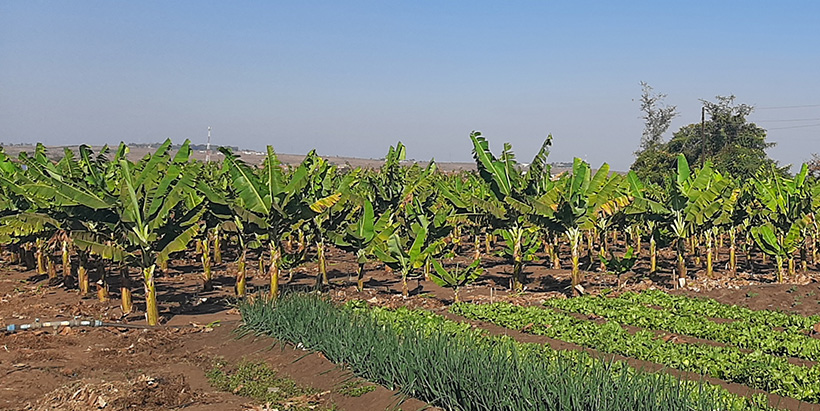
Banana plantation at Hortinet Foods Limited.

IITA provides technical support to Hortinet Foods Limited, Malawi, on tissue culture banana seedling production within the framework of a collaborative agreement between IITA and EXCHANGE VZW established in June 2022. Hortinet aspires to scale banana production and reduce the large quantities imported from neighboring Tanzania and Mozambique.

The banana bunchy top virus and poor agronomic practices have severely impacted banana production in Malawi, resulting in over 80% loss and underscoring the need for disease-free planting material to revive production. To address this need, Hortinet owner Frankie Washoni established a commercial tissue culture lab about 23 km off Lilongwe to produce disease-free planting material for growers. Virus-free banana plants imported from Vitropic, France, were used for field establishment, and the plantation currently serves a mother garden where suckers are obtained for further multiplication through tissue culture.
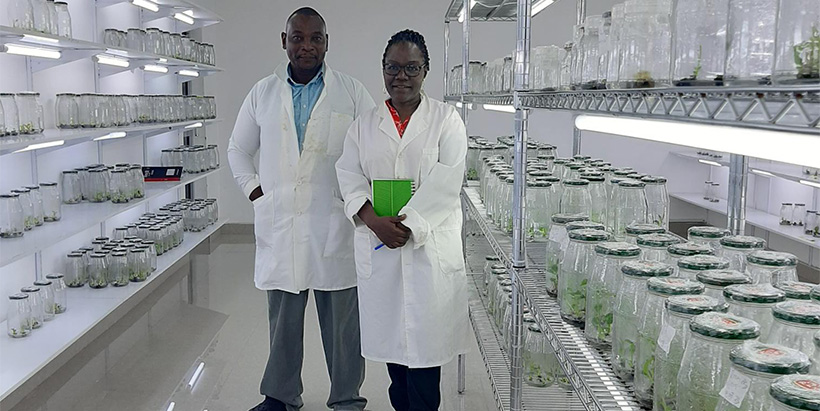
Frankie and Delphine at Hortinet tissue culture laboratory  growth room filled with banana cultures.
Frankie and Delphine at Hortinet tissue culture laboratory growth room filled with banana cultures.

However, Hortinet laboratory faced challenges of high levels of contamination, low multiplication rates, and sub-optimal capacity use compounded by a lack of technical expertise in banana seedling production and reached out to Exchange for support. Exchange supports promising African entrepreneurs with tailor-made expertise in their growth and scale-up. Exchange Coach Jan Aertsen, in response to Hortinet’s request, contacted IITA Banana Breeder Rony Swennen and brokered a consultancy agreement with IITA for technical support to Hortinet.

Through this agreement, IITA Tissue Culture Expert Delphine Amah has been working with Hortinet since August 2022, deploying her expertise on banana tissue culture for clean seed production.

During the first mission to Hortinet’s laboratory, she conducted a thorough diagnostic survey, identified the key issues with production, and proposed a plan for capacity development and a combination of remote and physical backstopping to address the production bottlenecks. Following this, Washoni and his lab manager, Nancy Chidzalo, attended a hands-on training on banana tissue culture at the IITA Bioscience Tissue culture laboratory in Ibadan, Nigeria.
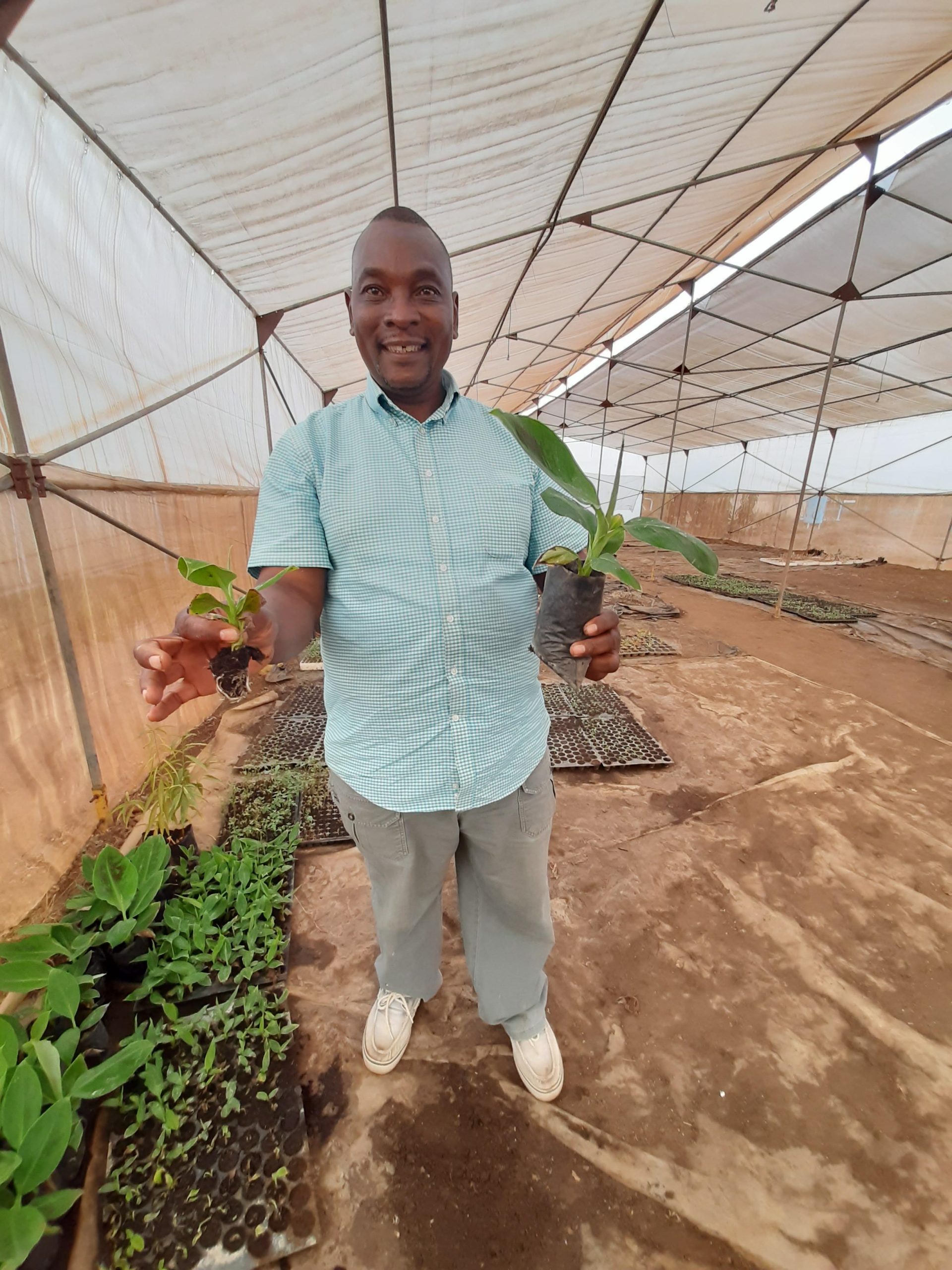
Frankie shows pre-hardened and fully hardened banana plants in Hortinet screenhouse.

As Washoni and the team are very committed and open to learning, significant changes were observed with better plant establishment and multiplication right after the first diagnostic mission and further refined after the hands-on training. On a recent backstopping mission to Hortinet in August 2023, one year after the first mission, Amah discovered that the lab is now in high production with enough stocks set to deliver over 15,000 plantlets to farmers by Q1 of 2024.

“We are happy we got support from IITA through Delphine, and we are now confident that we will continue to improve our production and provide clean planting material to smallholder farmers who grow bananas in the wetlands in Malawi,” Washoni said. He also confirmed that they are confident with post-flask management of tissue culture plantlets with very high success rates at the pre- and fully-acclimatized stages.

Capacity building for private sector tissue culture labs is crucial to strengthen skills on banana seed production and address the inherent demand for clean seed imposed by climate challenges and scale productive varieties to smallholder farmers. “Tissue culture is a technology-intensive process, and I am passionate about training young tissue culture lab managers to scale this technology in Africa,” noted Amah, who also provides similar technical support to other public and private sector tissue culture labs in Africa through other projects – PROSSIVA. Functional commercial tissue culture laboratories are game-changers in the vegetatively-propagated crop seed systems landscape with huge potential for sustainable high quality seed delivery to African smallholder farmers who rely on these crops.

Contributed by Delphi Amah


Contributed by

Recent stories

No items found

Leave a Reply

Your email address will not be published. Required fields are marked *

Scroll to Top
Olaosebikan, Olamide

Olamide Deborah Nwanze is a Senior Research Associate specializing in gender mainstreaming research to inform participatory and inclusive breeding, variety development, and seed systems policies regarding root, tuber, and banana (RTB) crops in the International Institute of Tropical Agriculture Headquarters, Ibadan, Nigeria. She is a PhD candidate at the University of Ibadan and holds an MSc and B. Agric in Agricultural Extension and Rural Development. Olamide is a fellow of the African Women in Agricultural Research and Development – Gender Responsive Agricultural Systems Policy (AWARD-GRASP) and the Gender Responsive Researchers Equipped for Agricultural Transformation (GREAT). She seeks to apply her gender-mainstreaming learnings, gender-responsive research, and policy development, and review expertise to facilitate women, youth, children, and vulnerable social group’s access to and adoption of agricultural Innovations that guarantee food, nutrition, income, and livelihood security in Africa. Her current roles include mentoring research fellows, development of guides and training manuals, implementation and adaptation of gender frameworks and tools, value chain actors’ engagement as citizen science partners, policy review and redesign, data management, and analysis. Her current research explores mixed methods and participatory and interdisciplinary approaches to capture and highlight gender dynamics, needs, preferences, and challenges stakeholders face within the agricultural livelihood value chain to prioritize gender-inclusive strategies in breeding programs, policy design, and implementation.

At IITA, she contributes to the implementation of the CGIAR Accelerated Breeding Initiative and Genetic Innovation Programs; participatory and gender research within the NextGen CassavaHarvestPlusRTBFoods, and Tricot-ClimMob 1000Farms Projects; and gender knowledge communication via the G-LENS webinar series, video documentary, policy briefspublications, and blogs.


Recent publications

de Sousa, K., van Etten, J., Manners, R. Bello, A., Teeken, B., Olaosebikan, O., et al. 2024. The tricot approach: an agile framework for decentralized on-farm testing supported by citizen science. A retrospective. Agron. Sustain. Dev. 44, 8. https://doi.org/10.1007/s13593-023-00937-1

Madu, T., Onwuka, S., Nwafor, S., Onyemauwa, N., Ejechi, M., Ofoeze, M., Ukeje, B., Eluagu, C., Olaosebikan, O., Okoye, B., 2024. Gender-Inclusive Consumer Studies Improve Cassava Breeding in Nigeria in: Frontiers in Sociology, volume 9, number: 1224504, doi: 10.3389/fsoc.2024.1224504

Olaosebikan, O.; Bello, A.; Utoblo, O.; Okoye, B.; Olutegbe, N.; Garner, E.; Teeken, B.; Bryan, E.; Forsythe, L.; Cole, S.; Madu, T. 2023.  Stressors and Resilience within the Cassava Value Chain in Nigeria: Preferred Cassava Variety Traits and Response Strategies of Men and Women to Inform Breeding. Sustainability 15, 7837. https://doi.org/10.3390/su15107837

Okoye, B., Ofoeze, M., Ejechi, M., Onwuka, S., Nwafor, S., Onyemauwa, N., Ukeje, B., Eluagu, C., Obidiegwu, J.*, Olaosebikan, O., Madu, T.* 2023. Prioritizing preferred traits in the yam value chain in Nigeria: a gender situation analysis in: Frontiers in Sociology, volume 8, number: 1232626, pages 1 – 9, ISSN 2297-7775, 2023. https://www.frontiersin.org/articles/10.3389/fsoc.2023.1232626/full

Olaosebikan, O., Bello, A. A., de Sousa, K., Ndjouenkeu, R., Adesokan, M., Alamu, E. O., Agbona, A., van Etten, J., Kegah, F. N.*, Dufour, D., Bouniol, A., Teeken, B. 2023. Consumer acceptability of cassava gari-eba food products across cultural and environmental settings using the triadic comparison of technologies approach (tricot) in: Journal of the Science of Food and Agriculture,

Teeken, B., Olaosebikan, O., Bello, A. A., Madu, T.*, Cole, S. M. 2023. Qualitative assessment on the positionality and preferences of dyads in relation to cassava-related activities: working with tricot trial citizen scientists https://hdl.handle.net/10568/138326 Type: Manual

Bouniol, A., Ceballos, H., Bello, A. A., Teeken, B., Olaosebikan, O., Owoade, D., Agbona, A., Fotso Kuate, A., Madu, T.*, Okoye, B.*, Ofoeze, M.*, Nwafor, S.*, Onyemauwa, N.*, Adinsi, L.*, Forsythe, L., Dufour, D. 2023. Varietal impact on women’s labour, workload and related drudgery in processing root, tuber and banana crops: focus on cassava in sub-Saharan Africa in: Journal of the Science of Food and Agriculture, pages 1 – 25, ISSN 0022-5142,

Bello, A. A., Agbona, A., Olaosebikan, O., Edughaen, G., Dufour, D., Bouniol, A., Iluebbey, P., Ndjouenkeu, R.*, Rabbi, I. Y., Teeken, B. 2023. Genetic and environmental effects on processing productivity and food product yield: drudgery of women’s work in: Journal of the Science of Food and Agriculture, pages 1 – 32, ISSN 0022-5142, 5

Cavicchioli, M., Zimbiti, T., Teeken, B., Nwanze, D.O., Liani, M., Parkes, E. & Bello, A. 2023. IITA-Gender Responsive Breeding Training Report. Genetic Resources Center, IITA-HQ, Ibadan, 21-23 September, 2022. Ibadan, Nigeria: IITA, (34 p.).https://hdl.handle.net/10568/131368

Agbona, A. Peteti P., Teeken B., Olaosebikan O. Bello, A. A., Parkes, E., Rabbi, I. Y., Mueller, L., Egesi, C., Kulakow, P. 2022. Data Management in Multi-disciplinary African RTB Crop Breeding Programs. In: Williamson, H.F., Leonelli, S. (eds) Towards Responsible Plant Data Linkage: Data Challenges for Agricultural Research and Development. Springer, Cham. https://doi.org/10.1007/978-3-031-13276-6_5

Lora Forsythe, Pricilla Marimo, Sarah Mayanja, Olamide D. Olaosebikan, Esme Stuart, Bela Teeken, Benjamin Okoye, Tessy Madu, (2021). Cross-product Gender Analysis of RTBfoods Step 2 Gendered Food Mapping on RTB Products. Understanding the Drivers of Trait Preferences and the Development of Multi-user RTB Product Profiles, WP1. London, UK: RTBfoods Field Scientific Report, 30 p.

Teeken, B., Garner, E., Agbona, A., Balogun, I., Olaosebikan, O., Bello, A., Madu, T., Okoye, B., Egesi, C., Kulakow, P. and Tufan, H.A. 2021. Beyond “Women’s Traits”: Exploring How Gender, Social Difference, and Household Characteristics Influence Trait Preferences. Frontiers Sustainable Food Systems 5:740926. https://doi.org/10.3389/fsufs.2021.740926

Teeken, B., Agbona, A., Bello, A., Olaosebikan, O., Alamu, E., Adesokan, M., Awoyale, W., Madu, T., Okoye, B., Chijioke, U., Owoade, D., Okoro, M., Bouniol, A., Dufour, D., Hershey, C., Rabbi, I., Maziya‐Dixon, B., Egesi, C., Tufan, H. and Kulakow, P. (020. Understanding cassava varietal preferences through pairwise ranking of gari‐eba and fufu prepared by local farmer–processors. Int J Food Sci Technol. https://doi.org/10.1111/ijfs.14862

Bela Teeken, Olamide Olaosebikan, Ireti Balogun, Benjamin Okoye, Tessy Madu, Steven Cole, Abolore Bello, Elizabeth Parkes. (2020). Piloting the G+ customer and product profile tools for gender-responsive cassava breeding in Nigeria. Nigeria: International Institute of Tropical Agriculture (IITA). https://hdl.handle.net/20.500.11766/13000