IITA Forest Center celebrates Biodiversity Day 2026 with major restoration and community impact
May 22, 2026
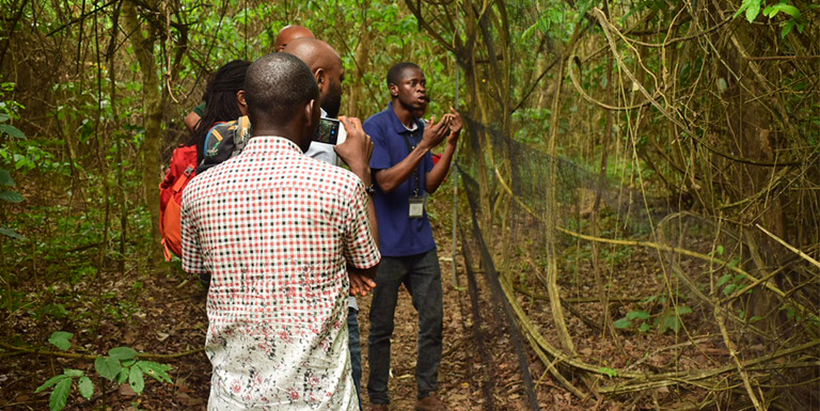
Dr Adewale Awoyemi, IITA Forest Center Manager, advocating for biodiversity conservation with guests on forest tour at IITA Forest.
As the world commemorates the International Day for Biodiversity 2026, IITA–CGIAR, through the IITA Forest Center, celebrates remarkable strides in restoring degraded landscapes, conserving biodiversity, and empowering communities across Nigeria and beyond.
In the last 5 years, the IITA Forest Center has successfully restored 319 hectares of degraded land through strategic reforestation and conservation initiatives. More than 309,000 seedlings representing 82 native tree species have been planted across restoration sites, contributing significantly to biodiversity recovery, ecosystem stability, and habitat regeneration for wildlife.
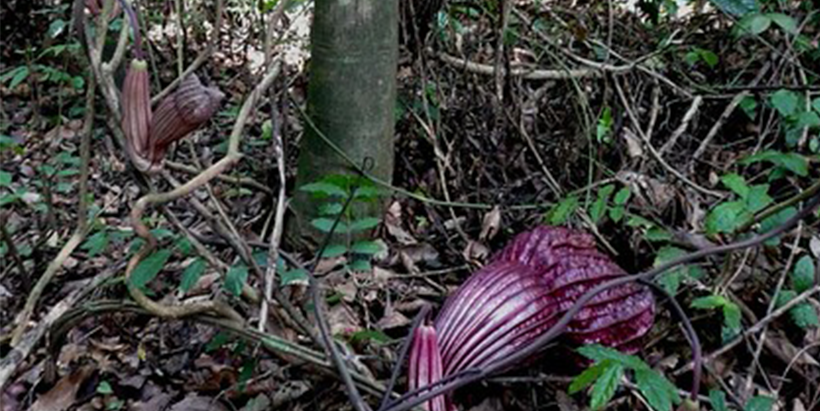
Pararistolochia goldieana (PG plant), one of IITA Forest Center’s flagship species, blooming on IITA Forest floor.
These restoration efforts are also delivering measurable climate benefits. Current projections estimate a carbon sequestration potential of 10 to 50 tons per hectare. This translates to an estimated 3,190 to 15,950 tons of carbon captured, underscoring the importance of forests as natural climate solutions in addressing the growing global climate crisis.
Speaking on the significance of the day, IITA Forest Center Manager, Dr Adewale Awoyemi, noted, “Biodiversity conservation goes beyond protecting trees and wildlife; it also involves strengthening communities and creating sustainable opportunities for people living around forest landscapes.”
This people-centered approach has become a defining feature of the IITA Forest Center’s conservation strategy. Through its restoration projects, 116 individuals have directly benefited from livelihood support initiatives. Of this number, 44 people are directly employed in restoration-related activities, including nursery management, tree planting, site maintenance, and fire control operations, providing immediate income while fostering local ownership of conservation efforts.
Beyond short-term employment, IITA Forest Center has continued investing in long-term human capital development. Seventy-two beneficiaries, representing 62 percent of engaged individuals, received targeted skills training in vegetable production, beekeeping, IT placements, and internship opportunities. These interventions are helping communities build sustainable livelihood pathways that reduce pressure on forest resources while improving household resilience.
IITA Forest Center has also continued to champion bird monitoring, native species conservation, environmental education, and community engagement across multiple landscapes. Through collaborations with local communities, researchers, conservation partners, and government staff, IITA Forest Center supports initiatives that promote habitat protection, ecological restoration, and sustainable land-use practices.
In recent years, IITA Forest Center has intensified efforts to conserve indigenous tree species, restore forest reserves, and monitor bird and wildlife populations as indicators of ecosystem health. Environmental awareness campaigns, school engagements, and community outreach programs have further strengthened public understanding of the importance of biodiversity conservation for food security, climate adaptation, and sustainable development.
This year’s celebration highlights the critical role forests play in sustaining life, mitigating climate change, and supporting livelihoods, while reaffirming IITA Forest Center’s commitment to building resilient ecosystems and resilient people together. As biodiversity loss, land degradation, and climate change continue to threaten ecosystems globally, IITA Forest Center emphasized the urgent need for collective action and stronger investments in nature-based solutions.
Through science-driven restoration, inclusive partnerships, and community-focused conservation, IITA Forest Center continues to demonstrate that protecting biodiversity is not only essential for the planet but also critical for building healthier, more resilient societies.
Contributed by Folake OduntanRelated Story:
Olamide Deborah Nwanze is a Senior Research Associate specializing in gender mainstreaming research to inform participatory and inclusive breeding, variety development, and seed systems policies regarding root, tuber, and banana (RTB) crops in the International Institute of Tropical Agriculture Headquarters, Ibadan, Nigeria. She is a PhD candidate at the University of Ibadan and holds an MSc and B. Agric in Agricultural Extension and Rural Development. Olamide is a fellow of the African Women in Agricultural Research and Development – Gender Responsive Agricultural Systems Policy (AWARD-GRASP) and the Gender Responsive Researchers Equipped for Agricultural Transformation (GREAT). She seeks to apply her gender-mainstreaming learnings, gender-responsive research, and policy development, and review expertise to facilitate women, youth, children, and vulnerable social group’s access to and adoption of agricultural Innovations that guarantee food, nutrition, income, and livelihood security in Africa. Her current roles include mentoring research fellows, development of guides and training manuals, implementation and adaptation of gender frameworks and tools, value chain actors’ engagement as citizen science partners, policy review and redesign, data management, and analysis. Her current research explores mixed methods and participatory and interdisciplinary approaches to capture and highlight gender dynamics, needs, preferences, and challenges stakeholders face within the agricultural livelihood value chain to prioritize gender-inclusive strategies in breeding programs, policy design, and implementation.
de Sousa, K., van Etten, J., Manners, R. Bello, A., Teeken, B., Olaosebikan, O., et al. 2024. The tricot approach: an agile framework for decentralized on-farm testing supported by citizen science. A retrospective. Agron. Sustain. Dev. 44, 8. https://doi.org/10.1007/s13593-023-00937-1
Madu, T., Onwuka, S., Nwafor, S., Onyemauwa, N., Ejechi, M., Ofoeze, M., Ukeje, B., Eluagu, C., Olaosebikan, O., Okoye, B., 2024. Gender-Inclusive Consumer Studies Improve Cassava Breeding in Nigeria in: Frontiers in Sociology, volume 9, number: 1224504, doi: 10.3389/fsoc.2024.1224504
Olaosebikan, O.; Bello, A.; Utoblo, O.; Okoye, B.; Olutegbe, N.; Garner, E.; Teeken, B.; Bryan, E.; Forsythe, L.; Cole, S.; Madu, T. 2023. Stressors and Resilience within the Cassava Value Chain in Nigeria: Preferred Cassava Variety Traits and Response Strategies of Men and Women to Inform Breeding. Sustainability 15, 7837. https://doi.org/10.3390/su15107837
Okoye, B., Ofoeze, M., Ejechi, M., Onwuka, S., Nwafor, S., Onyemauwa, N., Ukeje, B., Eluagu, C., Obidiegwu, J.*, Olaosebikan, O., Madu, T.* 2023. Prioritizing preferred traits in the yam value chain in Nigeria: a gender situation analysis in: Frontiers in Sociology, volume 8, number: 1232626, pages 1 – 9, ISSN 2297-7775, 2023. https://www.frontiersin.org/articles/10.3389/fsoc.2023.1232626/full
Olaosebikan, O., Bello, A. A., de Sousa, K., Ndjouenkeu, R., Adesokan, M., Alamu, E. O., Agbona, A., van Etten, J., Kegah, F. N.*, Dufour, D., Bouniol, A., Teeken, B. 2023. Consumer acceptability of cassava gari-eba food products across cultural and environmental settings using the triadic comparison of technologies approach (tricot) in: Journal of the Science of Food and Agriculture,
Teeken, B., Olaosebikan, O., Bello, A. A., Madu, T.*, Cole, S. M. 2023. Qualitative assessment on the positionality and preferences of dyads in relation to cassava-related activities: working with tricot trial citizen scientists https://hdl.handle.net/10568/138326 Type: Manual
Bouniol, A., Ceballos, H., Bello, A. A., Teeken, B., Olaosebikan, O., Owoade, D., Agbona, A., Fotso Kuate, A., Madu, T.*, Okoye, B.*, Ofoeze, M.*, Nwafor, S.*, Onyemauwa, N.*, Adinsi, L.*, Forsythe, L., Dufour, D. 2023. Varietal impact on women’s labour, workload and related drudgery in processing root, tuber and banana crops: focus on cassava in sub-Saharan Africa in: Journal of the Science of Food and Agriculture, pages 1 – 25, ISSN 0022-5142,
Bello, A. A., Agbona, A., Olaosebikan, O., Edughaen, G., Dufour, D., Bouniol, A., Iluebbey, P., Ndjouenkeu, R.*, Rabbi, I. Y., Teeken, B. 2023. Genetic and environmental effects on processing productivity and food product yield: drudgery of women’s work in: Journal of the Science of Food and Agriculture, pages 1 – 32, ISSN 0022-5142, 5
Cavicchioli, M., Zimbiti, T., Teeken, B., Nwanze, D.O., Liani, M., Parkes, E. & Bello, A. 2023. IITA-Gender Responsive Breeding Training Report. Genetic Resources Center, IITA-HQ, Ibadan, 21-23 September, 2022. Ibadan, Nigeria: IITA, (34 p.).https://hdl.handle.net/10568/131368
Agbona, A. Peteti P., Teeken B., Olaosebikan O. Bello, A. A., Parkes, E., Rabbi, I. Y., Mueller, L., Egesi, C., Kulakow, P. 2022. Data Management in Multi-disciplinary African RTB Crop Breeding Programs. In: Williamson, H.F., Leonelli, S. (eds) Towards Responsible Plant Data Linkage: Data Challenges for Agricultural Research and Development. Springer, Cham. https://doi.org/10.1007/978-3-031-13276-6_5
Lora Forsythe, Pricilla Marimo, Sarah Mayanja, Olamide D. Olaosebikan, Esme Stuart, Bela Teeken, Benjamin Okoye, Tessy Madu, (2021). Cross-product Gender Analysis of RTBfoods Step 2 Gendered Food Mapping on RTB Products. Understanding the Drivers of Trait Preferences and the Development of Multi-user RTB Product Profiles, WP1. London, UK: RTBfoods Field Scientific Report, 30 p.
Teeken, B., Garner, E., Agbona, A., Balogun, I., Olaosebikan, O., Bello, A., Madu, T., Okoye, B., Egesi, C., Kulakow, P. and Tufan, H.A. 2021. Beyond “Women’s Traits”: Exploring How Gender, Social Difference, and Household Characteristics Influence Trait Preferences. Frontiers Sustainable Food Systems 5:740926. https://doi.org/10.3389/fsufs.2021.740926
Teeken, B., Agbona, A., Bello, A., Olaosebikan, O., Alamu, E., Adesokan, M., Awoyale, W., Madu, T., Okoye, B., Chijioke, U., Owoade, D., Okoro, M., Bouniol, A., Dufour, D., Hershey, C., Rabbi, I., Maziya‐Dixon, B., Egesi, C., Tufan, H. and Kulakow, P. (020. Understanding cassava varietal preferences through pairwise ranking of gari‐eba and fufu prepared by local farmer–processors. Int J Food Sci Technol.https://doi.org/10.1111/ijfs.14862
Bela Teeken, Olamide Olaosebikan, Ireti Balogun, Benjamin Okoye, Tessy Madu, Steven Cole, Abolore Bello, Elizabeth Parkes. (2020). Piloting the G+ customer and product profile tools for gender-responsive cassava breeding in Nigeria. Nigeria: International Institute of Tropical Agriculture (IITA). https://hdl.handle.net/20.500.11766/13000