
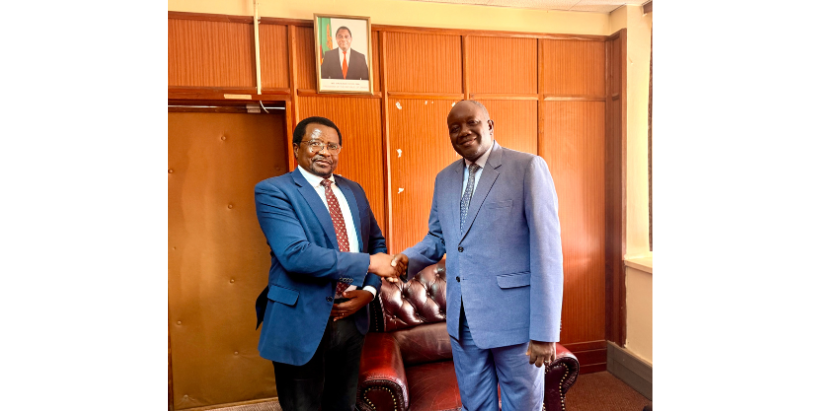
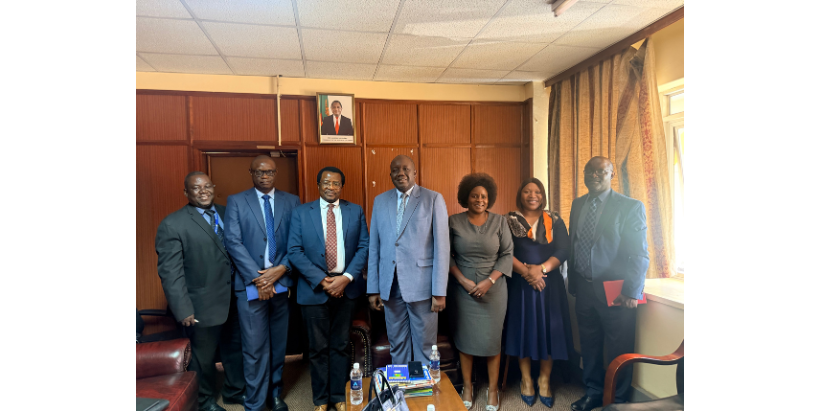
The Zambian Government’s Management Development Division (MDD) and IITA have met to explore opportunities to strengthen the link between agricultural research, decentralized government structures, and local economic development. The engagement, held at the Cabinet Office on 8 September, brought together IITA Southern Africa Hub Director Dr David Chikoye, MDD Permanent Secretary (PS) Alfred Sakwiya, and senior departmental directors to discuss how agricultural research, technologies, and knowledge can be better integrated into government systems as Zambia advances its decentralization agenda.
Welcoming the IITA delegation, Sakwiya outlined the MDD’s mandate, which includes decentralization, strategic planning, organizational structure, performance management, and public service transformation. He said the Division was interested in understanding the work of institutions such as IITA and identifying opportunities for their expertise to contribute to Government delivery systems. “It is therefore a matter of interest for us to interact with partners like yourselves, to understand what you are doing, to find ways in which we could be of beneficial use or partnership with you,” Sakwiya said.
For IITA, the engagement provided an opportunity to highlight its longstanding contribution to Zambia’s agricultural development and its increasing focus on ensuring that research translates into practical outcomes for farmers and communities. IITA has worked in Zambia since the mid-1980s and has developed partnerships with the government, including the Ministry of Agriculture and the Zambia Agriculture Research Institute (ZARI), in areas such as crop improvement, seed systems, extension, climate resilience, and youth agribusiness. The Institute currently works on crops including cassava, soybean, and cowpea in the Southern African region. “Our focus now is putting our research to work. We are more interested in delivering and making sure that there is adoption of agricultural research technologies,” Dr Chikoye said. He added, “We need to bridge research, the farmer, and extension.”
The discussion highlighted the potential for decentralized structures to strengthen the connection among research institutions, extension services, local authorities, and farming communities, including through demonstration plots, knowledge dissemination, and technology adoption. Cassava provided a practical example of how this connection could translate research into economic opportunity. Dr Chikoye shared IITA’s work on improved cassava varieties, including those capable of maturing within 12 months, compared with the traditional 24-month cycle, as well as on seed systems and processing technologies.
Participants discussed how research and evidence could help the government and local stakeholders determine where cassava production makes economic sense, strengthen access to improved planting material, support processing closer to production areas, and create opportunities for young people across the value chain. “How do the economics play out if Dr Swana has five acres of cassava and I have five acres of maize, typical in this country?” Sakwiya asked, emphasizing the importance of evidence in informing local agricultural decisions.
The discussion also explored the potential for youth participation in cassava production, seed multiplication, and processing, with financing mechanisms such as the Constituency Development Fund (CDF) and the Citizens Economic Empowerment Commission (CEEC) identified as pathways to support emerging enterprises. Sakwiya noted that research-backed evidence could help strengthen confidence in agricultural enterprise opportunities among young people. “But when it is backed by science, it’s much easier for us to tell our young people to go and make money because IITA said so, that the money is there,” he said. The engagement further highlighted the role of agriculture in creating opportunities beyond public-sector employment, including in production, processing, seed enterprises, services, technology, and markets.
The meeting identified potential areas for continued collaboration, including strengthening research–extension linkages, expanding agricultural demonstration and learning platforms, improving access to research knowledge at the local level, generating evidence to inform crop and investment decisions, and supporting youth and private-sector participation in agricultural value chains.
The engagement provides a platform for continued dialogue between IITA and the government on how agricultural research and innovation can support decentralized service delivery and local economic development. For IITA, the discussions reinforce the importance of ensuring that agricultural research moves beyond discovery and along the pathway to adoption, productivity, commercialization, and impact.
Contributed by
Rachel Namukolo-Nali