
IITA Kano hosts CSAT project implementation partners from Mali and Niger Republic
November 21, 2019
A team of CSAT/IITA project staff and collaborating partners from Mali and Niger Republic visited IITA, Kano Station on 15 October as part of the four-day exchange visit aimed at facilitating knowledge transfer and sharing experience on improved agricultural technologies in the development of smallholder agriculture productivity.
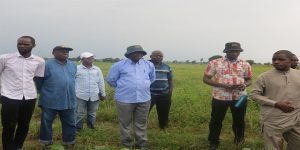 Mr Reuben leading the field visit. Photo by Sarah Sallau.
The Head of IITA Kano Station, Alpha Y. Kamara and some senior staff of the station received the delegation, which was led by Dr Alassan Maiga, a Malian and Mr Mani Mamman, a Nigerien.
In his opening remarks, Kamara stated that the aim of agricultural technologies when developed is to create impact and should not to be kept on the shelf. In his brief presentation titled ‘”Key Approach to Scaling up Agricultural Technology to Increase Productivity and Income”, he highlighted key elements to use in scaling out technologies for high impact. These include effective partnership, use of scalable technologies, use of decision support tools to target suitable ecologies for the technologies, awareness creation, field demonstrations, capacity building of users, and use of market linkages to create demand.
He concluded the presentation by encouraging the project team and partners to always send their financial and technical reports on time to avoid late release of funds and to adhere strictly to the agreement in the implementation of the project activities.
In his remarks, Mr Tofa Abdullahi gave a report on his field visit to Mali and Niger Republic in September 2019. He disclosed the successes and failures of the implementation of the projects in some regions of both countries with particular reference to Kaye in Mali and Dosso in Niger where the NGOs did not do their work properly. He said the team must have learned from their past mistakes and admonished them to consolidate on the achievements made so far.
The visiting team showed excitement about the dynamism in the strategy used by IITA Kano in technology dissemination that improves smallholder farmers’ agricultural productivity. On their part, they highlighted some of the challenges and difficulties they have encountered in marketing soybean in the two countries. They proffered solutions to some of the problems such as training of households in the processing and utilization of soybean to create demand for the crop.
Mr Reuben leading the field visit. Photo by Sarah Sallau.
The Head of IITA Kano Station, Alpha Y. Kamara and some senior staff of the station received the delegation, which was led by Dr Alassan Maiga, a Malian and Mr Mani Mamman, a Nigerien.
In his opening remarks, Kamara stated that the aim of agricultural technologies when developed is to create impact and should not to be kept on the shelf. In his brief presentation titled ‘”Key Approach to Scaling up Agricultural Technology to Increase Productivity and Income”, he highlighted key elements to use in scaling out technologies for high impact. These include effective partnership, use of scalable technologies, use of decision support tools to target suitable ecologies for the technologies, awareness creation, field demonstrations, capacity building of users, and use of market linkages to create demand.
He concluded the presentation by encouraging the project team and partners to always send their financial and technical reports on time to avoid late release of funds and to adhere strictly to the agreement in the implementation of the project activities.
In his remarks, Mr Tofa Abdullahi gave a report on his field visit to Mali and Niger Republic in September 2019. He disclosed the successes and failures of the implementation of the projects in some regions of both countries with particular reference to Kaye in Mali and Dosso in Niger where the NGOs did not do their work properly. He said the team must have learned from their past mistakes and admonished them to consolidate on the achievements made so far.
The visiting team showed excitement about the dynamism in the strategy used by IITA Kano in technology dissemination that improves smallholder farmers’ agricultural productivity. On their part, they highlighted some of the challenges and difficulties they have encountered in marketing soybean in the two countries. They proffered solutions to some of the problems such as training of households in the processing and utilization of soybean to create demand for the crop.
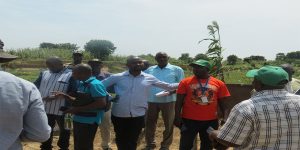 It could be recalled that the visit was also in part to meet with the newly recruited field coordinators and Supervisors under WS2 and WS8; to visit some of the modelling CSAT activities under WS8, and on-farm and on-station activities carried out in Nigeria to monitor the performance of agronomic technologies.
During the four-day visit, the team toured several IITA Kano on-station and out-station research fields at Bayero University Kano Research Farm, Early Generation Seed Production field, Teaching and Research farm of Audu Bako College of Agriculture Danbatta, IITA Research Farm in Shika, Zaria, and Kafin Madaki Ganjuwa LGA in Bauchi State.
During one of the visits, the visitors had a brief meeting with Prof Jibrin M. Jibrin, Director Centre for Dry Land Agriculture, BUK, where they discussed issues concerning the crop-modelling component of the project. An interactive session was also held between the IITA Agronomy team headed by Tofa and the visiting team and partners on protocols for the on-farm harvesting and data collection. The team left Nigeria with great excitement.
It could be recalled that the visit was also in part to meet with the newly recruited field coordinators and Supervisors under WS2 and WS8; to visit some of the modelling CSAT activities under WS8, and on-farm and on-station activities carried out in Nigeria to monitor the performance of agronomic technologies.
During the four-day visit, the team toured several IITA Kano on-station and out-station research fields at Bayero University Kano Research Farm, Early Generation Seed Production field, Teaching and Research farm of Audu Bako College of Agriculture Danbatta, IITA Research Farm in Shika, Zaria, and Kafin Madaki Ganjuwa LGA in Bauchi State.
During one of the visits, the visitors had a brief meeting with Prof Jibrin M. Jibrin, Director Centre for Dry Land Agriculture, BUK, where they discussed issues concerning the crop-modelling component of the project. An interactive session was also held between the IITA Agronomy team headed by Tofa and the visiting team and partners on protocols for the on-farm harvesting and data collection. The team left Nigeria with great excitement.
Mr Reuben leading the field visit. Photo by Sarah Sallau.
The Head of IITA Kano Station, Alpha Y. Kamara and some senior staff of the station received the delegation, which was led by Dr Alassan Maiga, a Malian and Mr Mani Mamman, a Nigerien.
In his opening remarks, Kamara stated that the aim of agricultural technologies when developed is to create impact and should not to be kept on the shelf. In his brief presentation titled ‘”Key Approach to Scaling up Agricultural Technology to Increase Productivity and Income”, he highlighted key elements to use in scaling out technologies for high impact. These include effective partnership, use of scalable technologies, use of decision support tools to target suitable ecologies for the technologies, awareness creation, field demonstrations, capacity building of users, and use of market linkages to create demand.
He concluded the presentation by encouraging the project team and partners to always send their financial and technical reports on time to avoid late release of funds and to adhere strictly to the agreement in the implementation of the project activities.
In his remarks, Mr Tofa Abdullahi gave a report on his field visit to Mali and Niger Republic in September 2019. He disclosed the successes and failures of the implementation of the projects in some regions of both countries with particular reference to Kaye in Mali and Dosso in Niger where the NGOs did not do their work properly. He said the team must have learned from their past mistakes and admonished them to consolidate on the achievements made so far.
The visiting team showed excitement about the dynamism in the strategy used by IITA Kano in technology dissemination that improves smallholder farmers’ agricultural productivity. On their part, they highlighted some of the challenges and difficulties they have encountered in marketing soybean in the two countries. They proffered solutions to some of the problems such as training of households in the processing and utilization of soybean to create demand for the crop.
Alpha Y. Kamara addressing the visiting team.
Contributed by
Recent stories
No items found