
IITA launches Internet radio station to enhance dissemination of agricultural information for farmers, other stakeholders
August 27, 2019
Smallholder farmers in Africa can increase their productivity and improve their means of livelihood if they are able to access agricultural information, which is a key factor in IITA’s goal of transforming African agriculture.
Using radio to disseminate vital agricultural messages, especially for rural dwellers, is one way of achieving this.
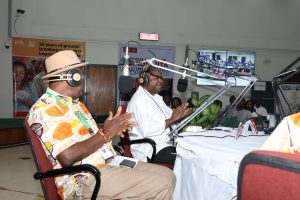 To harness this advantage, IITA formally launched a radio broadcast service, Radio IITA, on 14 August, at the Ibadan headquarters of the Institute. The launch took place as part of the IITA Communication Open House, an event to highlight the capacities and activities of the communication function in the Institute.
Deputy Director General, Research for Development May-Guri Saethre, in her opening remarks, said, “Communication is our most important tool for indirect resource mobilization.”
In her presentation, Head of Communication Katherine Lopez shared the big dream of the Communication team, which is to “make IITA the center of excellence for science communication.” She described Radio IITA as a collaborative effort between different directorates and units of IITA.
IITA Director General Nteranya Sanginga officially launched the radio station when he switched the “On Air” sign at the Conference Center. The first scheduled program was a live studio interview featuring Sanginga and Director of the Development and Delivery Office, Alfred Dixon in a show called “Good morning, IITA!”
To harness this advantage, IITA formally launched a radio broadcast service, Radio IITA, on 14 August, at the Ibadan headquarters of the Institute. The launch took place as part of the IITA Communication Open House, an event to highlight the capacities and activities of the communication function in the Institute.
Deputy Director General, Research for Development May-Guri Saethre, in her opening remarks, said, “Communication is our most important tool for indirect resource mobilization.”
In her presentation, Head of Communication Katherine Lopez shared the big dream of the Communication team, which is to “make IITA the center of excellence for science communication.” She described Radio IITA as a collaborative effort between different directorates and units of IITA.
IITA Director General Nteranya Sanginga officially launched the radio station when he switched the “On Air” sign at the Conference Center. The first scheduled program was a live studio interview featuring Sanginga and Director of the Development and Delivery Office, Alfred Dixon in a show called “Good morning, IITA!”
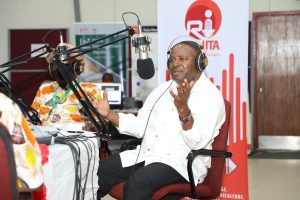 The DG described the celebration as “historic” and gave kudos to the project implementation and Communication teams, and everyone who was involved in facilitating the foundation of Radio IITA. He said, “As we are scaling up IITA’s initiatives and innovations, Radio IITA is going to be an opportunity to reach a larger number of people.”
While speaking on the current phase of implementation of Radio IITA, Dixon said, “We have the expertise that can make Radio IITA the CNN of Africa, which is the DG’s vision.” He also spoke about the broadcast license approval of the Nigeria Broadcasting Commission (NBC) and noted opportunities for collaboration with other organizations interested in agricultural broadcasting.
Deputy Director General, Corporate Services Hilde Koper and others attending the event provided feedback and reiterated the significance of radio to smallholder farmers. They noted that with radio transmission, agricultural information is more likely to reach the target audience.
Radio IITA broadcasts test transmissions twice weekly, on Tuesdays and Thursdays. It currently operates as an Internet radio station with plans to upgrade to full service broadcast.
The DG described the celebration as “historic” and gave kudos to the project implementation and Communication teams, and everyone who was involved in facilitating the foundation of Radio IITA. He said, “As we are scaling up IITA’s initiatives and innovations, Radio IITA is going to be an opportunity to reach a larger number of people.”
While speaking on the current phase of implementation of Radio IITA, Dixon said, “We have the expertise that can make Radio IITA the CNN of Africa, which is the DG’s vision.” He also spoke about the broadcast license approval of the Nigeria Broadcasting Commission (NBC) and noted opportunities for collaboration with other organizations interested in agricultural broadcasting.
Deputy Director General, Corporate Services Hilde Koper and others attending the event provided feedback and reiterated the significance of radio to smallholder farmers. They noted that with radio transmission, agricultural information is more likely to reach the target audience.
Radio IITA broadcasts test transmissions twice weekly, on Tuesdays and Thursdays. It currently operates as an Internet radio station with plans to upgrade to full service broadcast.
Applause as DG Sanginga switches the On Air sign (above).
IITA Director General Nteranya Sanginga speaking in his first live Radio IITA interview.
Contributed by
Recent stories
No items found