
IITA participates in annual National Farmers’ Exhibition in Tanzania
September 7, 2018
IITA participated in the annual Farmers’ Exhibition in Tanzania held 1-8 August. The exhibitions, popularly known as Nane nane, take place annually in the different regions of Tanzania along with a single national event that is hosted on a rotating basis across all the regions, and showcase different value chains. The national exhibition this year was held in the Simiyu Region.
 IITA featured several projects in the regional exhibitions in Dodoma, Morogoro, Mwanza, and Mbeya regions and in Zanzibar. IITA showcased its technologies and innovations from its research to farmers and other stakeholders in the agriculture sector including policymakers, development partners, and actors in the private sector.
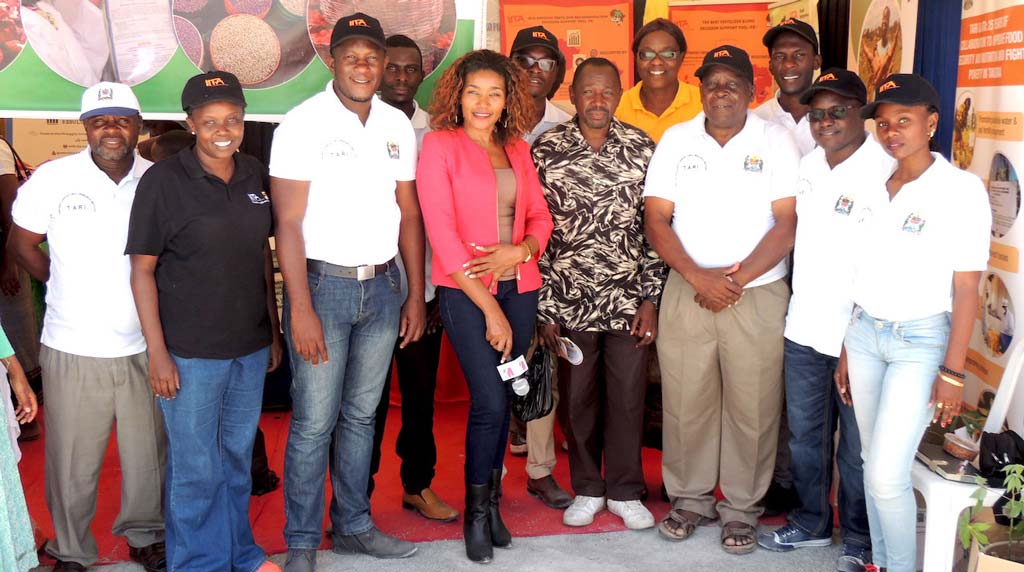
In mainland Tanzania, IITA exhibited alongside an important partner, the newly created Tanzania Agricultural Research Institute (TARI), while in Zanzibar the Institute collaborated with the Zanzibar Agricultural Research Institute, another important partner.
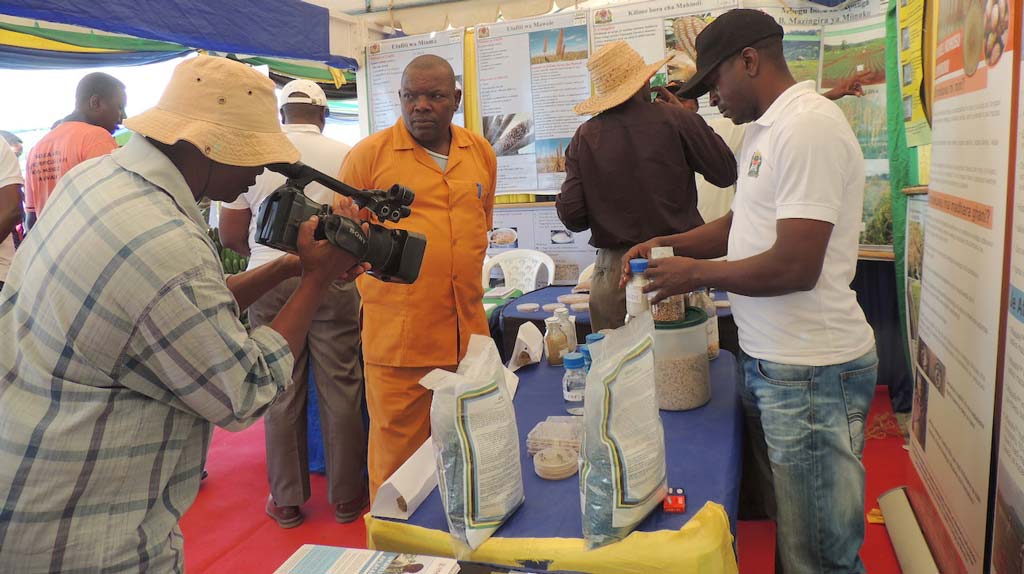
Among the innovations and technologies featured was aflasafeTZ01, the innovative, safe, and effective biocontrol product for reducing aflatoxin contamination in maize and groundnut.
The registration of the technology in the country is at the final stage and IITA and partners are already charting the way forward for its commercialization and mass production so it reaches farmers through the Aflasafe Technology Transfer and Commercialization (aTTC) project.
IITA also demonstrated its work on soil health and agronomy including on cassava agronomy through the Africa Cassava Agronomy Initiative (ACAI). ACAI showcased the decision support tools it is developing to address various agronomy challenges. These include site-specific fertilizer recommendations; a fertilizer blending recommendation tool to optimize cassava root yield; a scheduled planting recommendation tool to ensure sustainable, year-round supply of cassava to the processing industry; and the high starch recommendation tool for optimum starch content in cassava roots.
The other decision tools include the intercropping recommendation tool for cassava intercropped with maize and sweet potato, and the best planting practices support tool.
IITA also used the exhibitions to create awareness on Climate Smart Agriculture through the Building Capacity for Resilient Food Security in Tanzania that is addressing the capacity gaps within the country to effectively respond to the challenges that climate change poses to agriculture.
This is an initiative of the Government of Tanzania in partnership with United States Department of Agriculture (USDA), supported by USAID–Tanzania. IITA is an implementing partner alongside the Food and Agriculture Organization (FAO) and World Agroforestry Centre (ICRAF). The project took part in the exhibitions in Dodoma and Zanzibar, which are among its project sites as well as in Simiyu. In Dodoma, IITA and project partners had demonstration plots for Climate Smart Agriculture technology and practices.
IITA featured several projects in the regional exhibitions in Dodoma, Morogoro, Mwanza, and Mbeya regions and in Zanzibar. IITA showcased its technologies and innovations from its research to farmers and other stakeholders in the agriculture sector including policymakers, development partners, and actors in the private sector.
In mainland Tanzania, IITA exhibited alongside an important partner, the newly created Tanzania Agricultural Research Institute (TARI), while in Zanzibar the Institute collaborated with the Zanzibar Agricultural Research Institute, another important partner.
Among the innovations and technologies featured was aflasafeTZ01, the innovative, safe, and effective biocontrol product for reducing aflatoxin contamination in maize and groundnut.
The registration of the technology in the country is at the final stage and IITA and partners are already charting the way forward for its commercialization and mass production so it reaches farmers through the Aflasafe Technology Transfer and Commercialization (aTTC) project.
IITA also demonstrated its work on soil health and agronomy including on cassava agronomy through the Africa Cassava Agronomy Initiative (ACAI). ACAI showcased the decision support tools it is developing to address various agronomy challenges. These include site-specific fertilizer recommendations; a fertilizer blending recommendation tool to optimize cassava root yield; a scheduled planting recommendation tool to ensure sustainable, year-round supply of cassava to the processing industry; and the high starch recommendation tool for optimum starch content in cassava roots.
The other decision tools include the intercropping recommendation tool for cassava intercropped with maize and sweet potato, and the best planting practices support tool.
IITA also used the exhibitions to create awareness on Climate Smart Agriculture through the Building Capacity for Resilient Food Security in Tanzania that is addressing the capacity gaps within the country to effectively respond to the challenges that climate change poses to agriculture.
This is an initiative of the Government of Tanzania in partnership with United States Department of Agriculture (USDA), supported by USAID–Tanzania. IITA is an implementing partner alongside the Food and Agriculture Organization (FAO) and World Agroforestry Centre (ICRAF). The project took part in the exhibitions in Dodoma and Zanzibar, which are among its project sites as well as in Simiyu. In Dodoma, IITA and project partners had demonstration plots for Climate Smart Agriculture technology and practices.
 IITA, TARI, and the Mennonite Economic Development Associates (MEDA) showcased efforts to set up a clean cassava seed system in Tanzania through the Building an Economically Sustainable Seed System for Cassava in Tanzania (BEST Cassava). This project is led by MEDA and IITA, and has TARI as a major partner.
The IITA-led Africa RISING project also took part in the exhibition in Mbeya Region, which is one of its project sites and showed technologies on sustainably intensifying agricultural production to increase production with minimal or no negative effects on the environment.
The Tanzania Youth Agripreneurs also exhibited their processed products including high quality cassava flour and snacks made from it such as chin-chin and titbits.
IITA, TARI, and the Mennonite Economic Development Associates (MEDA) showcased efforts to set up a clean cassava seed system in Tanzania through the Building an Economically Sustainable Seed System for Cassava in Tanzania (BEST Cassava). This project is led by MEDA and IITA, and has TARI as a major partner.
The IITA-led Africa RISING project also took part in the exhibition in Mbeya Region, which is one of its project sites and showed technologies on sustainably intensifying agricultural production to increase production with minimal or no negative effects on the environment.
The Tanzania Youth Agripreneurs also exhibited their processed products including high quality cassava flour and snacks made from it such as chin-chin and titbits.
Group photo of IITA and TARI staff at the national exhibition.
The Aflasafe exhibition stand
Contributed by
Recent stories
No items found