IITA plays vital role in Cameroon seed system during COVID-19 crisis
July 17, 2020
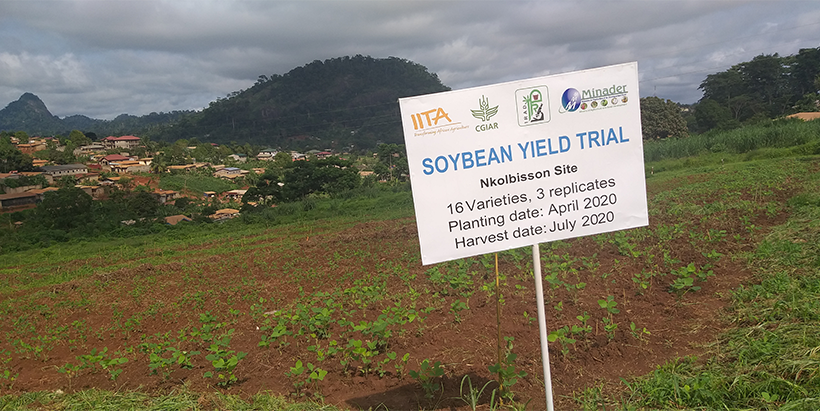
During the COVID-19 pandemic IITA-Cameroon is providing high-quality seeds of improved crop varieties to smallholder farmers through the Ministry of Agriculture and Rural Development (MINADER). The seed legislation in Cameroon classifies seed into basic seeds, certified seeds, and standard (commercial) seeds. IITA, in collaboration with Cameroon’s Agricultural Research Institute for Development (IRAD), has the responsibility of producing basic seeds for major commodities such as cassava, plantain, maize, soybean, and cowpea, which are the Institute’s mandate crops and staple foods for millions of people.
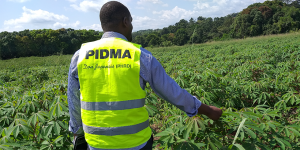
.IITA produces basic seeds for major crops, including cassava.MINADER has requested to emphasize the introduction of biofortified cassava through its various projects. Introduced varieties undergo preliminary yield and advanced testing in trial fields for two cropping cycles. During these two trials, any variety with low yield or high susceptibility to major pests and diseases get dropped. After this, farmers around the country participate in trials to evaluate the adaptability and resistance of the preselected varieties in contrasting environments.
Basic seed from the final selection are cultivated in multiplication plots, and the resulting seeds are certified by the Department of Regulation and Quality Control of Agricultural Inputs (DRCQ), after at least two inspections. For commodities like banana and plantain, the IITA tissue culture laboratory produces in vitro plants for mainly MINADER and the private sector.
The coronavirus pandemic has caused much uncertainty for farmers, making it harder to access improved seed. For seed producers, this has created an opportunity to build the food sector and put in place quick recovery measures and a diverse foundation for the food system, beginning with the seeds.
An IITA seed multiplication plot for maize.
The current food shortages could be a sign of more severe issues in the nearest future. In the context of COVID-19, IITA-Cameroon has been intervening in the seed system by introducing cowpea and soybean seeds from Ibadan and establishing small multiplication plots for cassava and maize on the station grounds.
IITA is also intervening by building the capacity of the national agricultural research system through a series of workshops organized annually to train seed multipliers and seed inspectors on variety identification, high-quality seed production techniques, integrated pest management (IPM), and integrated soil fertility management (ISFM). As a result, IITA varieties contributed to the first official catalog of plant species and varieties printed in 2020 with 11 cassava varieties (79% of the total), three plantain varieties (21%), 19 soybean varieties (100%), and seven maize varieties (28 %).
Over 109 cassava multipliers and seed inspectors, of whom 12% are women, have received training in the last two years in cassava seed production and IPM.
Olamide Deborah Nwanze is a Senior Research Associate specializing in gender mainstreaming research to inform participatory and inclusive breeding, variety development, and seed systems policies regarding root, tuber, and banana (RTB) crops in the International Institute of Tropical Agriculture Headquarters, Ibadan, Nigeria. She is a PhD candidate at the University of Ibadan and holds an MSc and B. Agric in Agricultural Extension and Rural Development. Olamide is a fellow of the African Women in Agricultural Research and Development – Gender Responsive Agricultural Systems Policy (AWARD-GRASP) and the Gender Responsive Researchers Equipped for Agricultural Transformation (GREAT). She seeks to apply her gender-mainstreaming learnings, gender-responsive research, and policy development, and review expertise to facilitate women, youth, children, and vulnerable social group’s access to and adoption of agricultural Innovations that guarantee food, nutrition, income, and livelihood security in Africa. Her current roles include mentoring research fellows, development of guides and training manuals, implementation and adaptation of gender frameworks and tools, value chain actors’ engagement as citizen science partners, policy review and redesign, data management, and analysis. Her current research explores mixed methods and participatory and interdisciplinary approaches to capture and highlight gender dynamics, needs, preferences, and challenges stakeholders face within the agricultural livelihood value chain to prioritize gender-inclusive strategies in breeding programs, policy design, and implementation.
de Sousa, K., van Etten, J., Manners, R. Bello, A., Teeken, B., Olaosebikan, O., et al. 2024. The tricot approach: an agile framework for decentralized on-farm testing supported by citizen science. A retrospective. Agron. Sustain. Dev. 44, 8. https://doi.org/10.1007/s13593-023-00937-1
Madu, T., Onwuka, S., Nwafor, S., Onyemauwa, N., Ejechi, M., Ofoeze, M., Ukeje, B., Eluagu, C., Olaosebikan, O., Okoye, B., 2024. Gender-Inclusive Consumer Studies Improve Cassava Breeding in Nigeria in: Frontiers in Sociology, volume 9, number: 1224504, doi: 10.3389/fsoc.2024.1224504
Olaosebikan, O.; Bello, A.; Utoblo, O.; Okoye, B.; Olutegbe, N.; Garner, E.; Teeken, B.; Bryan, E.; Forsythe, L.; Cole, S.; Madu, T. 2023. Stressors and Resilience within the Cassava Value Chain in Nigeria: Preferred Cassava Variety Traits and Response Strategies of Men and Women to Inform Breeding. Sustainability 15, 7837. https://doi.org/10.3390/su15107837
Okoye, B., Ofoeze, M., Ejechi, M., Onwuka, S., Nwafor, S., Onyemauwa, N., Ukeje, B., Eluagu, C., Obidiegwu, J.*, Olaosebikan, O., Madu, T.* 2023. Prioritizing preferred traits in the yam value chain in Nigeria: a gender situation analysis in: Frontiers in Sociology, volume 8, number: 1232626, pages 1 – 9, ISSN 2297-7775, 2023. https://www.frontiersin.org/articles/10.3389/fsoc.2023.1232626/full
Olaosebikan, O., Bello, A. A., de Sousa, K., Ndjouenkeu, R., Adesokan, M., Alamu, E. O., Agbona, A., van Etten, J., Kegah, F. N.*, Dufour, D., Bouniol, A., Teeken, B. 2023. Consumer acceptability of cassava gari-eba food products across cultural and environmental settings using the triadic comparison of technologies approach (tricot) in: Journal of the Science of Food and Agriculture,
Teeken, B., Olaosebikan, O., Bello, A. A., Madu, T.*, Cole, S. M. 2023. Qualitative assessment on the positionality and preferences of dyads in relation to cassava-related activities: working with tricot trial citizen scientists https://hdl.handle.net/10568/138326 Type: Manual
Bouniol, A., Ceballos, H., Bello, A. A., Teeken, B., Olaosebikan, O., Owoade, D., Agbona, A., Fotso Kuate, A., Madu, T.*, Okoye, B.*, Ofoeze, M.*, Nwafor, S.*, Onyemauwa, N.*, Adinsi, L.*, Forsythe, L., Dufour, D. 2023. Varietal impact on women’s labour, workload and related drudgery in processing root, tuber and banana crops: focus on cassava in sub-Saharan Africa in: Journal of the Science of Food and Agriculture, pages 1 – 25, ISSN 0022-5142,
Bello, A. A., Agbona, A., Olaosebikan, O., Edughaen, G., Dufour, D., Bouniol, A., Iluebbey, P., Ndjouenkeu, R.*, Rabbi, I. Y., Teeken, B. 2023. Genetic and environmental effects on processing productivity and food product yield: drudgery of women’s work in: Journal of the Science of Food and Agriculture, pages 1 – 32, ISSN 0022-5142, 5
Cavicchioli, M., Zimbiti, T., Teeken, B., Nwanze, D.O., Liani, M., Parkes, E. & Bello, A. 2023. IITA-Gender Responsive Breeding Training Report. Genetic Resources Center, IITA-HQ, Ibadan, 21-23 September, 2022. Ibadan, Nigeria: IITA, (34 p.).https://hdl.handle.net/10568/131368
Agbona, A. Peteti P., Teeken B., Olaosebikan O. Bello, A. A., Parkes, E., Rabbi, I. Y., Mueller, L., Egesi, C., Kulakow, P. 2022. Data Management in Multi-disciplinary African RTB Crop Breeding Programs. In: Williamson, H.F., Leonelli, S. (eds) Towards Responsible Plant Data Linkage: Data Challenges for Agricultural Research and Development. Springer, Cham. https://doi.org/10.1007/978-3-031-13276-6_5
Lora Forsythe, Pricilla Marimo, Sarah Mayanja, Olamide D. Olaosebikan, Esme Stuart, Bela Teeken, Benjamin Okoye, Tessy Madu, (2021). Cross-product Gender Analysis of RTBfoods Step 2 Gendered Food Mapping on RTB Products. Understanding the Drivers of Trait Preferences and the Development of Multi-user RTB Product Profiles, WP1. London, UK: RTBfoods Field Scientific Report, 30 p.
Teeken, B., Garner, E., Agbona, A., Balogun, I., Olaosebikan, O., Bello, A., Madu, T., Okoye, B., Egesi, C., Kulakow, P. and Tufan, H.A. 2021. Beyond “Women’s Traits”: Exploring How Gender, Social Difference, and Household Characteristics Influence Trait Preferences. Frontiers Sustainable Food Systems 5:740926. https://doi.org/10.3389/fsufs.2021.740926
Teeken, B., Agbona, A., Bello, A., Olaosebikan, O., Alamu, E., Adesokan, M., Awoyale, W., Madu, T., Okoye, B., Chijioke, U., Owoade, D., Okoro, M., Bouniol, A., Dufour, D., Hershey, C., Rabbi, I., Maziya‐Dixon, B., Egesi, C., Tufan, H. and Kulakow, P. (020. Understanding cassava varietal preferences through pairwise ranking of gari‐eba and fufu prepared by local farmer–processors. Int J Food Sci Technol.https://doi.org/10.1111/ijfs.14862
Bela Teeken, Olamide Olaosebikan, Ireti Balogun, Benjamin Okoye, Tessy Madu, Steven Cole, Abolore Bello, Elizabeth Parkes. (2020). Piloting the G+ customer and product profile tools for gender-responsive cassava breeding in Nigeria. Nigeria: International Institute of Tropical Agriculture (IITA). https://hdl.handle.net/20.500.11766/13000

 The current food shortages could be a sign of more severe issues in the nearest future. In the context of COVID-19, IITA-Cameroon has been intervening in the seed system by introducing cowpea and soybean seeds from Ibadan and establishing small multiplication plots for cassava and maize on the station grounds.
IITA is also intervening by building the capacity of the national agricultural research system through a series of workshops organized annually to train seed multipliers and seed inspectors on variety identification, high-quality seed production techniques, integrated pest management (IPM), and integrated soil fertility management (ISFM). As a result, IITA varieties contributed to the first official catalog of plant species and varieties printed in 2020 with 11 cassava varieties (79% of the total), three plantain varieties (21%), 19 soybean varieties (100%), and seven maize varieties (28 %).
Over 109 cassava multipliers and seed inspectors, of whom 12% are women, have received training in the last two years in cassava seed production and IPM.
The current food shortages could be a sign of more severe issues in the nearest future. In the context of COVID-19, IITA-Cameroon has been intervening in the seed system by introducing cowpea and soybean seeds from Ibadan and establishing small multiplication plots for cassava and maize on the station grounds.
IITA is also intervening by building the capacity of the national agricultural research system through a series of workshops organized annually to train seed multipliers and seed inspectors on variety identification, high-quality seed production techniques, integrated pest management (IPM), and integrated soil fertility management (ISFM). As a result, IITA varieties contributed to the first official catalog of plant species and varieties printed in 2020 with 11 cassava varieties (79% of the total), three plantain varieties (21%), 19 soybean varieties (100%), and seven maize varieties (28 %).
Over 109 cassava multipliers and seed inspectors, of whom 12% are women, have received training in the last two years in cassava seed production and IPM.