IITA reaffirms its commitment to transforming Africa’s agriculture as it marks its 50th Anniversary
July 16, 2017
The International Institute of Tropical Agriculture (IITA), which is turning 50 this year, has vowed to redouble its efforts to transform Africa’s agriculture in the Eastern Africa region.
Victor Manyong and guest of honour Nkuvililwa Simkanga at the function
This was expressed by IITA Director for Eastern Africa Dr Victor Manyong at a ceremony organized at the Institute’s Eastern Africa hub offices in Dar es Salaam, Tanzania, recently to mark its 50th anniversary.
Dr Manyong assured guests at the event who included partners, beneficiaries, and staff from the three East African countries of Kenya, Tanzania, and Ug anda, of IITA’s renewed commitment to continue supporting smallholder farmers in Africa.
He said while the 50th anniversary was a time to celebrate IITA’s achievements, it was also time to critically reflect on its future role and areas of focus in the region. He pointed out the many challenges still facing the agriculture sector in Eastern Africa that IITA was going to continue to address working through various partners.
“The population in Eastern African is increasing rapidly. It has more than doubled between 1990 and 2015 in the three major countries where IITA has research bases: Kenya, Tanzania, and Ug anda. The proportion of the urban population is also on the increase with Tanzania reaching more than 30% in 2015 while it was below 20% in 1990. It is projected that its urban population will jump to above 50% by 2050.
He noted food imports and malnutrition as other major areas of concern in the continent. Africa is spending more than US$35 billion per year on food imports; malnutrition is also widespread: between 26 and 38% of children in the region were found to be stunted between 2010 and 2015 although these figures are 5% lower than those in the previous period.
“With these trends, the collective goal therefore should be to achieve rural transformation in Eastern African. We need strategies that efficiently put under control biotic and abiotic stresses that continue to hamper the productivity of crops. This includes delivery of proven technologies to beneficiaries and development of appropriate R4D technologies to address new emerging threats,” he said.
Partners speaking at the event congratulated IITA for achieving this major milestone as they also noted some of its successes.
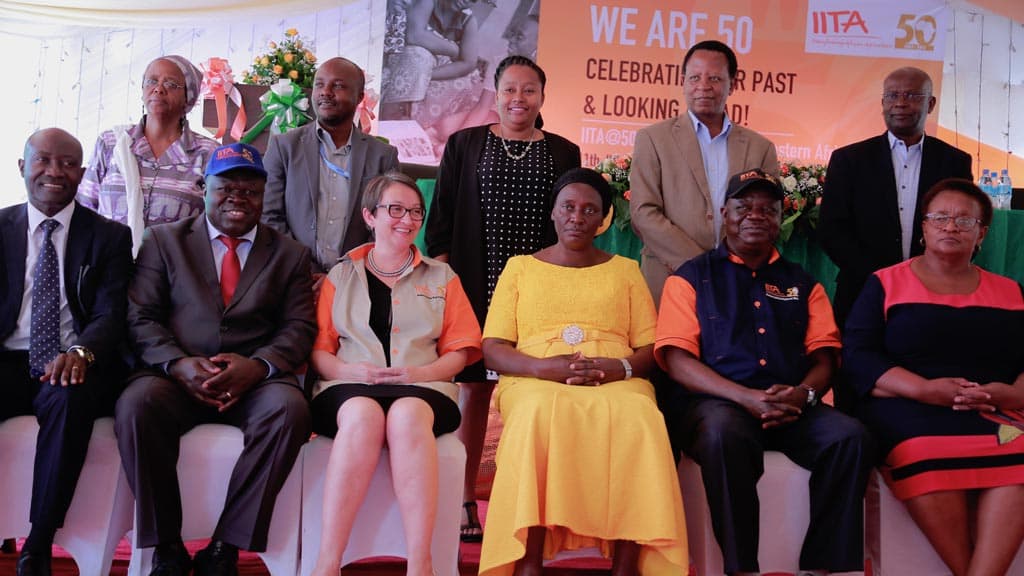
A cross section of the guests and partners at the event.
The Minister of Agriculture, Food Security and Livestock, Hon Dr Charles Tizeba, in a speech read on his behalf by Ms Nkuvililwa Simkanga, Director for Policy and Planning, congratulated IITA for this important milestone and its efforts in finding sustainable solutions to some of the critical challenges facing smallholder farmers in the country. These include lack of access to improved varieties, lack of modern agriculture production skills and knowledge, and attack by pests and diseases and postharvest losses.
“I take this opportunity to applaud IITA on the various successes it has had in addressing the challenges faced by smallholder farmers. From developing improved varieties of major crops such as cassava and banana and spearheading efforts to commercialize agriculture,” he said.
He noted that 20 improved varieties of cassava that are high yielding and disease resistant had been released in Tanzania in the last 10 years from efforts by IITA and the national breeding team.
EAC praises IITA’s support in aflatoxin prevention and control efforts in the region
IITA’s support to efforts to control aflatoxin contamination in food and feed in the East African community (EAC) was noted as a major achievement by Hon Christophe Bazivamo, the Deputy Secretary General, Productive and Social Sectors, EAC Secretariat. Aflatoxin is a carcinogenic chemical produced by naturally occurring fungi that infect various crops while in the fields and stores making food and feed unsafe.
Hon Bazivamo stated that IITA was a global center of excellence in agricultural sciences, technology, and innovation which had made conspicuous intervention in “addressing the pressing challenges of hunger, malnutrition, poverty and natural resource degradation in Africa.”
“I take this opportunity to acknowledge in a special way the contribution that IITA has made in the EAC integration process. With IITA support we have been able to develop a robust EAC aflatoxin and prevention control strategy and action plan aimed at addessing impacts and effects of aflatoxins along the food and feed value chains with the associated health, economic and farm level benefits,” he said.
Dr Betty Maeda, Agriculture Research Specialist at the USAID Mission in Tanzania also highlighted the joint efforts between IITA and USAID in building the country’s research capacity and addressing aflatoxins.
“Together we have strengthened national research institutions, paving the way for improved research products and services. And together we have built a lasting relationship by establishing partnerships with the donor community and local government and farmers’ organizations to ensure that technologies reach our beneficiaries,” she said.
She said for the last four years, USAID had supported IITA to carry out research to develop aflasafe, a biocontrol product to address aflatoxin contamination which was awaiting official registration before being made commercially available for use in the country.
She said USAID had also provided funds to IITA for sensitization and awareness creation on aflatoxins that had seen hundreds of farmers trained as well as researchers and extension staff.
IITA has been marking its 50th anniversary across all its country offices and regional hubs in sub-Saharan Africa. The Institute was established in 1967 in Ibadan, Nigeria.
Olamide Deborah Nwanze is a Senior Research Associate specializing in gender mainstreaming research to inform participatory and inclusive breeding, variety development, and seed systems policies regarding root, tuber, and banana (RTB) crops in the International Institute of Tropical Agriculture Headquarters, Ibadan, Nigeria. She is a PhD candidate at the University of Ibadan and holds an MSc and B. Agric in Agricultural Extension and Rural Development. Olamide is a fellow of the African Women in Agricultural Research and Development – Gender Responsive Agricultural Systems Policy (AWARD-GRASP) and the Gender Responsive Researchers Equipped for Agricultural Transformation (GREAT). She seeks to apply her gender-mainstreaming learnings, gender-responsive research, and policy development, and review expertise to facilitate women, youth, children, and vulnerable social group’s access to and adoption of agricultural Innovations that guarantee food, nutrition, income, and livelihood security in Africa. Her current roles include mentoring research fellows, development of guides and training manuals, implementation and adaptation of gender frameworks and tools, value chain actors’ engagement as citizen science partners, policy review and redesign, data management, and analysis. Her current research explores mixed methods and participatory and interdisciplinary approaches to capture and highlight gender dynamics, needs, preferences, and challenges stakeholders face within the agricultural livelihood value chain to prioritize gender-inclusive strategies in breeding programs, policy design, and implementation.
de Sousa, K., van Etten, J., Manners, R. Bello, A., Teeken, B., Olaosebikan, O., et al. 2024. The tricot approach: an agile framework for decentralized on-farm testing supported by citizen science. A retrospective. Agron. Sustain. Dev. 44, 8. https://doi.org/10.1007/s13593-023-00937-1
Madu, T., Onwuka, S., Nwafor, S., Onyemauwa, N., Ejechi, M., Ofoeze, M., Ukeje, B., Eluagu, C., Olaosebikan, O., Okoye, B., 2024. Gender-Inclusive Consumer Studies Improve Cassava Breeding in Nigeria in: Frontiers in Sociology, volume 9, number: 1224504, doi: 10.3389/fsoc.2024.1224504
Olaosebikan, O.; Bello, A.; Utoblo, O.; Okoye, B.; Olutegbe, N.; Garner, E.; Teeken, B.; Bryan, E.; Forsythe, L.; Cole, S.; Madu, T. 2023. Stressors and Resilience within the Cassava Value Chain in Nigeria: Preferred Cassava Variety Traits and Response Strategies of Men and Women to Inform Breeding. Sustainability 15, 7837. https://doi.org/10.3390/su15107837
Okoye, B., Ofoeze, M., Ejechi, M., Onwuka, S., Nwafor, S., Onyemauwa, N., Ukeje, B., Eluagu, C., Obidiegwu, J.*, Olaosebikan, O., Madu, T.* 2023. Prioritizing preferred traits in the yam value chain in Nigeria: a gender situation analysis in: Frontiers in Sociology, volume 8, number: 1232626, pages 1 – 9, ISSN 2297-7775, 2023. https://www.frontiersin.org/articles/10.3389/fsoc.2023.1232626/full
Olaosebikan, O., Bello, A. A., de Sousa, K., Ndjouenkeu, R., Adesokan, M., Alamu, E. O., Agbona, A., van Etten, J., Kegah, F. N.*, Dufour, D., Bouniol, A., Teeken, B. 2023. Consumer acceptability of cassava gari-eba food products across cultural and environmental settings using the triadic comparison of technologies approach (tricot) in: Journal of the Science of Food and Agriculture,
Teeken, B., Olaosebikan, O., Bello, A. A., Madu, T.*, Cole, S. M. 2023. Qualitative assessment on the positionality and preferences of dyads in relation to cassava-related activities: working with tricot trial citizen scientists https://hdl.handle.net/10568/138326 Type: Manual
Bouniol, A., Ceballos, H., Bello, A. A., Teeken, B., Olaosebikan, O., Owoade, D., Agbona, A., Fotso Kuate, A., Madu, T.*, Okoye, B.*, Ofoeze, M.*, Nwafor, S.*, Onyemauwa, N.*, Adinsi, L.*, Forsythe, L., Dufour, D. 2023. Varietal impact on women’s labour, workload and related drudgery in processing root, tuber and banana crops: focus on cassava in sub-Saharan Africa in: Journal of the Science of Food and Agriculture, pages 1 – 25, ISSN 0022-5142,
Bello, A. A., Agbona, A., Olaosebikan, O., Edughaen, G., Dufour, D., Bouniol, A., Iluebbey, P., Ndjouenkeu, R.*, Rabbi, I. Y., Teeken, B. 2023. Genetic and environmental effects on processing productivity and food product yield: drudgery of women’s work in: Journal of the Science of Food and Agriculture, pages 1 – 32, ISSN 0022-5142, 5
Cavicchioli, M., Zimbiti, T., Teeken, B., Nwanze, D.O., Liani, M., Parkes, E. & Bello, A. 2023. IITA-Gender Responsive Breeding Training Report. Genetic Resources Center, IITA-HQ, Ibadan, 21-23 September, 2022. Ibadan, Nigeria: IITA, (34 p.).https://hdl.handle.net/10568/131368
Agbona, A. Peteti P., Teeken B., Olaosebikan O. Bello, A. A., Parkes, E., Rabbi, I. Y., Mueller, L., Egesi, C., Kulakow, P. 2022. Data Management in Multi-disciplinary African RTB Crop Breeding Programs. In: Williamson, H.F., Leonelli, S. (eds) Towards Responsible Plant Data Linkage: Data Challenges for Agricultural Research and Development. Springer, Cham. https://doi.org/10.1007/978-3-031-13276-6_5
Lora Forsythe, Pricilla Marimo, Sarah Mayanja, Olamide D. Olaosebikan, Esme Stuart, Bela Teeken, Benjamin Okoye, Tessy Madu, (2021). Cross-product Gender Analysis of RTBfoods Step 2 Gendered Food Mapping on RTB Products. Understanding the Drivers of Trait Preferences and the Development of Multi-user RTB Product Profiles, WP1. London, UK: RTBfoods Field Scientific Report, 30 p.
Teeken, B., Garner, E., Agbona, A., Balogun, I., Olaosebikan, O., Bello, A., Madu, T., Okoye, B., Egesi, C., Kulakow, P. and Tufan, H.A. 2021. Beyond “Women’s Traits”: Exploring How Gender, Social Difference, and Household Characteristics Influence Trait Preferences. Frontiers Sustainable Food Systems 5:740926. https://doi.org/10.3389/fsufs.2021.740926
Teeken, B., Agbona, A., Bello, A., Olaosebikan, O., Alamu, E., Adesokan, M., Awoyale, W., Madu, T., Okoye, B., Chijioke, U., Owoade, D., Okoro, M., Bouniol, A., Dufour, D., Hershey, C., Rabbi, I., Maziya‐Dixon, B., Egesi, C., Tufan, H. and Kulakow, P. (020. Understanding cassava varietal preferences through pairwise ranking of gari‐eba and fufu prepared by local farmer–processors. Int J Food Sci Technol.https://doi.org/10.1111/ijfs.14862
Bela Teeken, Olamide Olaosebikan, Ireti Balogun, Benjamin Okoye, Tessy Madu, Steven Cole, Abolore Bello, Elizabeth Parkes. (2020). Piloting the G+ customer and product profile tools for gender-responsive cassava breeding in Nigeria. Nigeria: International Institute of Tropical Agriculture (IITA). https://hdl.handle.net/20.500.11766/13000