
IITA NEWS

IITA seeks to build the next generation of female scientists and leaders
February 19, 2021

On 11 February, the Women in Research and Science (WIRES) held a 13-hour marathon webinar to celebrate the International Day of Women and Girls in Science. The event themed “CGIAR Women in Science: Shaping the world through science and innovation,” assembled CGIAR centers to each give an hour presentation. Besides hearing about some cutting-edge science, participants engaged directly with some of CGIAR’s finest women scientists and speakers.

IITA joined WIRES to showcase how CGIAR women scientists are transforming how we look at food, land, and water systems worldwide. Apart from celebrating its female scientists, IITA also sought to train and attract young girls into science through programs like IITA Youth Agripreneurs (IYA) and Start Them Early Program (STEP). IITA Women’s Group also partners in the Raising Girls Ambition (RAGA) program to sponsor young girls in science careers.
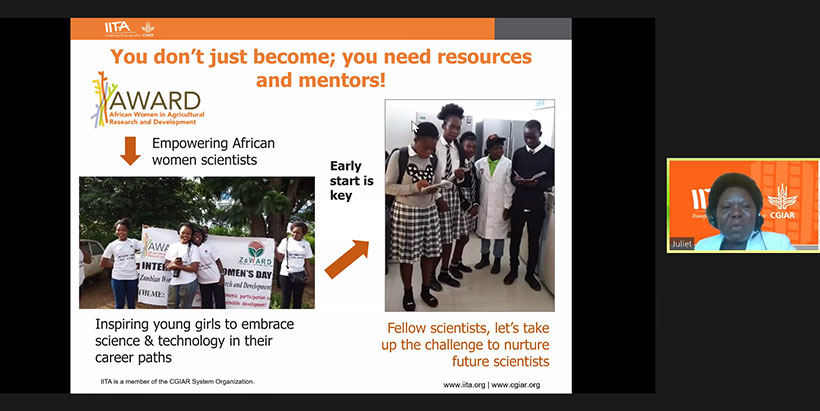
IITA seeks to build more female scientists and leaders
IITA Plant Pathologist Juliet Akello giving her presentation.

Director R4D, Central Africa and Natural Resource Management, Bernard Vanlauwe, gave the keynote address during the IITA power hour, moderated by Sylvia Oyinlola, Head Administration of Western Africa Hub. Vanlauwe focused on the importance of diversity and highlighted three points—first, diversity in research leads to diverse science solutions; hence, both men and women scientists are important and needed. Secondly, he stressed the need for every center to promote gender diversity starting within their organization. Finally, Vanlauwe stated that science careers could be very rewarding for women, looking at female scientists within and outside IITA.

Speaking on the contribution of women scientists to agriculture through IITA, Leena Tripathi, Plant Biotechnologist, looked at the potentials biotechnology has to transform agriculture. She emphasized that genome editing tools are becoming popular molecular tools of choice for crop improvement, and that her team in Kenya has trained quite a number of women and men researchers on the technology.
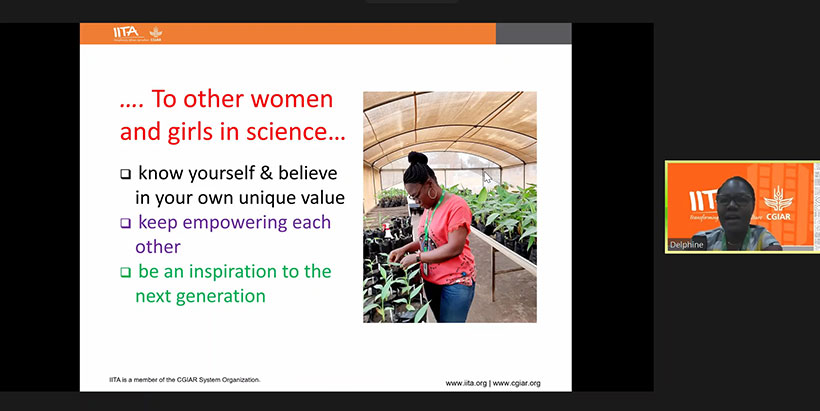
IITA seeks to build more female scientists and leaders
Regional Breeding Manager for plantain/banana improvement in West/Central Africa, Delphine Amah, advises other women and girls in science.

Mercy Diebiru-Ojo, Assistant Specialist in Cassava Seed Systems, shared IITA’s innovations to aid the rapid multiplication of clonal crops, including Semi-Autotrophic Hydroponics (SAH) for cassava and aeroponics for yam. “Food security is majorly dependent on seed systems, but there is the challenge of getting planting materials,” she said.

Delphine Amah, Regional Breeding Manager, spoke on how IITA has turned challenges in plantain breeding into opportunities. “Our contribution in resolving the challenges of pests and diseases in plantain production has improved food security in Africa,” she noted.

Busie Maziya-Dixon, Food and Nutrition Scientist, explained the importance of knowing the types and amounts of food consumed in different locations of Africa, stating that most diseases are related to diet. “Because we are what we eat, knowing what people eat, the quantity and nutritional quality of the food, will help us have the right interventions,” she said.
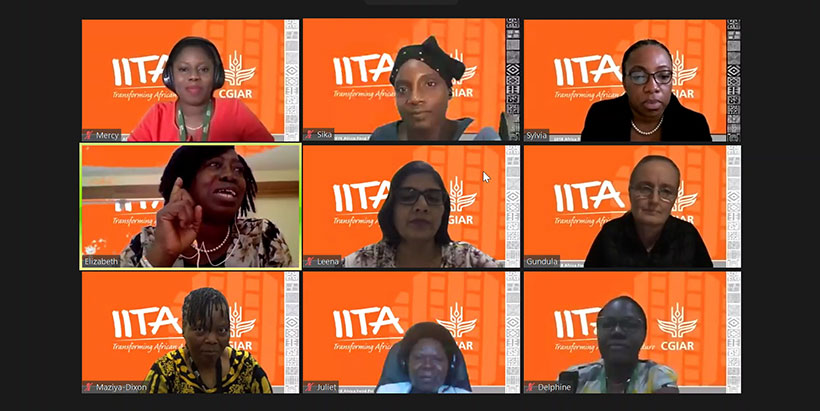
IITA News: 8 - 12 February 2021 (No. 2575) - IITA seeks to build more female scientists and leaders
The IITA power hour featured women scientists from different Institute hubs and stations across Africa.

Emphasizing the significance of mentorship to building a career in science, Valentine Nakato, a Postdoctoral fellow in Plant Pathology, spoke on how to fit the puzzle pieces together in the world of plant science research. She mentioned the need to be mentored by senior scientists and mentoring upcoming scientists. “I have an ongoing research project where I am being mentored by senior scientists and I am also mentoring the young scientist within my team. So I am both a mentor and a mentee,” she said.

Juliet Akello, Plant Pathologist, recalled how the hunger she experienced in the 90s fueled her passion to find a solution to hunger and malnutrition in Africa. She highlighted how the experience also inspired her to mentor young girls to build a career in science. “I encourage senior scientists also to take up the challenge to nurture young scientists.”

Also, Sika Gbegbelegbe, Agricultural Economist (Foresight Modeler), looked at what the future holds and how science can help. According to her, “The food security in Africa can be improved by nurturing young people, including girls, to take up a science career.”

Wrapping up the presentations, Elizabeth Parkes, HarvestPlus Cassava Breeder, handled the question and answer session while Gundula Fischer, Social Scientist and Gender Expert, gave the closing remarks. Fischer mentioned that women scientists network to use the best talent and achieve development goals, but there is still a long way to go to include more women and girls in science, and building their interest and mentoring them to improve and sustain inclusion and diversity.


Contributed by

Recent stories

No items found

Leave a Reply

Your email address will not be published. Required fields are marked *

Scroll to Top
Olaosebikan, Olamide

Olamide Deborah Nwanze is a Senior Research Associate specializing in gender mainstreaming research to inform participatory and inclusive breeding, variety development, and seed systems policies regarding root, tuber, and banana (RTB) crops in the International Institute of Tropical Agriculture Headquarters, Ibadan, Nigeria. She is a PhD candidate at the University of Ibadan and holds an MSc and B. Agric in Agricultural Extension and Rural Development. Olamide is a fellow of the African Women in Agricultural Research and Development – Gender Responsive Agricultural Systems Policy (AWARD-GRASP) and the Gender Responsive Researchers Equipped for Agricultural Transformation (GREAT). She seeks to apply her gender-mainstreaming learnings, gender-responsive research, and policy development, and review expertise to facilitate women, youth, children, and vulnerable social group’s access to and adoption of agricultural Innovations that guarantee food, nutrition, income, and livelihood security in Africa. Her current roles include mentoring research fellows, development of guides and training manuals, implementation and adaptation of gender frameworks and tools, value chain actors’ engagement as citizen science partners, policy review and redesign, data management, and analysis. Her current research explores mixed methods and participatory and interdisciplinary approaches to capture and highlight gender dynamics, needs, preferences, and challenges stakeholders face within the agricultural livelihood value chain to prioritize gender-inclusive strategies in breeding programs, policy design, and implementation.

At IITA, she contributes to the implementation of the CGIAR Accelerated Breeding Initiative and Genetic Innovation Programs; participatory and gender research within the NextGen CassavaHarvestPlusRTBFoods, and Tricot-ClimMob 1000Farms Projects; and gender knowledge communication via the G-LENS webinar series, video documentary, policy briefspublications, and blogs.


Recent publications

de Sousa, K., van Etten, J., Manners, R. Bello, A., Teeken, B., Olaosebikan, O., et al. 2024. The tricot approach: an agile framework for decentralized on-farm testing supported by citizen science. A retrospective. Agron. Sustain. Dev. 44, 8. https://doi.org/10.1007/s13593-023-00937-1

Madu, T., Onwuka, S., Nwafor, S., Onyemauwa, N., Ejechi, M., Ofoeze, M., Ukeje, B., Eluagu, C., Olaosebikan, O., Okoye, B., 2024. Gender-Inclusive Consumer Studies Improve Cassava Breeding in Nigeria in: Frontiers in Sociology, volume 9, number: 1224504, doi: 10.3389/fsoc.2024.1224504

Olaosebikan, O.; Bello, A.; Utoblo, O.; Okoye, B.; Olutegbe, N.; Garner, E.; Teeken, B.; Bryan, E.; Forsythe, L.; Cole, S.; Madu, T. 2023.  Stressors and Resilience within the Cassava Value Chain in Nigeria: Preferred Cassava Variety Traits and Response Strategies of Men and Women to Inform Breeding. Sustainability 15, 7837. https://doi.org/10.3390/su15107837

Okoye, B., Ofoeze, M., Ejechi, M., Onwuka, S., Nwafor, S., Onyemauwa, N., Ukeje, B., Eluagu, C., Obidiegwu, J.*, Olaosebikan, O., Madu, T.* 2023. Prioritizing preferred traits in the yam value chain in Nigeria: a gender situation analysis in: Frontiers in Sociology, volume 8, number: 1232626, pages 1 – 9, ISSN 2297-7775, 2023. https://www.frontiersin.org/articles/10.3389/fsoc.2023.1232626/full

Olaosebikan, O., Bello, A. A., de Sousa, K., Ndjouenkeu, R., Adesokan, M., Alamu, E. O., Agbona, A., van Etten, J., Kegah, F. N.*, Dufour, D., Bouniol, A., Teeken, B. 2023. Consumer acceptability of cassava gari-eba food products across cultural and environmental settings using the triadic comparison of technologies approach (tricot) in: Journal of the Science of Food and Agriculture,

Teeken, B., Olaosebikan, O., Bello, A. A., Madu, T.*, Cole, S. M. 2023. Qualitative assessment on the positionality and preferences of dyads in relation to cassava-related activities: working with tricot trial citizen scientists https://hdl.handle.net/10568/138326 Type: Manual

Bouniol, A., Ceballos, H., Bello, A. A., Teeken, B., Olaosebikan, O., Owoade, D., Agbona, A., Fotso Kuate, A., Madu, T.*, Okoye, B.*, Ofoeze, M.*, Nwafor, S.*, Onyemauwa, N.*, Adinsi, L.*, Forsythe, L., Dufour, D. 2023. Varietal impact on women’s labour, workload and related drudgery in processing root, tuber and banana crops: focus on cassava in sub-Saharan Africa in: Journal of the Science of Food and Agriculture, pages 1 – 25, ISSN 0022-5142,

Bello, A. A., Agbona, A., Olaosebikan, O., Edughaen, G., Dufour, D., Bouniol, A., Iluebbey, P., Ndjouenkeu, R.*, Rabbi, I. Y., Teeken, B. 2023. Genetic and environmental effects on processing productivity and food product yield: drudgery of women’s work in: Journal of the Science of Food and Agriculture, pages 1 – 32, ISSN 0022-5142, 5

Cavicchioli, M., Zimbiti, T., Teeken, B., Nwanze, D.O., Liani, M., Parkes, E. & Bello, A. 2023. IITA-Gender Responsive Breeding Training Report. Genetic Resources Center, IITA-HQ, Ibadan, 21-23 September, 2022. Ibadan, Nigeria: IITA, (34 p.).https://hdl.handle.net/10568/131368

Agbona, A. Peteti P., Teeken B., Olaosebikan O. Bello, A. A., Parkes, E., Rabbi, I. Y., Mueller, L., Egesi, C., Kulakow, P. 2022. Data Management in Multi-disciplinary African RTB Crop Breeding Programs. In: Williamson, H.F., Leonelli, S. (eds) Towards Responsible Plant Data Linkage: Data Challenges for Agricultural Research and Development. Springer, Cham. https://doi.org/10.1007/978-3-031-13276-6_5

Lora Forsythe, Pricilla Marimo, Sarah Mayanja, Olamide D. Olaosebikan, Esme Stuart, Bela Teeken, Benjamin Okoye, Tessy Madu, (2021). Cross-product Gender Analysis of RTBfoods Step 2 Gendered Food Mapping on RTB Products. Understanding the Drivers of Trait Preferences and the Development of Multi-user RTB Product Profiles, WP1. London, UK: RTBfoods Field Scientific Report, 30 p.

Teeken, B., Garner, E., Agbona, A., Balogun, I., Olaosebikan, O., Bello, A., Madu, T., Okoye, B., Egesi, C., Kulakow, P. and Tufan, H.A. 2021. Beyond “Women’s Traits”: Exploring How Gender, Social Difference, and Household Characteristics Influence Trait Preferences. Frontiers Sustainable Food Systems 5:740926. https://doi.org/10.3389/fsufs.2021.740926

Teeken, B., Agbona, A., Bello, A., Olaosebikan, O., Alamu, E., Adesokan, M., Awoyale, W., Madu, T., Okoye, B., Chijioke, U., Owoade, D., Okoro, M., Bouniol, A., Dufour, D., Hershey, C., Rabbi, I., Maziya‐Dixon, B., Egesi, C., Tufan, H. and Kulakow, P. (020. Understanding cassava varietal preferences through pairwise ranking of gari‐eba and fufu prepared by local farmer–processors. Int J Food Sci Technol. https://doi.org/10.1111/ijfs.14862

Bela Teeken, Olamide Olaosebikan, Ireti Balogun, Benjamin Okoye, Tessy Madu, Steven Cole, Abolore Bello, Elizabeth Parkes. (2020). Piloting the G+ customer and product profile tools for gender-responsive cassava breeding in Nigeria. Nigeria: International Institute of Tropical Agriculture (IITA). https://hdl.handle.net/20.500.11766/13000