IITA strengthens strategic partnership with Tanzania to accelerate agricultural agenda
June 3, 2026
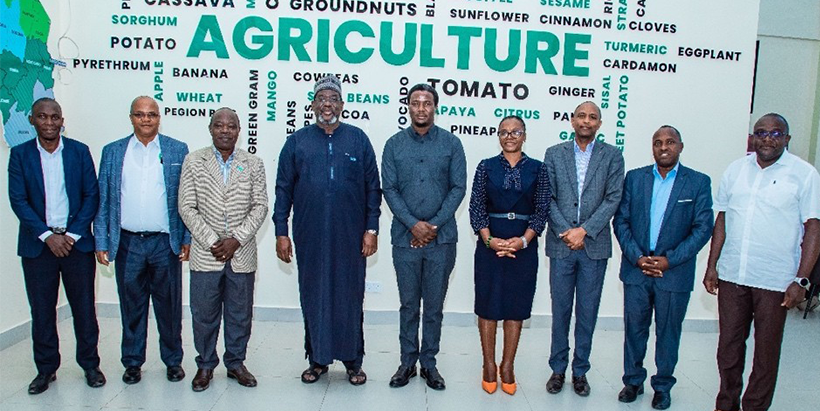
From left to right Galib Ally, Apenda Mrinji, Frederick Baijukya, Dr Tahirou Abdoulaye, Hon. Deputy Minister David Silinde, Yasinta Nzogela, Juma Mdeke, Deusdedith Mbazibwa, Mpoki ShimwelaIITA–CGIAR has reaffirmed its commitment to deepening collaboration with the Government of Tanzania and national research institutions following a high-level mission to Dodoma to advance agricultural transformation in the country.
The delegation, led by IITA Deputy Director General for Partnerships for Delivery and Scaling, Dr Tahirou Abdoulaye, held strategic meetings with senior officials from the Tanzania Agricultural Research Institute (TARI) and the Ministry of Agriculture in May. The visit focused on consolidating longstanding partnerships, reviewing ongoing collaborations, and identifying priority areas for future cooperation.
During the meeting at TARI Headquarters, discussions centered on strengthening joint research and scaling innovations to address emerging agricultural challenges in Tanzania.
Dr Deusdedith Mbazibwa, Director of Research and Innovation at TARI, acknowledged IITA’s longstanding contributions to Tanzania’s agricultural sector, particularly in collaborative research and capacity development. He emphasized the importance of sustained technical support and knowledge exchange to enhance national research systems.
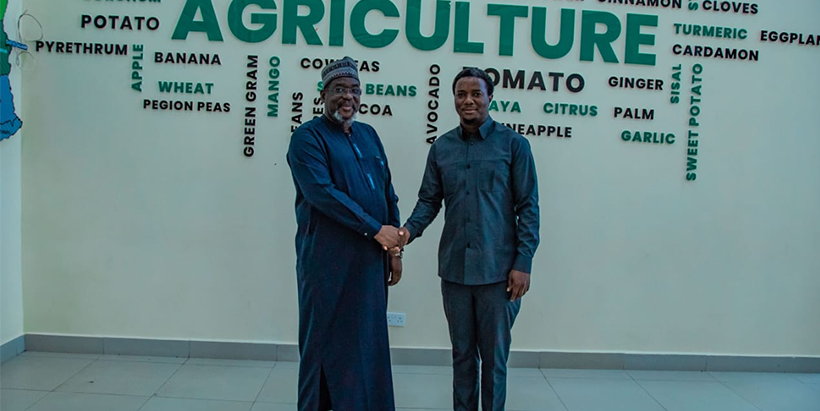
Dr Tahirou Abdoulaye and Hon. Deputy Minister David Silinde
Dr Abdoulaye reaffirming IITA’s commitment to expanding partnerships with Tanzania during discussions, highlighted opportunities for deeper collaboration in areas such as:
Strengthening seed systems, particularly for vegetatively propagated crops and legumes such as soybean and cowpea
Expanding research on nutrition and food safety
Participation in international variety trials for key crops
Development of digital agricultural tools to improve advisory services and disease detection
Capacity building in modern breeding techniques to accelerate varietal development
At the Tanzania Ministry of Agriculture, the IITA delegation met with key directorates to discuss the country’s strategic priorities for agricultural development.
Dr Yasinta Nzogela, Director for Crop Development, outlined ongoing institutional reforms, including plans to establish an Agricultural Extension Agency to enhance the delivery of technologies and advisory services to farmers. She noted the government’s ambitions to achieve self-sufficiency in edible oil and wheat production by 2032, while promoting key crops such as apples and Irish potatoes and strengthening national seed systems.
She enjoined IITA-CGIAR to support these goals through research collaboration, improved seed access, and sustainable seed system development.
…Government commends IITA’s impact
As part of the mission, the IITA-CGIAR team paid a courtesy visit to the Deputy Minister for Agriculture, Hon. David Ernest Silinde. The IITA delegation expressed appreciation for Tanzania’s continued support since the institute established its presence in the country over three decades ago.
“Over the past 32 years, IITA-CGIAR has remained committed to improving smallholder livelihoods, strengthening food security, and contributing to Tanzania’s economic development,” Dr Abdoulaye said.
Hon. Silinde commended IITA’s contributions, highlighting key achievements from the partnership, including:
Development of improved varieties of cassava, banana, soybean, and cowpea
Advancements in crop protection and agronomic practices
Capacity building that has supported more than 60 PhD and 80 MSc graduates, over 1,000 youth, and approximately 100,000 smallholder farmers
He reaffirmed the government’s continued support for IITA-CGIAR’s research and development initiatives.
The visit concluded with a shared commitment between IITA-CGIAR, TARI, and the Ministry of Agriculture to deepen collaboration in support of Tanzania’s agricultural transformation agenda.
Priority areas identified include strengthening seed systems, advancing digital agriculture, improving nutrition and food safety, and accelerating innovation through modern breeding technologies.
The engagements in Dodoma brought to the fore the critical role of partnerships in driving sustainable agricultural development and improving livelihoods, positioning Tanzania to make significant progress toward national food and nutrition security goals.
Contributed by ’Timilehin Osunde
Olamide Deborah Nwanze is a Senior Research Associate specializing in gender mainstreaming research to inform participatory and inclusive breeding, variety development, and seed systems policies regarding root, tuber, and banana (RTB) crops in the International Institute of Tropical Agriculture Headquarters, Ibadan, Nigeria. She is a PhD candidate at the University of Ibadan and holds an MSc and B. Agric in Agricultural Extension and Rural Development. Olamide is a fellow of the African Women in Agricultural Research and Development – Gender Responsive Agricultural Systems Policy (AWARD-GRASP) and the Gender Responsive Researchers Equipped for Agricultural Transformation (GREAT). She seeks to apply her gender-mainstreaming learnings, gender-responsive research, and policy development, and review expertise to facilitate women, youth, children, and vulnerable social group’s access to and adoption of agricultural Innovations that guarantee food, nutrition, income, and livelihood security in Africa. Her current roles include mentoring research fellows, development of guides and training manuals, implementation and adaptation of gender frameworks and tools, value chain actors’ engagement as citizen science partners, policy review and redesign, data management, and analysis. Her current research explores mixed methods and participatory and interdisciplinary approaches to capture and highlight gender dynamics, needs, preferences, and challenges stakeholders face within the agricultural livelihood value chain to prioritize gender-inclusive strategies in breeding programs, policy design, and implementation.
de Sousa, K., van Etten, J., Manners, R. Bello, A., Teeken, B., Olaosebikan, O., et al. 2024. The tricot approach: an agile framework for decentralized on-farm testing supported by citizen science. A retrospective. Agron. Sustain. Dev. 44, 8. https://doi.org/10.1007/s13593-023-00937-1
Madu, T., Onwuka, S., Nwafor, S., Onyemauwa, N., Ejechi, M., Ofoeze, M., Ukeje, B., Eluagu, C., Olaosebikan, O., Okoye, B., 2024. Gender-Inclusive Consumer Studies Improve Cassava Breeding in Nigeria in: Frontiers in Sociology, volume 9, number: 1224504, doi: 10.3389/fsoc.2024.1224504
Olaosebikan, O.; Bello, A.; Utoblo, O.; Okoye, B.; Olutegbe, N.; Garner, E.; Teeken, B.; Bryan, E.; Forsythe, L.; Cole, S.; Madu, T. 2023. Stressors and Resilience within the Cassava Value Chain in Nigeria: Preferred Cassava Variety Traits and Response Strategies of Men and Women to Inform Breeding. Sustainability 15, 7837. https://doi.org/10.3390/su15107837
Okoye, B., Ofoeze, M., Ejechi, M., Onwuka, S., Nwafor, S., Onyemauwa, N., Ukeje, B., Eluagu, C., Obidiegwu, J.*, Olaosebikan, O., Madu, T.* 2023. Prioritizing preferred traits in the yam value chain in Nigeria: a gender situation analysis in: Frontiers in Sociology, volume 8, number: 1232626, pages 1 – 9, ISSN 2297-7775, 2023. https://www.frontiersin.org/articles/10.3389/fsoc.2023.1232626/full
Olaosebikan, O., Bello, A. A., de Sousa, K., Ndjouenkeu, R., Adesokan, M., Alamu, E. O., Agbona, A., van Etten, J., Kegah, F. N.*, Dufour, D., Bouniol, A., Teeken, B. 2023. Consumer acceptability of cassava gari-eba food products across cultural and environmental settings using the triadic comparison of technologies approach (tricot) in: Journal of the Science of Food and Agriculture,
Teeken, B., Olaosebikan, O., Bello, A. A., Madu, T.*, Cole, S. M. 2023. Qualitative assessment on the positionality and preferences of dyads in relation to cassava-related activities: working with tricot trial citizen scientists https://hdl.handle.net/10568/138326 Type: Manual
Bouniol, A., Ceballos, H., Bello, A. A., Teeken, B., Olaosebikan, O., Owoade, D., Agbona, A., Fotso Kuate, A., Madu, T.*, Okoye, B.*, Ofoeze, M.*, Nwafor, S.*, Onyemauwa, N.*, Adinsi, L.*, Forsythe, L., Dufour, D. 2023. Varietal impact on women’s labour, workload and related drudgery in processing root, tuber and banana crops: focus on cassava in sub-Saharan Africa in: Journal of the Science of Food and Agriculture, pages 1 – 25, ISSN 0022-5142,
Bello, A. A., Agbona, A., Olaosebikan, O., Edughaen, G., Dufour, D., Bouniol, A., Iluebbey, P., Ndjouenkeu, R.*, Rabbi, I. Y., Teeken, B. 2023. Genetic and environmental effects on processing productivity and food product yield: drudgery of women’s work in: Journal of the Science of Food and Agriculture, pages 1 – 32, ISSN 0022-5142, 5
Cavicchioli, M., Zimbiti, T., Teeken, B., Nwanze, D.O., Liani, M., Parkes, E. & Bello, A. 2023. IITA-Gender Responsive Breeding Training Report. Genetic Resources Center, IITA-HQ, Ibadan, 21-23 September, 2022. Ibadan, Nigeria: IITA, (34 p.).https://hdl.handle.net/10568/131368
Agbona, A. Peteti P., Teeken B., Olaosebikan O. Bello, A. A., Parkes, E., Rabbi, I. Y., Mueller, L., Egesi, C., Kulakow, P. 2022. Data Management in Multi-disciplinary African RTB Crop Breeding Programs. In: Williamson, H.F., Leonelli, S. (eds) Towards Responsible Plant Data Linkage: Data Challenges for Agricultural Research and Development. Springer, Cham. https://doi.org/10.1007/978-3-031-13276-6_5
Lora Forsythe, Pricilla Marimo, Sarah Mayanja, Olamide D. Olaosebikan, Esme Stuart, Bela Teeken, Benjamin Okoye, Tessy Madu, (2021). Cross-product Gender Analysis of RTBfoods Step 2 Gendered Food Mapping on RTB Products. Understanding the Drivers of Trait Preferences and the Development of Multi-user RTB Product Profiles, WP1. London, UK: RTBfoods Field Scientific Report, 30 p.
Teeken, B., Garner, E., Agbona, A., Balogun, I., Olaosebikan, O., Bello, A., Madu, T., Okoye, B., Egesi, C., Kulakow, P. and Tufan, H.A. 2021. Beyond “Women’s Traits”: Exploring How Gender, Social Difference, and Household Characteristics Influence Trait Preferences. Frontiers Sustainable Food Systems 5:740926. https://doi.org/10.3389/fsufs.2021.740926
Teeken, B., Agbona, A., Bello, A., Olaosebikan, O., Alamu, E., Adesokan, M., Awoyale, W., Madu, T., Okoye, B., Chijioke, U., Owoade, D., Okoro, M., Bouniol, A., Dufour, D., Hershey, C., Rabbi, I., Maziya‐Dixon, B., Egesi, C., Tufan, H. and Kulakow, P. (020. Understanding cassava varietal preferences through pairwise ranking of gari‐eba and fufu prepared by local farmer–processors. Int J Food Sci Technol.https://doi.org/10.1111/ijfs.14862
Bela Teeken, Olamide Olaosebikan, Ireti Balogun, Benjamin Okoye, Tessy Madu, Steven Cole, Abolore Bello, Elizabeth Parkes. (2020). Piloting the G+ customer and product profile tools for gender-responsive cassava breeding in Nigeria. Nigeria: International Institute of Tropical Agriculture (IITA). https://hdl.handle.net/20.500.11766/13000