
IITA trains media on aflatoxin and its biocontrol solution aflasafe
August 18, 2017
IITA recently trained 15 journalists from Tanzania on aflatoxin, its impact on health and trade, and ongoing efforts by IITA in partnership with the Ministry of Agriculture, Livestock and Fisheries (MALF) to control this deadly chemical produced by certain types of fungi. The training was conducted at the IITA-East Africa hub office in Dar es Salaam, Tanzania, by the team working on the problem from both IITA and MALF.
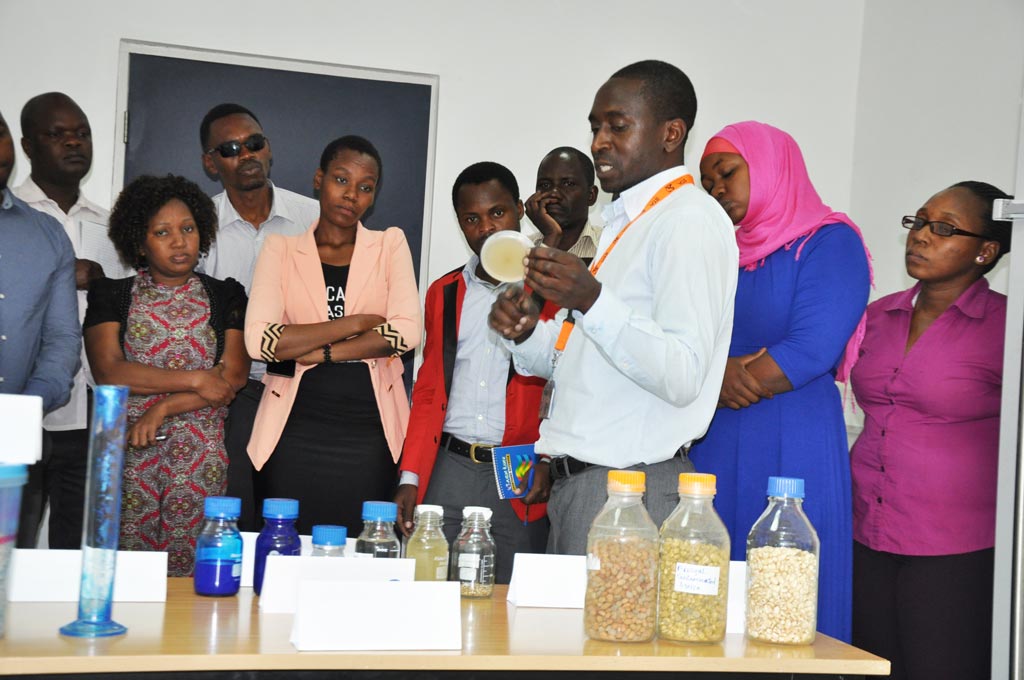 Welcoming the media to the one-day training session, the East Africa Hub Director, Victor Manyong, said it was important to build the capacity of the media to accurately report complex, technical issues such as aflatoxin.
He noted that aflatoxin was a major threat to food security and the health of the farming communities in sub-Saharan Africa yet awareness levels were still very low.
Aflatoxin is produced by the fungus Aspergillus flavus that resides in decayed matter in soil and attacks crops in the field. Maize and groundnut, important staple crops in the country, are most susceptible to contamination by aflatoxin. Chronic exposure to aflatoxin leads to liver diseases, stunting in children, and reduced immunity. Acute exposure can lead to instant death. Aflatoxin also affects animals when they consume contaminated feed.
The training covered aflatoxin—what it is and its effects, and ongoing control efforts including the use of Aflasafe™, a biocontrol technology. It also included a participatory session on how to communicate effectively on aflasafe and a tour of the lab facilities where aflatoxin is tested and Aflasafe™ produced.
George Mahuku, IITA’s Senior Plant Pathology and Aflasafe project leader in East, Southern, and Central Africa who led the training, noted that aflatoxin was a pre- and postharvest problem. He said that some of the factors that contribute to aflatoxin contamination of food and feed are poor agronomic practices and poor drying and storage during and after harvest.
The use of AflasafeTM eliminates the toxin-producing strains, thus reducing aflatoxin contamination.
Beatrice Pallangyo from MALF said the efficacy trial by IITA and the Ministry had proven that the technology was safe, effective, and easy to use. Efforts to get the product registered in the country were at an advanced stage.
She noted that one of the challenges in controlling aflatoxin was the low levels of awareness, hence the importance of working with the media.
The journalists appreciated the exercise, noting that it was important for scientific institutions to open their doors to journalists to give them a thorough briefing on their research efforts as IITA had done.
“Before this training, I had little knowledge about aflatoxin. Now I have learned a lot and I will share the knowledge with others,” said Alex Malika, a media professional from RAS media, Dodoma.
“I now understand the issue very well. It will be easy for me to communicate the message to my family and the audience in general,” said Hawa Kahemele from Nyemo FM Dodoma.
Welcoming the media to the one-day training session, the East Africa Hub Director, Victor Manyong, said it was important to build the capacity of the media to accurately report complex, technical issues such as aflatoxin.
He noted that aflatoxin was a major threat to food security and the health of the farming communities in sub-Saharan Africa yet awareness levels were still very low.
Aflatoxin is produced by the fungus Aspergillus flavus that resides in decayed matter in soil and attacks crops in the field. Maize and groundnut, important staple crops in the country, are most susceptible to contamination by aflatoxin. Chronic exposure to aflatoxin leads to liver diseases, stunting in children, and reduced immunity. Acute exposure can lead to instant death. Aflatoxin also affects animals when they consume contaminated feed.
The training covered aflatoxin—what it is and its effects, and ongoing control efforts including the use of Aflasafe™, a biocontrol technology. It also included a participatory session on how to communicate effectively on aflasafe and a tour of the lab facilities where aflatoxin is tested and Aflasafe™ produced.
George Mahuku, IITA’s Senior Plant Pathology and Aflasafe project leader in East, Southern, and Central Africa who led the training, noted that aflatoxin was a pre- and postharvest problem. He said that some of the factors that contribute to aflatoxin contamination of food and feed are poor agronomic practices and poor drying and storage during and after harvest.
The use of AflasafeTM eliminates the toxin-producing strains, thus reducing aflatoxin contamination.
Beatrice Pallangyo from MALF said the efficacy trial by IITA and the Ministry had proven that the technology was safe, effective, and easy to use. Efforts to get the product registered in the country were at an advanced stage.
She noted that one of the challenges in controlling aflatoxin was the low levels of awareness, hence the importance of working with the media.
The journalists appreciated the exercise, noting that it was important for scientific institutions to open their doors to journalists to give them a thorough briefing on their research efforts as IITA had done.
“Before this training, I had little knowledge about aflatoxin. Now I have learned a lot and I will share the knowledge with others,” said Alex Malika, a media professional from RAS media, Dodoma.
“I now understand the issue very well. It will be easy for me to communicate the message to my family and the audience in general,” said Hawa Kahemele from Nyemo FM Dodoma.
Jacob Njegela, Research Associate at IITA, explains how aflasafe was developed and manufactured in the lab at IITA East Africa hub.
Contributed by
Recent stories
No items found