
IITA Women’s Group visits leading Nigerian school; encourages students to embrace agriculture
October 13, 2018
In a bid to create more awareness about the importance of agriculture to the economy, IITA Women’s group visited Lifeforte International School, Ibadan (LIS) on 2 October to familiarize themselves with the institute and also sow a seed of mindset change to the students and staff.
 The seven-member delegation comprising Charlotte Sanginga, Ranjana Bhattacharjee, Gloria Oluwadare, Kazembe Mulenga, Vaishali Nitturkar, Amina Abdoulaye, and Felicia Attah-Krah was received by Dr Sarah Olubi-Johnson, Founder and Chief Executive Officer (CEO) of LIS and Grace Aina, Principal, LIS. The meeting availed the visitors the opportunity to interact and invest in the students some life changing principles that would help them realize that agriculture is the engine to economic development.
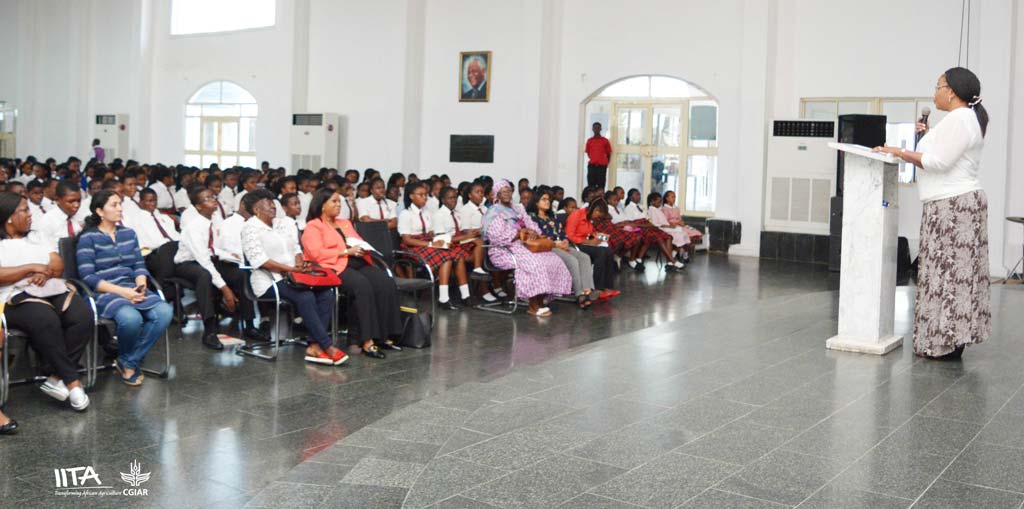
With the aim to enlighten and change the perception of the students about agriculture, Mrs Sanginga said, “Agriculture is the bedrock for economic development and its relevance cannot be overemphasized. Having chosen LIS to be the first school ever visited by the IITA Women’s Group is for a good reason and I know that will be fulfilled. We have come to impact, mentor, and inspire you all on the need to sow a seed so as to be sure of a lifetime legacy, bearing in mind that if you want to be part of change, you have to join us in making history.”
Dr Olubi-Johnson gave a breakdown of the school from its inception to date, highlighting the importance of capturing young minds from the cradle and nurturing them through the precarious age of adolescence, where they will be able to distinguish right from wrong, while striving for excellence at all times. The Executive Director, Mentoring and Child Support, Kunle Sokoya conducted the visitors round the facilities and applauded them for stimulating the passion of young school children into accepting agriculture to guarantee a food-secure continent.
In her address, Bhattacharjee highlighted the need for everyone to contribute towards transforming African agriculture by securing the path to food and nutrition security, which will further translate to reduced poverty and malnutrition. According to her, “Nigeria is one of those countries that needs rapid societal changes. This is because of the low agricultural base and lack of interest by the younger generation in agriculture. She also emphasized that the world’s population will rise from 7 billion to 9 billion by 2050, and for us to able to feed the additional 2 billion people, we need to grow about 60–70% more food.”
[su_quote]“I challenge the management to engage the children into hands-on training on farming to provide a strong foundation on agriculture. I believe that if the necessary agricultural practices are put in place, your efforts will not be in vain. We will return next year to check the progress of your crop and give a reward to the best group,” she added.[/su_quote]
Giving an overview of the IITA Women’s group farm, Oluwadare and Mulenga apprised the participants of their involvement in agriculture, and how they have been working to improve the livelihood of people, especially women and children through the provision of scholarships and agricultural produce.
Nitturkar addressed the students on the essence of developing an interest in agriculture, and led them through some relaxation activities to help them overcome stress and keep them fit to undertake new tasks.
In concluding the meeting, Dr Olubi-Johnson assured the team that agriculture will not only be taught but also practicalized. She immediately charged the principal to form a committee to oversee the progress and the smooth running of the farms.
The seven-member delegation comprising Charlotte Sanginga, Ranjana Bhattacharjee, Gloria Oluwadare, Kazembe Mulenga, Vaishali Nitturkar, Amina Abdoulaye, and Felicia Attah-Krah was received by Dr Sarah Olubi-Johnson, Founder and Chief Executive Officer (CEO) of LIS and Grace Aina, Principal, LIS. The meeting availed the visitors the opportunity to interact and invest in the students some life changing principles that would help them realize that agriculture is the engine to economic development.
With the aim to enlighten and change the perception of the students about agriculture, Mrs Sanginga said, “Agriculture is the bedrock for economic development and its relevance cannot be overemphasized. Having chosen LIS to be the first school ever visited by the IITA Women’s Group is for a good reason and I know that will be fulfilled. We have come to impact, mentor, and inspire you all on the need to sow a seed so as to be sure of a lifetime legacy, bearing in mind that if you want to be part of change, you have to join us in making history.”
Dr Olubi-Johnson gave a breakdown of the school from its inception to date, highlighting the importance of capturing young minds from the cradle and nurturing them through the precarious age of adolescence, where they will be able to distinguish right from wrong, while striving for excellence at all times. The Executive Director, Mentoring and Child Support, Kunle Sokoya conducted the visitors round the facilities and applauded them for stimulating the passion of young school children into accepting agriculture to guarantee a food-secure continent.
In her address, Bhattacharjee highlighted the need for everyone to contribute towards transforming African agriculture by securing the path to food and nutrition security, which will further translate to reduced poverty and malnutrition. According to her, “Nigeria is one of those countries that needs rapid societal changes. This is because of the low agricultural base and lack of interest by the younger generation in agriculture. She also emphasized that the world’s population will rise from 7 billion to 9 billion by 2050, and for us to able to feed the additional 2 billion people, we need to grow about 60–70% more food.”
[su_quote]“I challenge the management to engage the children into hands-on training on farming to provide a strong foundation on agriculture. I believe that if the necessary agricultural practices are put in place, your efforts will not be in vain. We will return next year to check the progress of your crop and give a reward to the best group,” she added.[/su_quote]
Giving an overview of the IITA Women’s group farm, Oluwadare and Mulenga apprised the participants of their involvement in agriculture, and how they have been working to improve the livelihood of people, especially women and children through the provision of scholarships and agricultural produce.
Nitturkar addressed the students on the essence of developing an interest in agriculture, and led them through some relaxation activities to help them overcome stress and keep them fit to undertake new tasks.
In concluding the meeting, Dr Olubi-Johnson assured the team that agriculture will not only be taught but also practicalized. She immediately charged the principal to form a committee to oversee the progress and the smooth running of the farms.
Charlotte Sanginga, Head of Scholarship and Charity Committee, IITA Women’s Group, addressing the staff and students of LIS.
Contributed by
Recent stories
No items found