
IITA NEWS

IITA Zero Hunger Project equips nutrition and agripreneurship trainers in Nigeria’s Middle Belt
September 9, 2022

Twenty-nine farmers, extension agents, food processors, and food entrepreneurs participated in a training of trainers workshop on nutrition and agripreneurship in Benue State, Nigeria. The IITA Zero Hunger Initiative (IITA-ZHI) project conducted the five-day intensive training from 15 to 19 August in partnership with the Center for Food Technology and Research of the Benue State University (CEFTER-BSU) and the International Fund for Agricultural Development Value Chain Development Programme (IFAD-VCDP).
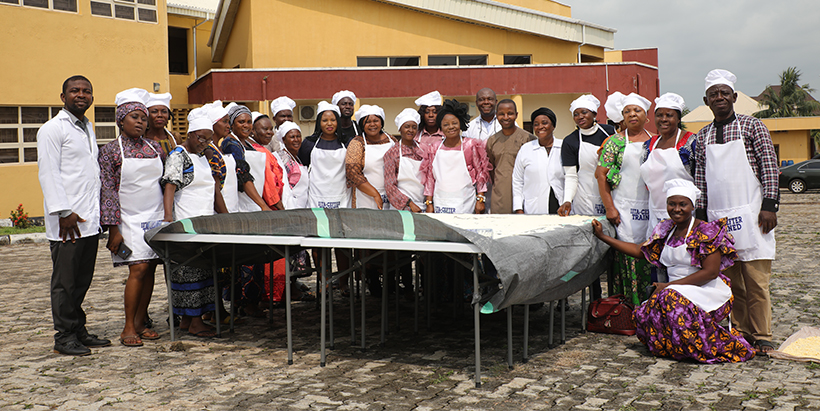
Workshop participants displaying their just-produced HQCF.

Benue State Commissioner for Agriculture and Natural Resources, Dr Kester Kyenge, lauded the collaborative efforts of IITA-ZHI, CEFTER-BSU, IFAD-VCDP, and other partners to make the training possible. He noted that today’s global hunger threat highlighted the training’s essence and called for an inward solution to address it. He praised the workshop’s gender mainstreaming, evident in the female majority participation (26 women and three men). “As long as we keep emphasizing the role of women in food value chain development, we are halfway towards ensuring nutrition and food security. The government’s responsibility is to keep encouraging women to be drivers of this food sustenance vehicle,” Kyenge said.

IITA-ZHI Monitoring, Evaluation and Learning Manager, Oyewale Abioye, celebrated extension agents’ ceaseless efforts to achieve zero hunger in the state. He disclosed that early interactions between ZHI and CEFTER led to mapping CEFTER as one of the Initiatives to support the state government in achieving zero hunger and culminated in signing an MoU between IITA and BSU.

Abioye noted that the IITA-ZHI in Benue State has three main components: agricultural policy assessment for technology uptake, productivity enhancement for cassava and rice farmers, and capacity development for agriculture extension officers, service providers, and farmers. Based on these, the project has engaged the government and other stakeholders to assess agriculture policies and has made recommendations to ensure the attainment of zero hunger in the state.

The IITA-ZHI project’s work with extension agents and other stakeholders aims to increase farmers’ production capacity and improve collaboration between the government and farmers to achieve zero hunger. Capacity-building activities include introducing extension agents to digital agricultural tools like the IITA Herbicide Calculator and Area Calculator, which are available on mobile app stores. While the Herbicide Calculator helps farmers determine the right amounts of agrochemicals to use to avoid overdosing or underdosing on farmlands, the land measurement tool—Area Calculator—assists farmers in determining the exact size of their land to ensure they purchase the correct quantity of inputs. This, in turn, leads to profit maximization by farmers.

The training also addressed cassava substitution in pastry making, particularly now, with wheat costs and availability hugely impacted by the Russia-Ukraine war.

Another rationale for the training, according to Abioye, was to improve nutrition for pregnant women, nursing mothers, and households in general with simple and non-expensive products like vitamin A cassava and High-Quality Cassava Flour (HQCF). IITA-CGIAR has improved some of these cassava products, which are not entirely new.

CEFTER-BSU Center Leader Dr Barnaba Ikyo noted that the skills learned in this workshop hold huge income generation potential and charged participants to maximize it. He appreciated IITA for actualizing the MoU signed in 2022. The workshop focused on value addition, teaching participants to prepare products such as Cassava–Beans Moi-Moi, Combo bits, Yellow cassava Garri, Cassava Custard, and Peanut Burger. They also learned to make HQCF cakes, puff-puff cakes, peanut burgers, and cassava custard (Castard).

The attendees received their participation Certificates from the Permanent Secretary Hembadoon Gum, representing the Hon Commissioner of Agriculture and Natural Resources, and the Deputy Vice-Chancellor, Administration, of the Benue State University, Prof. Mike Odugbo Odey, who represented the Vice-Chancellor.

One of the participants and wife of the Paramount Ruler of Tiv Land, Prof. Felicia Ayatse, commended the workshop organizers and expressed optimism that the training would go a long way in ensuring nutrition and food security in the state. She hoped the training would provide Benue women with sources of income when the knowledge is eventually stepped down by the participants to members of their various cooperatives and communities.

Contributed by Zero Hunger Project Team


Contributed by

Recent stories

No items found

Leave a Reply

Your email address will not be published. Required fields are marked *

Scroll to Top
Olaosebikan, Olamide

Olamide Deborah Nwanze is a Senior Research Associate specializing in gender mainstreaming research to inform participatory and inclusive breeding, variety development, and seed systems policies regarding root, tuber, and banana (RTB) crops in the International Institute of Tropical Agriculture Headquarters, Ibadan, Nigeria. She is a PhD candidate at the University of Ibadan and holds an MSc and B. Agric in Agricultural Extension and Rural Development. Olamide is a fellow of the African Women in Agricultural Research and Development – Gender Responsive Agricultural Systems Policy (AWARD-GRASP) and the Gender Responsive Researchers Equipped for Agricultural Transformation (GREAT). She seeks to apply her gender-mainstreaming learnings, gender-responsive research, and policy development, and review expertise to facilitate women, youth, children, and vulnerable social group’s access to and adoption of agricultural Innovations that guarantee food, nutrition, income, and livelihood security in Africa. Her current roles include mentoring research fellows, development of guides and training manuals, implementation and adaptation of gender frameworks and tools, value chain actors’ engagement as citizen science partners, policy review and redesign, data management, and analysis. Her current research explores mixed methods and participatory and interdisciplinary approaches to capture and highlight gender dynamics, needs, preferences, and challenges stakeholders face within the agricultural livelihood value chain to prioritize gender-inclusive strategies in breeding programs, policy design, and implementation.

At IITA, she contributes to the implementation of the CGIAR Accelerated Breeding Initiative and Genetic Innovation Programs; participatory and gender research within the NextGen CassavaHarvestPlusRTBFoods, and Tricot-ClimMob 1000Farms Projects; and gender knowledge communication via the G-LENS webinar series, video documentary, policy briefspublications, and blogs.


Recent publications

de Sousa, K., van Etten, J., Manners, R. Bello, A., Teeken, B., Olaosebikan, O., et al. 2024. The tricot approach: an agile framework for decentralized on-farm testing supported by citizen science. A retrospective. Agron. Sustain. Dev. 44, 8. https://doi.org/10.1007/s13593-023-00937-1

Madu, T., Onwuka, S., Nwafor, S., Onyemauwa, N., Ejechi, M., Ofoeze, M., Ukeje, B., Eluagu, C., Olaosebikan, O., Okoye, B., 2024. Gender-Inclusive Consumer Studies Improve Cassava Breeding in Nigeria in: Frontiers in Sociology, volume 9, number: 1224504, doi: 10.3389/fsoc.2024.1224504

Olaosebikan, O.; Bello, A.; Utoblo, O.; Okoye, B.; Olutegbe, N.; Garner, E.; Teeken, B.; Bryan, E.; Forsythe, L.; Cole, S.; Madu, T. 2023.  Stressors and Resilience within the Cassava Value Chain in Nigeria: Preferred Cassava Variety Traits and Response Strategies of Men and Women to Inform Breeding. Sustainability 15, 7837. https://doi.org/10.3390/su15107837

Okoye, B., Ofoeze, M., Ejechi, M., Onwuka, S., Nwafor, S., Onyemauwa, N., Ukeje, B., Eluagu, C., Obidiegwu, J.*, Olaosebikan, O., Madu, T.* 2023. Prioritizing preferred traits in the yam value chain in Nigeria: a gender situation analysis in: Frontiers in Sociology, volume 8, number: 1232626, pages 1 – 9, ISSN 2297-7775, 2023. https://www.frontiersin.org/articles/10.3389/fsoc.2023.1232626/full

Olaosebikan, O., Bello, A. A., de Sousa, K., Ndjouenkeu, R., Adesokan, M., Alamu, E. O., Agbona, A., van Etten, J., Kegah, F. N.*, Dufour, D., Bouniol, A., Teeken, B. 2023. Consumer acceptability of cassava gari-eba food products across cultural and environmental settings using the triadic comparison of technologies approach (tricot) in: Journal of the Science of Food and Agriculture,

Teeken, B., Olaosebikan, O., Bello, A. A., Madu, T.*, Cole, S. M. 2023. Qualitative assessment on the positionality and preferences of dyads in relation to cassava-related activities: working with tricot trial citizen scientists https://hdl.handle.net/10568/138326 Type: Manual

Bouniol, A., Ceballos, H., Bello, A. A., Teeken, B., Olaosebikan, O., Owoade, D., Agbona, A., Fotso Kuate, A., Madu, T.*, Okoye, B.*, Ofoeze, M.*, Nwafor, S.*, Onyemauwa, N.*, Adinsi, L.*, Forsythe, L., Dufour, D. 2023. Varietal impact on women’s labour, workload and related drudgery in processing root, tuber and banana crops: focus on cassava in sub-Saharan Africa in: Journal of the Science of Food and Agriculture, pages 1 – 25, ISSN 0022-5142,

Bello, A. A., Agbona, A., Olaosebikan, O., Edughaen, G., Dufour, D., Bouniol, A., Iluebbey, P., Ndjouenkeu, R.*, Rabbi, I. Y., Teeken, B. 2023. Genetic and environmental effects on processing productivity and food product yield: drudgery of women’s work in: Journal of the Science of Food and Agriculture, pages 1 – 32, ISSN 0022-5142, 5

Cavicchioli, M., Zimbiti, T., Teeken, B., Nwanze, D.O., Liani, M., Parkes, E. & Bello, A. 2023. IITA-Gender Responsive Breeding Training Report. Genetic Resources Center, IITA-HQ, Ibadan, 21-23 September, 2022. Ibadan, Nigeria: IITA, (34 p.).https://hdl.handle.net/10568/131368

Agbona, A. Peteti P., Teeken B., Olaosebikan O. Bello, A. A., Parkes, E., Rabbi, I. Y., Mueller, L., Egesi, C., Kulakow, P. 2022. Data Management in Multi-disciplinary African RTB Crop Breeding Programs. In: Williamson, H.F., Leonelli, S. (eds) Towards Responsible Plant Data Linkage: Data Challenges for Agricultural Research and Development. Springer, Cham. https://doi.org/10.1007/978-3-031-13276-6_5

Lora Forsythe, Pricilla Marimo, Sarah Mayanja, Olamide D. Olaosebikan, Esme Stuart, Bela Teeken, Benjamin Okoye, Tessy Madu, (2021). Cross-product Gender Analysis of RTBfoods Step 2 Gendered Food Mapping on RTB Products. Understanding the Drivers of Trait Preferences and the Development of Multi-user RTB Product Profiles, WP1. London, UK: RTBfoods Field Scientific Report, 30 p.

Teeken, B., Garner, E., Agbona, A., Balogun, I., Olaosebikan, O., Bello, A., Madu, T., Okoye, B., Egesi, C., Kulakow, P. and Tufan, H.A. 2021. Beyond “Women’s Traits”: Exploring How Gender, Social Difference, and Household Characteristics Influence Trait Preferences. Frontiers Sustainable Food Systems 5:740926. https://doi.org/10.3389/fsufs.2021.740926

Teeken, B., Agbona, A., Bello, A., Olaosebikan, O., Alamu, E., Adesokan, M., Awoyale, W., Madu, T., Okoye, B., Chijioke, U., Owoade, D., Okoro, M., Bouniol, A., Dufour, D., Hershey, C., Rabbi, I., Maziya‐Dixon, B., Egesi, C., Tufan, H. and Kulakow, P. (020. Understanding cassava varietal preferences through pairwise ranking of gari‐eba and fufu prepared by local farmer–processors. Int J Food Sci Technol. https://doi.org/10.1111/ijfs.14862

Bela Teeken, Olamide Olaosebikan, Ireti Balogun, Benjamin Okoye, Tessy Madu, Steven Cole, Abolore Bello, Elizabeth Parkes. (2020). Piloting the G+ customer and product profile tools for gender-responsive cassava breeding in Nigeria. Nigeria: International Institute of Tropical Agriculture (IITA). https://hdl.handle.net/20.500.11766/13000