NEWS

IITA’s forest unit partners with BGCI to address depleting forest resources
July 7, 2017

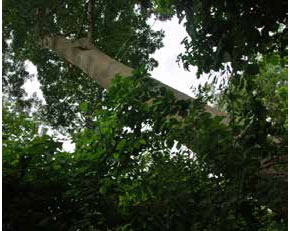
Secondary forest growth, IITA forest.

Nigeria’s forest cover is now less than 5% of its original state and far below the recognized target of 25% to mitigate climate change. According to the country’s Biodiversity Strategy and Action Plan, all of its forests will be gone in less than 3 years unless urgent steps are taken to halt and reverse this trend. Botanic Gardens Conservation International (BGCI), funded by the Mohamed bin Zayed Species Conservation Fund (MbZ), has partnered with the IITA Forest Unit in Ibadan to raise awareness of the threats facing Nigeria’s forests and to begin practical conservation of threatened trees by collecting seeds, propagating trees, and contributing training and capacity building for reforestation and forest restoration projects. Nigeria has one of the highest deforestation rates in the world, with an annual deforestation rate of 3.5%. About 20% of the country was previously covered in what are known as Guineo-Congolean lowland rainforests. Both legal and illegal forestry practices, combined with agriculture, have reduced this by 95%, resulting in hardship for rural communities that then migrate to cities. A number of trees in these forests, such as mahoganies (Khaya and Entandrophragma spp.), Iroko, and African walnut (Mansonia altissima), are also important to Nigeria’s economy, and at one time African whitewood (Triplochiton scleroxylon), known locally as obeche, contributed 80% to Nigeria’s GDP. These forests also contain 84% of African primates, 68% of African passerine birds, and 66% of African butterfly species, making them important also in the conservation of biodiversity and endangered species. The first step in setting up the project was compiling a list of 58 threatened tree species, four of which are high priority: Nigerian kola (Cola nigerica), sapele (Entandrophragma cylindricum), afrormosia (Pericopsis elata), and cherry mahogany (Tieghemella heckelii). Only a few of these species are represented in botanic gardens globally and the endemic Nigerian kola, which has no reported collections, is assessed by the IUCN Red List as critically endangered. Of the 58 species, the Forest Unit has so far collected propagation material from 31 tree species, including surplus seeds from 13 target species, which are now stored in the IITA genebank. When threatened species are successfully propagated, young trees are planted in the IITA Tree Heritage Park. A total of 34 threatened species have been planted so far as an insurance policy against extinction and as a source of propagation material for future reintroductions. The Forest Unit has also conducted propagation trials for 10 target species, and has completed Red List assessments for eight. The team is still trying to collect propagation material from other species on the list. However, funding for the MbZ project closed on 31 May, and though supplementary funding for certain aspects of the project were awarded by the Australian High Commission Abuja until October 2017, further funding is urgently needed to sustain the conservation of Nigeria’s most threatened trees. To raise awareness locally, the Forest Unit held a workshop in June to which representatives from the Forestry Research Institute of Nigeria (FRIN), the National Centre for Genetic Resources & Biotechnology (NACGRAB), and the Nigerian Conservation Foundation (NCF) were invited, together with staff of universities, state departments of forestry, and national parks. While maintaining connections with conservation partners, the Unit is now focused on compiling a Manual of Propagation for Nigerian Trees that will be available to download free when the new website is active. Deni Bown, Head of IITA’s Forest Unit, pointed out the threat of encroachment, clearance, logging, unsustainable collection of non-timber forest products, and illegal timber trading to the country’s forests. She urges everyone to take immediate action to prevent the irreversible decline of hardwoods such as mahogany, afrormosia, and Senegal rosewood (Pterocarpus erinaceus). She also encourages planting native, fast-growing trees instead of exotics such as teak, Gmelina, and eucalyptus normally used in tree planting activities. Bown also suggests that increased international pressure should be put on the Federal Government to take measures to conserve Nigeria’s forests. Sources: National Biodiversity Strategy and Action Plan, 2015, and Prioritising and Protecting Nigeria’s Most Threatened Trees, Deni Bown

Contributed by

Recent stories

No items found

Leave a Reply

Your email address will not be published. Required fields are marked *

Scroll to Top
Olaosebikan, Olamide

Olamide Deborah Nwanze is a Senior Research Associate specializing in gender mainstreaming research to inform participatory and inclusive breeding, variety development, and seed systems policies regarding root, tuber, and banana (RTB) crops in the International Institute of Tropical Agriculture Headquarters, Ibadan, Nigeria. She is a PhD candidate at the University of Ibadan and holds an MSc and B. Agric in Agricultural Extension and Rural Development. Olamide is a fellow of the African Women in Agricultural Research and Development – Gender Responsive Agricultural Systems Policy (AWARD-GRASP) and the Gender Responsive Researchers Equipped for Agricultural Transformation (GREAT). She seeks to apply her gender-mainstreaming learnings, gender-responsive research, and policy development, and review expertise to facilitate women, youth, children, and vulnerable social group’s access to and adoption of agricultural Innovations that guarantee food, nutrition, income, and livelihood security in Africa. Her current roles include mentoring research fellows, development of guides and training manuals, implementation and adaptation of gender frameworks and tools, value chain actors’ engagement as citizen science partners, policy review and redesign, data management, and analysis. Her current research explores mixed methods and participatory and interdisciplinary approaches to capture and highlight gender dynamics, needs, preferences, and challenges stakeholders face within the agricultural livelihood value chain to prioritize gender-inclusive strategies in breeding programs, policy design, and implementation.

At IITA, she contributes to the implementation of the CGIAR Accelerated Breeding Initiative and Genetic Innovation Programs; participatory and gender research within the NextGen CassavaHarvestPlusRTBFoods, and Tricot-ClimMob 1000Farms Projects; and gender knowledge communication via the G-LENS webinar series, video documentary, policy briefspublications, and blogs.


Recent publications

de Sousa, K., van Etten, J., Manners, R. Bello, A., Teeken, B., Olaosebikan, O., et al. 2024. The tricot approach: an agile framework for decentralized on-farm testing supported by citizen science. A retrospective. Agron. Sustain. Dev. 44, 8. https://doi.org/10.1007/s13593-023-00937-1

Madu, T., Onwuka, S., Nwafor, S., Onyemauwa, N., Ejechi, M., Ofoeze, M., Ukeje, B., Eluagu, C., Olaosebikan, O., Okoye, B., 2024. Gender-Inclusive Consumer Studies Improve Cassava Breeding in Nigeria in: Frontiers in Sociology, volume 9, number: 1224504, doi: 10.3389/fsoc.2024.1224504

Olaosebikan, O.; Bello, A.; Utoblo, O.; Okoye, B.; Olutegbe, N.; Garner, E.; Teeken, B.; Bryan, E.; Forsythe, L.; Cole, S.; Madu, T. 2023.  Stressors and Resilience within the Cassava Value Chain in Nigeria: Preferred Cassava Variety Traits and Response Strategies of Men and Women to Inform Breeding. Sustainability 15, 7837. https://doi.org/10.3390/su15107837

Okoye, B., Ofoeze, M., Ejechi, M., Onwuka, S., Nwafor, S., Onyemauwa, N., Ukeje, B., Eluagu, C., Obidiegwu, J.*, Olaosebikan, O., Madu, T.* 2023. Prioritizing preferred traits in the yam value chain in Nigeria: a gender situation analysis in: Frontiers in Sociology, volume 8, number: 1232626, pages 1 – 9, ISSN 2297-7775, 2023. https://www.frontiersin.org/articles/10.3389/fsoc.2023.1232626/full

Olaosebikan, O., Bello, A. A., de Sousa, K., Ndjouenkeu, R., Adesokan, M., Alamu, E. O., Agbona, A., van Etten, J., Kegah, F. N.*, Dufour, D., Bouniol, A., Teeken, B. 2023. Consumer acceptability of cassava gari-eba food products across cultural and environmental settings using the triadic comparison of technologies approach (tricot) in: Journal of the Science of Food and Agriculture,

Teeken, B., Olaosebikan, O., Bello, A. A., Madu, T.*, Cole, S. M. 2023. Qualitative assessment on the positionality and preferences of dyads in relation to cassava-related activities: working with tricot trial citizen scientists https://hdl.handle.net/10568/138326 Type: Manual

Bouniol, A., Ceballos, H., Bello, A. A., Teeken, B., Olaosebikan, O., Owoade, D., Agbona, A., Fotso Kuate, A., Madu, T.*, Okoye, B.*, Ofoeze, M.*, Nwafor, S.*, Onyemauwa, N.*, Adinsi, L.*, Forsythe, L., Dufour, D. 2023. Varietal impact on women’s labour, workload and related drudgery in processing root, tuber and banana crops: focus on cassava in sub-Saharan Africa in: Journal of the Science of Food and Agriculture, pages 1 – 25, ISSN 0022-5142,

Bello, A. A., Agbona, A., Olaosebikan, O., Edughaen, G., Dufour, D., Bouniol, A., Iluebbey, P., Ndjouenkeu, R.*, Rabbi, I. Y., Teeken, B. 2023. Genetic and environmental effects on processing productivity and food product yield: drudgery of women’s work in: Journal of the Science of Food and Agriculture, pages 1 – 32, ISSN 0022-5142, 5

Cavicchioli, M., Zimbiti, T., Teeken, B., Nwanze, D.O., Liani, M., Parkes, E. & Bello, A. 2023. IITA-Gender Responsive Breeding Training Report. Genetic Resources Center, IITA-HQ, Ibadan, 21-23 September, 2022. Ibadan, Nigeria: IITA, (34 p.).https://hdl.handle.net/10568/131368

Agbona, A. Peteti P., Teeken B., Olaosebikan O. Bello, A. A., Parkes, E., Rabbi, I. Y., Mueller, L., Egesi, C., Kulakow, P. 2022. Data Management in Multi-disciplinary African RTB Crop Breeding Programs. In: Williamson, H.F., Leonelli, S. (eds) Towards Responsible Plant Data Linkage: Data Challenges for Agricultural Research and Development. Springer, Cham. https://doi.org/10.1007/978-3-031-13276-6_5

Lora Forsythe, Pricilla Marimo, Sarah Mayanja, Olamide D. Olaosebikan, Esme Stuart, Bela Teeken, Benjamin Okoye, Tessy Madu, (2021). Cross-product Gender Analysis of RTBfoods Step 2 Gendered Food Mapping on RTB Products. Understanding the Drivers of Trait Preferences and the Development of Multi-user RTB Product Profiles, WP1. London, UK: RTBfoods Field Scientific Report, 30 p.

Teeken, B., Garner, E., Agbona, A., Balogun, I., Olaosebikan, O., Bello, A., Madu, T., Okoye, B., Egesi, C., Kulakow, P. and Tufan, H.A. 2021. Beyond “Women’s Traits”: Exploring How Gender, Social Difference, and Household Characteristics Influence Trait Preferences. Frontiers Sustainable Food Systems 5:740926. https://doi.org/10.3389/fsufs.2021.740926

Teeken, B., Agbona, A., Bello, A., Olaosebikan, O., Alamu, E., Adesokan, M., Awoyale, W., Madu, T., Okoye, B., Chijioke, U., Owoade, D., Okoro, M., Bouniol, A., Dufour, D., Hershey, C., Rabbi, I., Maziya‐Dixon, B., Egesi, C., Tufan, H. and Kulakow, P. (020. Understanding cassava varietal preferences through pairwise ranking of gari‐eba and fufu prepared by local farmer–processors. Int J Food Sci Technol. https://doi.org/10.1111/ijfs.14862

Bela Teeken, Olamide Olaosebikan, Ireti Balogun, Benjamin Okoye, Tessy Madu, Steven Cole, Abolore Bello, Elizabeth Parkes. (2020). Piloting the G+ customer and product profile tools for gender-responsive cassava breeding in Nigeria. Nigeria: International Institute of Tropical Agriculture (IITA). https://hdl.handle.net/20.500.11766/13000