
Improving human health with plant extracts
April 30, 2021
Healthy eating starts with healthy food choices, improving health, and preventing malnutrition and a range of non-communicable diseases (NCDs) and health conditions. However, increased production of processed foods, rapid urbanization, and changing lifestyles have led to a shift in dietary patterns. Also, the exact make-up of a diversified, balanced, and healthy diet varies depending on individual characteristics, cultural context, locally available foods, and dietary customs.
Banana—Musa species, one of the first staple food sources in the tropics—is valued globally for its flavor, nutritional value, and availability year-round.
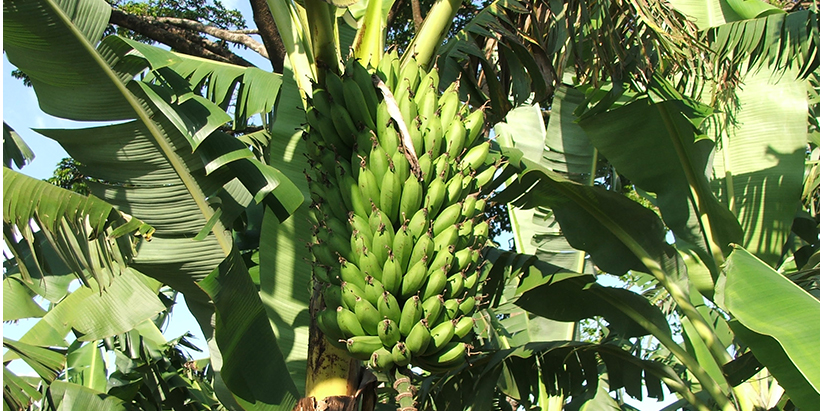 Studies have shown that several parts of the banana plant, such as the leaf, pseudostem, flowers, fruit, and peel, have been used in traditional medicine in Asia and Africa for centuries. Traditionally, the stem juice, flowers, and fruit are commonly used to treat diarrhea, dysentery, ulcer, and aphthae in children.
While banana increases the production of hemoglobin in the blood and reduces the cause of anemia due to its high iron content, almost every part of the plant has curative purposes both scientifically and traditionally. Scientifically, a fully ripe banana consists of antifungal and antibiotic properties present in the peel and pulp.
A group of scientists led by KU Leuven, and including IITA’s Rony Swennen, a banana breeder, examined the antimicrobial activity of the different parts of selected banana cultivars against food-borne clinically important human pathogens, including Candida albicans.
The study used three parts of different banana cultivars—the corm, pseudostem, and leaves—to test antimicrobial properties. The study revealed that genetically closely related banana cultivars with genome ABB have better antimicrobial properties against food-borne and clinically important pathogens, with antimicrobial activity stronger in the pseudostem and leaves than in the corm. Hence, this supports the traditional use of banana extracts for treating infections, including diarrhea and dysentery. A parallel study showed that these banana extracts also inhibit the growth of several human pathogenic viruses.
As part of IITA’s goal to ensure food safety and security in Africa, identifying the high value of banana cultivars to treat human ailments and infections is a major scientific breakthrough that has the potential for sustainable economic development. Banana is a major crop grown by millions of smallholder farmers across Africa, ensuring improved livelihoods, food security, and enhanced health systems.
Read the full article, Antimicrobial activity of selected banana cultivars against important human pathogens, including Candida biofilm: https://doi.org/10.3390/foods9040435. Also, refer to Antiviral and Cytotoxic Activity of Different Plant Parts of Banana (Musa spp.).
Studies have shown that several parts of the banana plant, such as the leaf, pseudostem, flowers, fruit, and peel, have been used in traditional medicine in Asia and Africa for centuries. Traditionally, the stem juice, flowers, and fruit are commonly used to treat diarrhea, dysentery, ulcer, and aphthae in children.
While banana increases the production of hemoglobin in the blood and reduces the cause of anemia due to its high iron content, almost every part of the plant has curative purposes both scientifically and traditionally. Scientifically, a fully ripe banana consists of antifungal and antibiotic properties present in the peel and pulp.
A group of scientists led by KU Leuven, and including IITA’s Rony Swennen, a banana breeder, examined the antimicrobial activity of the different parts of selected banana cultivars against food-borne clinically important human pathogens, including Candida albicans.
The study used three parts of different banana cultivars—the corm, pseudostem, and leaves—to test antimicrobial properties. The study revealed that genetically closely related banana cultivars with genome ABB have better antimicrobial properties against food-borne and clinically important pathogens, with antimicrobial activity stronger in the pseudostem and leaves than in the corm. Hence, this supports the traditional use of banana extracts for treating infections, including diarrhea and dysentery. A parallel study showed that these banana extracts also inhibit the growth of several human pathogenic viruses.
As part of IITA’s goal to ensure food safety and security in Africa, identifying the high value of banana cultivars to treat human ailments and infections is a major scientific breakthrough that has the potential for sustainable economic development. Banana is a major crop grown by millions of smallholder farmers across Africa, ensuring improved livelihoods, food security, and enhanced health systems.
Read the full article, Antimicrobial activity of selected banana cultivars against important human pathogens, including Candida biofilm: https://doi.org/10.3390/foods9040435. Also, refer to Antiviral and Cytotoxic Activity of Different Plant Parts of Banana (Musa spp.).
Banana leaves are used for traditional medicine.
Contributed by
Recent stories
No items found