Indian Consul-General explores collaboration opportunities with IITA
June 16, 2025
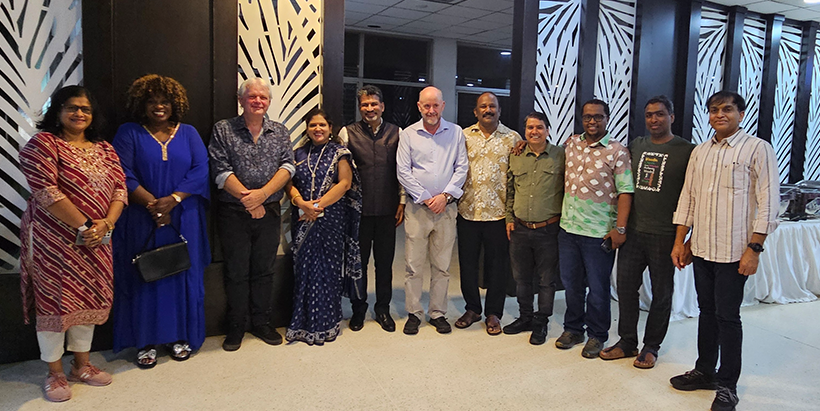
IITA team with the Consul-General of India to Nigeria, Chandramouli Kumar Kern after the meeting.
The Consul-General of India to Nigeria, Chandramouli Kumar Kern, visited IITA–CGIAR headquarters in Ibadan from 31 May to 1 June, aiming to strengthen India-Africa collaboration in agricultural research and innovation. Lava Kumar, the IITA Head of Virology and Germplasm Health, moderated the meeting.
In his welcome remarks, the IITA Deputy Director General for Research for Development (DDG-R4D), Bernard Vanlauwe, introduced Kern to IITA’s mission, strategy, and core research programs. He also highlighted ongoing collaborations between IITA and Indian research institutions, including:
Development of Fusarium wilt-resistant banana varieties with the National Research Centre for Bananas (NRCB);
Root and tuber crop research with the Central Tuber Crops Research Institute (CTCRI), including capacity building on cassava gene editing and Bambara groundnut breeding;
Genetic resource exchange from IITA genebank and Indian organizations, including the National Bureau of Plant Genetic Resources (NBPGR). India;
Agronomy and soil health initiatives through the Excellence in Agronomy (EiA) program in Odisha, India; and
Biocontrol efforts include successfully introducing predators for papaya mealybug from IITA-Benin and ongoing discussions on scaling Aflasafe in India.
Vanlauwe remarked that a formal Memorandum of Understanding (MoU) between IITA and the Indian Council of Agricultural Research (ICAR) would broaden collaboration in breeding, crop protection, mechanization, and digital agriculture. He also highlighted the Nigerian government’s interest in replicating India’s successful Soil Health Card initiative, positioning IITA as a potential lead partner for implementation.
Contributions from IITA scientists further enriched the discussions. The IITA Cassava Breeding Program Lead, Ismail Rabbi, noted India’s impressive cassava productivity and called for strengthened cooperation to enhance disease resistance. Rajneesh Paliwal, IITA DNA Fingerprinting for Genetic Resources Management, recommended accelerating germplasm exchange and adopting Digital Sequencing Information (DSI) tools to modernize gene banking. At the same time, IITA Emeritus Scientist and Senior Plant Pathologist Ranajit Bandyopadhyay highlighted the need to scale Aflasafe to combat mycotoxin contamination in India.
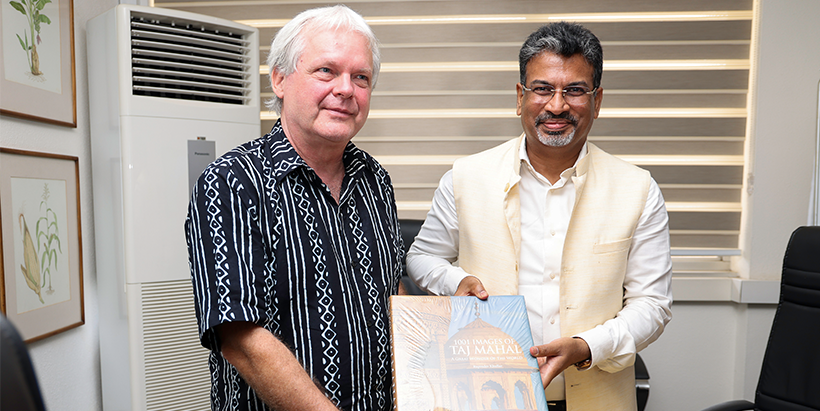
The Consul-General of India to Nigeria, Chandramouli Kumar Kern presenting a gift to IITA Deputy Director General for Research for Development (DDG-R4D), Dr Bernard Vanlauwe during the visit.
Kumar emphasized the importance of scaling IITA innovations for the benefit of end users and reaffirmed the potential for mutually beneficial collaboration with ICAR and other Indian partners.
In response, Kern expressed his gratitude for the warm reception. He shared insights on India’s journey from food insecurity to self-sufficiency, driven by advancements in sustainable agriculture, soil health, renewable energy, and digital advisory services. He introduced India’s “Development Partnership” (DP) initiative, which provides grants, concessional loans, and capacity-building opportunities. He encouraged IITA to develop concept notes in partnership with Indian institutions that are aligned with DP priorities.
Kern offered to facilitate connections between IITA and stakeholders involved in India’s Soil Health Card Scheme to strengthen institutional ties. This initiative helps farmers identify soil types and adopt appropriate agronomic practices based on research disseminated by the government and extension agents. He emphasized the importance of continued engagement with the Indian High Commission and noted that Indian agricultural practices could be adapted and deployed in Africa with the support of IITA. The initial follow-up step involves organizing an exchange visit between ICAR experts and IITA and establishing a task force to identify mutual priority areas for Development Partnership grants.
Kern’s visit concluded after visits to Genebanks, Virology and Molecular Diagnostics, Cassava Processing, and the Aflasafe unit.
Contributed by Lava Kumar and Anita Akinyomade
Olamide Deborah Nwanze is a Senior Research Associate specializing in gender mainstreaming research to inform participatory and inclusive breeding, variety development, and seed systems policies regarding root, tuber, and banana (RTB) crops in the International Institute of Tropical Agriculture Headquarters, Ibadan, Nigeria. She is a PhD candidate at the University of Ibadan and holds an MSc and B. Agric in Agricultural Extension and Rural Development. Olamide is a fellow of the African Women in Agricultural Research and Development – Gender Responsive Agricultural Systems Policy (AWARD-GRASP) and the Gender Responsive Researchers Equipped for Agricultural Transformation (GREAT). She seeks to apply her gender-mainstreaming learnings, gender-responsive research, and policy development, and review expertise to facilitate women, youth, children, and vulnerable social group’s access to and adoption of agricultural Innovations that guarantee food, nutrition, income, and livelihood security in Africa. Her current roles include mentoring research fellows, development of guides and training manuals, implementation and adaptation of gender frameworks and tools, value chain actors’ engagement as citizen science partners, policy review and redesign, data management, and analysis. Her current research explores mixed methods and participatory and interdisciplinary approaches to capture and highlight gender dynamics, needs, preferences, and challenges stakeholders face within the agricultural livelihood value chain to prioritize gender-inclusive strategies in breeding programs, policy design, and implementation.
de Sousa, K., van Etten, J., Manners, R. Bello, A., Teeken, B., Olaosebikan, O., et al. 2024. The tricot approach: an agile framework for decentralized on-farm testing supported by citizen science. A retrospective. Agron. Sustain. Dev. 44, 8. https://doi.org/10.1007/s13593-023-00937-1
Madu, T., Onwuka, S., Nwafor, S., Onyemauwa, N., Ejechi, M., Ofoeze, M., Ukeje, B., Eluagu, C., Olaosebikan, O., Okoye, B., 2024. Gender-Inclusive Consumer Studies Improve Cassava Breeding in Nigeria in: Frontiers in Sociology, volume 9, number: 1224504, doi: 10.3389/fsoc.2024.1224504
Olaosebikan, O.; Bello, A.; Utoblo, O.; Okoye, B.; Olutegbe, N.; Garner, E.; Teeken, B.; Bryan, E.; Forsythe, L.; Cole, S.; Madu, T. 2023. Stressors and Resilience within the Cassava Value Chain in Nigeria: Preferred Cassava Variety Traits and Response Strategies of Men and Women to Inform Breeding. Sustainability 15, 7837. https://doi.org/10.3390/su15107837
Okoye, B., Ofoeze, M., Ejechi, M., Onwuka, S., Nwafor, S., Onyemauwa, N., Ukeje, B., Eluagu, C., Obidiegwu, J.*, Olaosebikan, O., Madu, T.* 2023. Prioritizing preferred traits in the yam value chain in Nigeria: a gender situation analysis in: Frontiers in Sociology, volume 8, number: 1232626, pages 1 – 9, ISSN 2297-7775, 2023. https://www.frontiersin.org/articles/10.3389/fsoc.2023.1232626/full
Olaosebikan, O., Bello, A. A., de Sousa, K., Ndjouenkeu, R., Adesokan, M., Alamu, E. O., Agbona, A., van Etten, J., Kegah, F. N.*, Dufour, D., Bouniol, A., Teeken, B. 2023. Consumer acceptability of cassava gari-eba food products across cultural and environmental settings using the triadic comparison of technologies approach (tricot) in: Journal of the Science of Food and Agriculture,
Teeken, B., Olaosebikan, O., Bello, A. A., Madu, T.*, Cole, S. M. 2023. Qualitative assessment on the positionality and preferences of dyads in relation to cassava-related activities: working with tricot trial citizen scientists https://hdl.handle.net/10568/138326 Type: Manual
Bouniol, A., Ceballos, H., Bello, A. A., Teeken, B., Olaosebikan, O., Owoade, D., Agbona, A., Fotso Kuate, A., Madu, T.*, Okoye, B.*, Ofoeze, M.*, Nwafor, S.*, Onyemauwa, N.*, Adinsi, L.*, Forsythe, L., Dufour, D. 2023. Varietal impact on women’s labour, workload and related drudgery in processing root, tuber and banana crops: focus on cassava in sub-Saharan Africa in: Journal of the Science of Food and Agriculture, pages 1 – 25, ISSN 0022-5142,
Bello, A. A., Agbona, A., Olaosebikan, O., Edughaen, G., Dufour, D., Bouniol, A., Iluebbey, P., Ndjouenkeu, R.*, Rabbi, I. Y., Teeken, B. 2023. Genetic and environmental effects on processing productivity and food product yield: drudgery of women’s work in: Journal of the Science of Food and Agriculture, pages 1 – 32, ISSN 0022-5142, 5
Cavicchioli, M., Zimbiti, T., Teeken, B., Nwanze, D.O., Liani, M., Parkes, E. & Bello, A. 2023. IITA-Gender Responsive Breeding Training Report. Genetic Resources Center, IITA-HQ, Ibadan, 21-23 September, 2022. Ibadan, Nigeria: IITA, (34 p.).https://hdl.handle.net/10568/131368
Agbona, A. Peteti P., Teeken B., Olaosebikan O. Bello, A. A., Parkes, E., Rabbi, I. Y., Mueller, L., Egesi, C., Kulakow, P. 2022. Data Management in Multi-disciplinary African RTB Crop Breeding Programs. In: Williamson, H.F., Leonelli, S. (eds) Towards Responsible Plant Data Linkage: Data Challenges for Agricultural Research and Development. Springer, Cham. https://doi.org/10.1007/978-3-031-13276-6_5
Lora Forsythe, Pricilla Marimo, Sarah Mayanja, Olamide D. Olaosebikan, Esme Stuart, Bela Teeken, Benjamin Okoye, Tessy Madu, (2021). Cross-product Gender Analysis of RTBfoods Step 2 Gendered Food Mapping on RTB Products. Understanding the Drivers of Trait Preferences and the Development of Multi-user RTB Product Profiles, WP1. London, UK: RTBfoods Field Scientific Report, 30 p.
Teeken, B., Garner, E., Agbona, A., Balogun, I., Olaosebikan, O., Bello, A., Madu, T., Okoye, B., Egesi, C., Kulakow, P. and Tufan, H.A. 2021. Beyond “Women’s Traits”: Exploring How Gender, Social Difference, and Household Characteristics Influence Trait Preferences. Frontiers Sustainable Food Systems 5:740926. https://doi.org/10.3389/fsufs.2021.740926
Teeken, B., Agbona, A., Bello, A., Olaosebikan, O., Alamu, E., Adesokan, M., Awoyale, W., Madu, T., Okoye, B., Chijioke, U., Owoade, D., Okoro, M., Bouniol, A., Dufour, D., Hershey, C., Rabbi, I., Maziya‐Dixon, B., Egesi, C., Tufan, H. and Kulakow, P. (020. Understanding cassava varietal preferences through pairwise ranking of gari‐eba and fufu prepared by local farmer–processors. Int J Food Sci Technol.https://doi.org/10.1111/ijfs.14862
Bela Teeken, Olamide Olaosebikan, Ireti Balogun, Benjamin Okoye, Tessy Madu, Steven Cole, Abolore Bello, Elizabeth Parkes. (2020). Piloting the G+ customer and product profile tools for gender-responsive cassava breeding in Nigeria. Nigeria: International Institute of Tropical Agriculture (IITA). https://hdl.handle.net/20.500.11766/13000