Innovative app for chicken feed nearly doubles profits in pilot test with farmers in Tanzania
November 30, 2017
IITA supported pretesting of app that resulted in considerable reduction in costs of feed and an increase in the average weight for broilersFeedCalculator, an app that generates affordable quality feed recipes for poultry from locally available ingredients, has the potential to be a game changer for poultry farmers as results from its pilot testing saw a near doubling of profits.
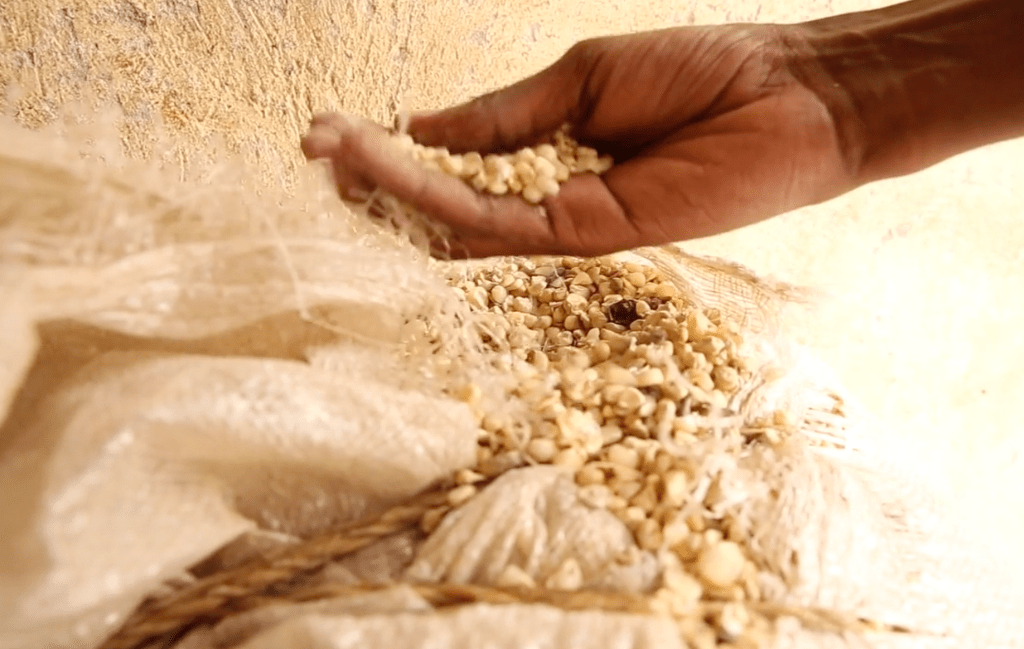
Chicken feed made following calculations from the app.
The app was co-created by leading Dutch nutritionists and livestock experts in partnership with farmers in developing countries and was tested by the NGO called BRAC and IITA in Tanzania. It will be available this December in the Google Play Store and will be free for all smallholder poultry farmers all over the world.
The pretest results showed that broilers fed using recipes suggested by the app had on average 15% higher weight and that the app on average reduced the cost of feed by 31% compared to regular commercial feed. This resulted, on average, to 80% higher profit due to lower feed costs and higher weight of the birds.
The farmers involved in the study divided their broilers into two batches and fed one half with the usual feed and the other with the self-prepared FeedCalculator mix and after six weeks compared animal growth and feed costs. A total of 4,400 birds were involved in the study.
Frederick Baijukya, a scientist at IITA and coordinator of the N2Africa project, said most of the farmers the project works with, and especially women, also keep poultry. “One of their challenges is the low productivity from the chicken due to poor nutrition. The farmers didn’t have the technology to make good feed formulation. We, therefore, selected Single Spark, as they have a state-of-the-art technology, which can be used to formulate animal feed. And so we started the pilot.”
The pilot was held in three regions in Tanzania (Gmboto, Tegeta, Kim andolu) with 19 farmers. Staff from IITA and BRAC were first trained on the app and they trained the farmers taking part in the pilot study.
Jazira Rashid, BRAC Program Organizer, said: “The farmers were very excited about this knowledge. You buy your raw materials by the quantities prescribed and you just mix it. It is much cheaper.”
“Due to FeedCalculator I improved my produce and doubled my income in just 6 weeks,” said Amina Shemsi, one of the poultry farmers that took part in the pilot study. Halima Mustapha, another poultry farmer using the app concurred: “By using the knowledge of the FeedCalculator, my chicks are growing faster. They are heavier and healthier compared to before.”
Single Spark, the company behind the app, noted that many livestock farmers have serious difficulties making a profit from their livestock due to costly feed. Peter Meijer, from Single Spark, says that on average 70% of the production costs of poultry go to feed as farmers buy costly commercial (imported) feed. A cheaper option is to buy locally mixed feed but the quality is unknown and often poor. Empowering farmers to make their own feed recipe is the solution.
“Feed formulation is very complex. Mixing high-quality balanced feed with the right energy levels, for the lowest price and for the whole year is complex. And that is why we developed the FeedCalculator.
“After several tests and pilots and with the support of BRAC and IITA, it is now time for farmers all over the world to benefit from it. We ask other NGOs to join our mission of empowering farmers to produce their own affordable, quality feed,” Meijer said.
How the app works
The app simply asks farmers to enter: (i) animal breed, (ii) age of animals, (iii) number of animals, and (iv) all the available local ingredients and prices. Based upon this data, the app calculates the most cost-efficient feed mix using algorithms of leading feed experts. The app is free for poultry farmers with less than 1000 chickens. Larger farmers will need to pay a fee of $50 per year or $10 per two months. The app can be downloaded from the Google Play Store or for more information see www.feedcalculator.com.
Olamide Deborah Nwanze is a Senior Research Associate specializing in gender mainstreaming research to inform participatory and inclusive breeding, variety development, and seed systems policies regarding root, tuber, and banana (RTB) crops in the International Institute of Tropical Agriculture Headquarters, Ibadan, Nigeria. She is a PhD candidate at the University of Ibadan and holds an MSc and B. Agric in Agricultural Extension and Rural Development. Olamide is a fellow of the African Women in Agricultural Research and Development – Gender Responsive Agricultural Systems Policy (AWARD-GRASP) and the Gender Responsive Researchers Equipped for Agricultural Transformation (GREAT). She seeks to apply her gender-mainstreaming learnings, gender-responsive research, and policy development, and review expertise to facilitate women, youth, children, and vulnerable social group’s access to and adoption of agricultural Innovations that guarantee food, nutrition, income, and livelihood security in Africa. Her current roles include mentoring research fellows, development of guides and training manuals, implementation and adaptation of gender frameworks and tools, value chain actors’ engagement as citizen science partners, policy review and redesign, data management, and analysis. Her current research explores mixed methods and participatory and interdisciplinary approaches to capture and highlight gender dynamics, needs, preferences, and challenges stakeholders face within the agricultural livelihood value chain to prioritize gender-inclusive strategies in breeding programs, policy design, and implementation.
de Sousa, K., van Etten, J., Manners, R. Bello, A., Teeken, B., Olaosebikan, O., et al. 2024. The tricot approach: an agile framework for decentralized on-farm testing supported by citizen science. A retrospective. Agron. Sustain. Dev. 44, 8. https://doi.org/10.1007/s13593-023-00937-1
Madu, T., Onwuka, S., Nwafor, S., Onyemauwa, N., Ejechi, M., Ofoeze, M., Ukeje, B., Eluagu, C., Olaosebikan, O., Okoye, B., 2024. Gender-Inclusive Consumer Studies Improve Cassava Breeding in Nigeria in: Frontiers in Sociology, volume 9, number: 1224504, doi: 10.3389/fsoc.2024.1224504
Olaosebikan, O.; Bello, A.; Utoblo, O.; Okoye, B.; Olutegbe, N.; Garner, E.; Teeken, B.; Bryan, E.; Forsythe, L.; Cole, S.; Madu, T. 2023. Stressors and Resilience within the Cassava Value Chain in Nigeria: Preferred Cassava Variety Traits and Response Strategies of Men and Women to Inform Breeding. Sustainability 15, 7837. https://doi.org/10.3390/su15107837
Okoye, B., Ofoeze, M., Ejechi, M., Onwuka, S., Nwafor, S., Onyemauwa, N., Ukeje, B., Eluagu, C., Obidiegwu, J.*, Olaosebikan, O., Madu, T.* 2023. Prioritizing preferred traits in the yam value chain in Nigeria: a gender situation analysis in: Frontiers in Sociology, volume 8, number: 1232626, pages 1 – 9, ISSN 2297-7775, 2023. https://www.frontiersin.org/articles/10.3389/fsoc.2023.1232626/full
Olaosebikan, O., Bello, A. A., de Sousa, K., Ndjouenkeu, R., Adesokan, M., Alamu, E. O., Agbona, A., van Etten, J., Kegah, F. N.*, Dufour, D., Bouniol, A., Teeken, B. 2023. Consumer acceptability of cassava gari-eba food products across cultural and environmental settings using the triadic comparison of technologies approach (tricot) in: Journal of the Science of Food and Agriculture,
Teeken, B., Olaosebikan, O., Bello, A. A., Madu, T.*, Cole, S. M. 2023. Qualitative assessment on the positionality and preferences of dyads in relation to cassava-related activities: working with tricot trial citizen scientists https://hdl.handle.net/10568/138326 Type: Manual
Bouniol, A., Ceballos, H., Bello, A. A., Teeken, B., Olaosebikan, O., Owoade, D., Agbona, A., Fotso Kuate, A., Madu, T.*, Okoye, B.*, Ofoeze, M.*, Nwafor, S.*, Onyemauwa, N.*, Adinsi, L.*, Forsythe, L., Dufour, D. 2023. Varietal impact on women’s labour, workload and related drudgery in processing root, tuber and banana crops: focus on cassava in sub-Saharan Africa in: Journal of the Science of Food and Agriculture, pages 1 – 25, ISSN 0022-5142,
Bello, A. A., Agbona, A., Olaosebikan, O., Edughaen, G., Dufour, D., Bouniol, A., Iluebbey, P., Ndjouenkeu, R.*, Rabbi, I. Y., Teeken, B. 2023. Genetic and environmental effects on processing productivity and food product yield: drudgery of women’s work in: Journal of the Science of Food and Agriculture, pages 1 – 32, ISSN 0022-5142, 5
Cavicchioli, M., Zimbiti, T., Teeken, B., Nwanze, D.O., Liani, M., Parkes, E. & Bello, A. 2023. IITA-Gender Responsive Breeding Training Report. Genetic Resources Center, IITA-HQ, Ibadan, 21-23 September, 2022. Ibadan, Nigeria: IITA, (34 p.).https://hdl.handle.net/10568/131368
Agbona, A. Peteti P., Teeken B., Olaosebikan O. Bello, A. A., Parkes, E., Rabbi, I. Y., Mueller, L., Egesi, C., Kulakow, P. 2022. Data Management in Multi-disciplinary African RTB Crop Breeding Programs. In: Williamson, H.F., Leonelli, S. (eds) Towards Responsible Plant Data Linkage: Data Challenges for Agricultural Research and Development. Springer, Cham. https://doi.org/10.1007/978-3-031-13276-6_5
Lora Forsythe, Pricilla Marimo, Sarah Mayanja, Olamide D. Olaosebikan, Esme Stuart, Bela Teeken, Benjamin Okoye, Tessy Madu, (2021). Cross-product Gender Analysis of RTBfoods Step 2 Gendered Food Mapping on RTB Products. Understanding the Drivers of Trait Preferences and the Development of Multi-user RTB Product Profiles, WP1. London, UK: RTBfoods Field Scientific Report, 30 p.
Teeken, B., Garner, E., Agbona, A., Balogun, I., Olaosebikan, O., Bello, A., Madu, T., Okoye, B., Egesi, C., Kulakow, P. and Tufan, H.A. 2021. Beyond “Women’s Traits”: Exploring How Gender, Social Difference, and Household Characteristics Influence Trait Preferences. Frontiers Sustainable Food Systems 5:740926. https://doi.org/10.3389/fsufs.2021.740926
Teeken, B., Agbona, A., Bello, A., Olaosebikan, O., Alamu, E., Adesokan, M., Awoyale, W., Madu, T., Okoye, B., Chijioke, U., Owoade, D., Okoro, M., Bouniol, A., Dufour, D., Hershey, C., Rabbi, I., Maziya‐Dixon, B., Egesi, C., Tufan, H. and Kulakow, P. (020. Understanding cassava varietal preferences through pairwise ranking of gari‐eba and fufu prepared by local farmer–processors. Int J Food Sci Technol.https://doi.org/10.1111/ijfs.14862
Bela Teeken, Olamide Olaosebikan, Ireti Balogun, Benjamin Okoye, Tessy Madu, Steven Cole, Abolore Bello, Elizabeth Parkes. (2020). Piloting the G+ customer and product profile tools for gender-responsive cassava breeding in Nigeria. Nigeria: International Institute of Tropical Agriculture (IITA). https://hdl.handle.net/20.500.11766/13000