Integrated Agriculture Activity trains youth as spray service providers in Adamawa and Borno States…
July 17, 2020
The USAID-funded Feed-the-Future Nigeria Integrated Agriculture Activity (IAA) recently concluded the training of 30 youths as spray service providers (SSPs) in Adamawa and Borno States, in North-Eastern Nigeria. The first sessions of the training, which began in February, and held in Borno had 15 participants. The Adamawa Agriculture Development Investment Limited Farming Skills Acquisition Centre (AADIL/FSAC) hosted the concluding sessions, with 15 youths in attendance and facilitated by CropLife Nigeria (CLN).
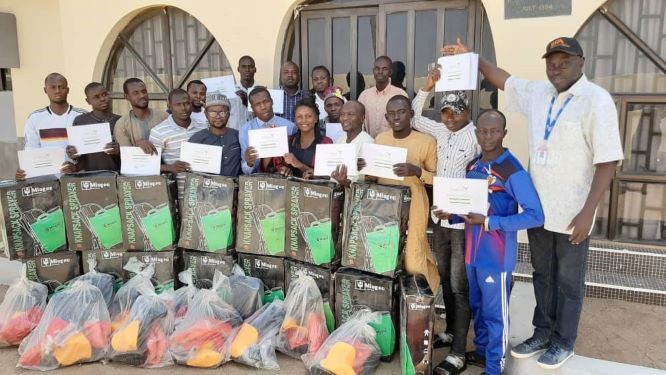
Adamawa State participants with training facilitators behind.
The training aimed to equip participants with the relevant skills to become expert SSPs and provide them with income-generating opportunities through rendering of agrochemical spraying services to farmers in their area. The learning sessions are part of the youth empowerment program of the IAA project.
The trained SSPs, all male and between 20 and 30 years old, are mostly practicing farmers and graduates of different tertiary institutions. The participants came from seven implementing Local Government Areas (LGAs) in Adamawa and five implementing LGAs in Borno. Because of reproductive health hazards involved in spray services and the heavy weight of the full knapsack sprayer, the training did not involve women.
Participants received training on weed and pest management, pest scouting, types and formulation of pesticides, personal protective equipment (PPE), first aid, record keeping, entrepreneurship, and customer relations.
In his comments during the closing program, the Activity’s Deputy Chief of Party (DCoP), Kayode Faleti, congratulated participants on taking part in the training. He urged them to be safety conscious while handling the chemicals and ensure that they make judicious use of the skills and tools they received. Responding to the DCoP, a participant from Hong LGA, Evans Ishaku, thanked IITA and USAID for giving them the opportunity and empowering them with skills.
The IAA supported the participants with knapsack sprayers and complete PPEs, which included safety caps, protective eyewear, overalls, respirators, hand gloves, rain boots, and logbooks to commence their enterprise activities in the farming season.
…and holds training on infant and young child feeding
Optimal Infant and Young Child Feeding (IYCF) practices are very crucial to the growth, development, health, and survival of every child. The Nigeria Demographic and Health Survey (NDHS) found that IYCF practices in Nigeria remain unsatisfactory as there is a low rate of timely breastfeeding initiation (38%) and lower rates of exclusive breastfeeding for six months (13%). They also estimate that nearly 60% of all childhood deaths are due to underlying malnutrition, while the outbreak of the COVID-19 pandemic further exacerbates the problem of nutrition deficiency.
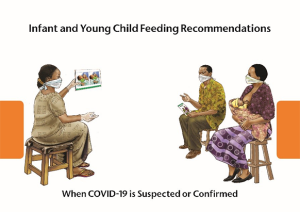
Infant and Young Child Feeding (IYCF) recommendations when COVID-19 infection is suspected or confirmed.
In efforts to improve participants’ nutritional status, the IAA, in collaboration with Adamawa State Primary Health Care Development Agency, recently conducted a 3-day training workshop on “Infant and young child feeding for Community Development Officers, Nutrition Focal Officers, and Social Workers” in Yola, the Adamawa State capital. The 21 participants (14 female and 7 male) were selected from seven implementing LGAs in the state. Facilitators took turns to explain why IYCF matters, especially with the COVID-19 pandemic and everyday situations that affect infant and young child feeding considering participants’ individual experiences and circumstances.
The training featured interactive sessions, such as group discussion and participation, practical sessions, illustrations, and PowerPoint presentations. The workshop also included role-playing on counseling using case studies, group work, demonstration, gallery, discussion, question and answer sessions, and buzz groups.
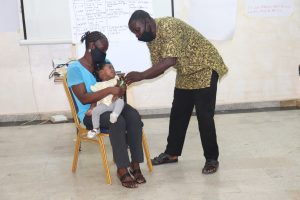
MUAC Tape demonstration at the training.
Participants learned how to breastfeed with proper positioning through practical demonstration while using a counseling card as a guide throughout the training. Also, the use of Mid-Upper Arm Circumference (MUAC) tape and its interpretation was demonstrated with IYCF data tools discussed in detail. The trainers also spoke about myths and misconceptions, women’s nutrition at different stages of life, feeding a sick child and when to take the child to the hospital, and other topics.
At the end of the workshop, participants developed their action plans to step down the IYCF training to participants in the LGAs they represent and use the knowledge gained themselves. The Activity conducted a post-test to confirm what they learned.
Olamide Deborah Nwanze is a Senior Research Associate specializing in gender mainstreaming research to inform participatory and inclusive breeding, variety development, and seed systems policies regarding root, tuber, and banana (RTB) crops in the International Institute of Tropical Agriculture Headquarters, Ibadan, Nigeria. She is a PhD candidate at the University of Ibadan and holds an MSc and B. Agric in Agricultural Extension and Rural Development. Olamide is a fellow of the African Women in Agricultural Research and Development – Gender Responsive Agricultural Systems Policy (AWARD-GRASP) and the Gender Responsive Researchers Equipped for Agricultural Transformation (GREAT). She seeks to apply her gender-mainstreaming learnings, gender-responsive research, and policy development, and review expertise to facilitate women, youth, children, and vulnerable social group’s access to and adoption of agricultural Innovations that guarantee food, nutrition, income, and livelihood security in Africa. Her current roles include mentoring research fellows, development of guides and training manuals, implementation and adaptation of gender frameworks and tools, value chain actors’ engagement as citizen science partners, policy review and redesign, data management, and analysis. Her current research explores mixed methods and participatory and interdisciplinary approaches to capture and highlight gender dynamics, needs, preferences, and challenges stakeholders face within the agricultural livelihood value chain to prioritize gender-inclusive strategies in breeding programs, policy design, and implementation.
de Sousa, K., van Etten, J., Manners, R. Bello, A., Teeken, B., Olaosebikan, O., et al. 2024. The tricot approach: an agile framework for decentralized on-farm testing supported by citizen science. A retrospective. Agron. Sustain. Dev. 44, 8. https://doi.org/10.1007/s13593-023-00937-1
Madu, T., Onwuka, S., Nwafor, S., Onyemauwa, N., Ejechi, M., Ofoeze, M., Ukeje, B., Eluagu, C., Olaosebikan, O., Okoye, B., 2024. Gender-Inclusive Consumer Studies Improve Cassava Breeding in Nigeria in: Frontiers in Sociology, volume 9, number: 1224504, doi: 10.3389/fsoc.2024.1224504
Olaosebikan, O.; Bello, A.; Utoblo, O.; Okoye, B.; Olutegbe, N.; Garner, E.; Teeken, B.; Bryan, E.; Forsythe, L.; Cole, S.; Madu, T. 2023. Stressors and Resilience within the Cassava Value Chain in Nigeria: Preferred Cassava Variety Traits and Response Strategies of Men and Women to Inform Breeding. Sustainability 15, 7837. https://doi.org/10.3390/su15107837
Okoye, B., Ofoeze, M., Ejechi, M., Onwuka, S., Nwafor, S., Onyemauwa, N., Ukeje, B., Eluagu, C., Obidiegwu, J.*, Olaosebikan, O., Madu, T.* 2023. Prioritizing preferred traits in the yam value chain in Nigeria: a gender situation analysis in: Frontiers in Sociology, volume 8, number: 1232626, pages 1 – 9, ISSN 2297-7775, 2023. https://www.frontiersin.org/articles/10.3389/fsoc.2023.1232626/full
Olaosebikan, O., Bello, A. A., de Sousa, K., Ndjouenkeu, R., Adesokan, M., Alamu, E. O., Agbona, A., van Etten, J., Kegah, F. N.*, Dufour, D., Bouniol, A., Teeken, B. 2023. Consumer acceptability of cassava gari-eba food products across cultural and environmental settings using the triadic comparison of technologies approach (tricot) in: Journal of the Science of Food and Agriculture,
Teeken, B., Olaosebikan, O., Bello, A. A., Madu, T.*, Cole, S. M. 2023. Qualitative assessment on the positionality and preferences of dyads in relation to cassava-related activities: working with tricot trial citizen scientists https://hdl.handle.net/10568/138326 Type: Manual
Bouniol, A., Ceballos, H., Bello, A. A., Teeken, B., Olaosebikan, O., Owoade, D., Agbona, A., Fotso Kuate, A., Madu, T.*, Okoye, B.*, Ofoeze, M.*, Nwafor, S.*, Onyemauwa, N.*, Adinsi, L.*, Forsythe, L., Dufour, D. 2023. Varietal impact on women’s labour, workload and related drudgery in processing root, tuber and banana crops: focus on cassava in sub-Saharan Africa in: Journal of the Science of Food and Agriculture, pages 1 – 25, ISSN 0022-5142,
Bello, A. A., Agbona, A., Olaosebikan, O., Edughaen, G., Dufour, D., Bouniol, A., Iluebbey, P., Ndjouenkeu, R.*, Rabbi, I. Y., Teeken, B. 2023. Genetic and environmental effects on processing productivity and food product yield: drudgery of women’s work in: Journal of the Science of Food and Agriculture, pages 1 – 32, ISSN 0022-5142, 5
Cavicchioli, M., Zimbiti, T., Teeken, B., Nwanze, D.O., Liani, M., Parkes, E. & Bello, A. 2023. IITA-Gender Responsive Breeding Training Report. Genetic Resources Center, IITA-HQ, Ibadan, 21-23 September, 2022. Ibadan, Nigeria: IITA, (34 p.).https://hdl.handle.net/10568/131368
Agbona, A. Peteti P., Teeken B., Olaosebikan O. Bello, A. A., Parkes, E., Rabbi, I. Y., Mueller, L., Egesi, C., Kulakow, P. 2022. Data Management in Multi-disciplinary African RTB Crop Breeding Programs. In: Williamson, H.F., Leonelli, S. (eds) Towards Responsible Plant Data Linkage: Data Challenges for Agricultural Research and Development. Springer, Cham. https://doi.org/10.1007/978-3-031-13276-6_5
Lora Forsythe, Pricilla Marimo, Sarah Mayanja, Olamide D. Olaosebikan, Esme Stuart, Bela Teeken, Benjamin Okoye, Tessy Madu, (2021). Cross-product Gender Analysis of RTBfoods Step 2 Gendered Food Mapping on RTB Products. Understanding the Drivers of Trait Preferences and the Development of Multi-user RTB Product Profiles, WP1. London, UK: RTBfoods Field Scientific Report, 30 p.
Teeken, B., Garner, E., Agbona, A., Balogun, I., Olaosebikan, O., Bello, A., Madu, T., Okoye, B., Egesi, C., Kulakow, P. and Tufan, H.A. 2021. Beyond “Women’s Traits”: Exploring How Gender, Social Difference, and Household Characteristics Influence Trait Preferences. Frontiers Sustainable Food Systems 5:740926. https://doi.org/10.3389/fsufs.2021.740926
Teeken, B., Agbona, A., Bello, A., Olaosebikan, O., Alamu, E., Adesokan, M., Awoyale, W., Madu, T., Okoye, B., Chijioke, U., Owoade, D., Okoro, M., Bouniol, A., Dufour, D., Hershey, C., Rabbi, I., Maziya‐Dixon, B., Egesi, C., Tufan, H. and Kulakow, P. (020. Understanding cassava varietal preferences through pairwise ranking of gari‐eba and fufu prepared by local farmer–processors. Int J Food Sci Technol.https://doi.org/10.1111/ijfs.14862
Bela Teeken, Olamide Olaosebikan, Ireti Balogun, Benjamin Okoye, Tessy Madu, Steven Cole, Abolore Bello, Elizabeth Parkes. (2020). Piloting the G+ customer and product profile tools for gender-responsive cassava breeding in Nigeria. Nigeria: International Institute of Tropical Agriculture (IITA). https://hdl.handle.net/20.500.11766/13000

 The training aimed to equip participants with the relevant skills to become expert SSPs and provide them with income-generating opportunities through rendering of agrochemical spraying services to farmers in their area. The learning sessions are part of the youth empowerment program of the IAA project.
The trained SSPs, all male and between 20 and 30 years old, are mostly practicing farmers and graduates of different tertiary institutions. The participants came from seven implementing Local Government Areas (LGAs) in Adamawa and five implementing LGAs in Borno. Because of reproductive health hazards involved in spray services and the heavy weight of the full knapsack sprayer, the training did not involve women.
Participants received training on weed and pest management, pest scouting, types and formulation of pesticides, personal protective equipment (PPE), first aid, record keeping, entrepreneurship, and customer relations.
In his comments during the closing program, the Activity’s Deputy Chief of Party (DCoP), Kayode Faleti, congratulated participants on taking part in the training. He urged them to be safety conscious while handling the chemicals and ensure that they make judicious use of the skills and tools they received. Responding to the DCoP, a participant from Hong LGA, Evans Ishaku, thanked IITA and USAID for giving them the opportunity and empowering them with skills.
The IAA supported the participants with knapsack sprayers and complete PPEs, which included safety caps, protective eyewear, overalls, respirators, hand gloves, rain boots, and logbooks to commence their enterprise activities in the farming season.
The training aimed to equip participants with the relevant skills to become expert SSPs and provide them with income-generating opportunities through rendering of agrochemical spraying services to farmers in their area. The learning sessions are part of the youth empowerment program of the IAA project.
The trained SSPs, all male and between 20 and 30 years old, are mostly practicing farmers and graduates of different tertiary institutions. The participants came from seven implementing Local Government Areas (LGAs) in Adamawa and five implementing LGAs in Borno. Because of reproductive health hazards involved in spray services and the heavy weight of the full knapsack sprayer, the training did not involve women.
Participants received training on weed and pest management, pest scouting, types and formulation of pesticides, personal protective equipment (PPE), first aid, record keeping, entrepreneurship, and customer relations.
In his comments during the closing program, the Activity’s Deputy Chief of Party (DCoP), Kayode Faleti, congratulated participants on taking part in the training. He urged them to be safety conscious while handling the chemicals and ensure that they make judicious use of the skills and tools they received. Responding to the DCoP, a participant from Hong LGA, Evans Ishaku, thanked IITA and USAID for giving them the opportunity and empowering them with skills.
The IAA supported the participants with knapsack sprayers and complete PPEs, which included safety caps, protective eyewear, overalls, respirators, hand gloves, rain boots, and logbooks to commence their enterprise activities in the farming season.
 In efforts to improve participants’ nutritional status, the IAA, in collaboration with Adamawa State Primary Health Care Development Agency, recently conducted a 3-day training workshop on “Infant and young child feeding for Community Development Officers, Nutrition Focal Officers, and Social Workers” in Yola, the Adamawa State capital. The 21 participants (14 female and 7 male) were selected from seven implementing LGAs in the state. Facilitators took turns to explain why IYCF matters, especially with the COVID-19 pandemic and everyday situations that affect infant and young child feeding considering participants’ individual experiences and circumstances.
The training featured interactive sessions, such as group discussion and participation, practical sessions, illustrations, and PowerPoint presentations. The workshop also included role-playing on counseling using case studies, group work, demonstration, gallery, discussion, question and answer sessions, and buzz groups.
In efforts to improve participants’ nutritional status, the IAA, in collaboration with Adamawa State Primary Health Care Development Agency, recently conducted a 3-day training workshop on “Infant and young child feeding for Community Development Officers, Nutrition Focal Officers, and Social Workers” in Yola, the Adamawa State capital. The 21 participants (14 female and 7 male) were selected from seven implementing LGAs in the state. Facilitators took turns to explain why IYCF matters, especially with the COVID-19 pandemic and everyday situations that affect infant and young child feeding considering participants’ individual experiences and circumstances.
The training featured interactive sessions, such as group discussion and participation, practical sessions, illustrations, and PowerPoint presentations. The workshop also included role-playing on counseling using case studies, group work, demonstration, gallery, discussion, question and answer sessions, and buzz groups.