
IWD2016: Gender parity in research and science by 2030
March 18, 2016
IITA joined the rest of the world in marking this year’s International Women’s Day and organized a half-day panel discussion that focused on how to accelerate gender parity in science and research at its Eastern Africa hub in Dar es Salaam, Tanzania. This was in line with the theme of this year’s international women’s day campaign “Pledge for Parity”.
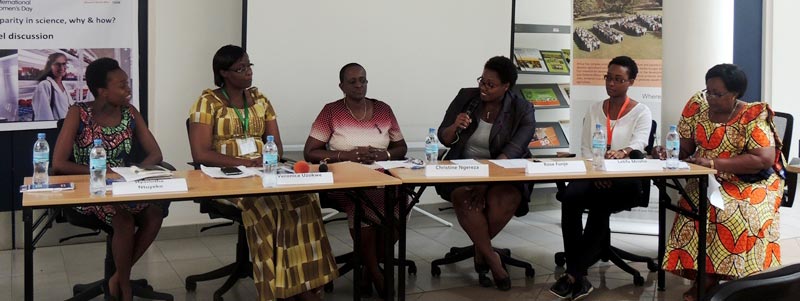 It is the second year that the hub has marked the International Women’s Day with the full support of its Director Victor Manyong, who ensured that resources were available for the event.
The event brought together an impressive lineup of women working in various science fields to share their experiences. The panel consisted of staff and partners at the hub as well as students from nearby secondary schools, the University of Dar es Salaam, and the media.
The panelists included Christine Ngereza, a Senior Curator of Invertebrate Zoology at the National Museum of Tanzania; Latifa Mrisho, a PhD student from the University of Dar es Salaam/University of Lund conducting research on cassava whitefly at IITA; and Veronica Uzokwe, an Agronomist with the SARD-SC project led by IITA.
Other panelists were Rose Funja, Founder and Managing Director, Agrinfo; and Hyasintha Ntuyeko, Founder and Managing Director, Kasole Secrets, both Mandela Washington Fellows for 2014 and 2015, respectively. Regina Kapinga, IITA’s Head of Advocacy and Resource Mobilization gave a talk on “Beyond the scientist’s desk” on her charity work with Mission Africa which she said was going to launch a scholarship program for women in science.
Catherinerose Barreto, a Human Resources expert and Co-Founder of Kinu Group Ltd, and an Aspen-African Leadership Initiative Fellow, gave a brief career talk to the young audience.
“IITA is very committed to supporting efforts towards gender parity and in particular in science and research where the representation by women is still very low”, said Edward Kanju, while officially welcoming the participants to the event on behalf of the hub director, Victor Manyong.
“Although there has been a lot of improvement and more and more women are coming into science and research, we are still not at 50:50. Therefore a lot still needs to be done to encourage women to pursue science careers as well as address the challenges they face,” he added.
Rose Shayo, a senior lecturer at the University of Dar es Salaam, noted that efforts to achieve gender parity by 2030 need to start in the education sector where girls should be encouraged to stay in school and to take up sciences.
“In the lower classes we find that there is gender parity―the ratio of girls to boys is nearly one. However, as they grow
older, there are more boys as the girls drop out for various reasons and this difference is even higher in science subjects,” she said.
The panelists and participants all agreed that it was possible to have a 50:50 representation of men and women in science if there was commitment and good will from all the stakeholders starting from policymakers, the education system, the employment sector, and the determination and effort by the women themselves to take up opportunities offered.
They also took the parity pledge to support efforts towards having 50:50 representation in all spheres by 2030.
“Women need to have confidence in themselves and be prepared to grab any opportunities that come their way,” said Veronica Uzokwe, IITA Agronomist.
“Always learn to fight, and just run for it; nothing comes easy; science is for both boys and girls. With our own effort and support we shall make gender parity feasible!” said Latifa Mrisho.
This was echoed by Sabrina Hassan, a Form Four student at Jangwani Secondary school: “To achieve gender parity we girls must fight for it. Nothing will come to us when we laze around. We must wake up. Women are capable and can do science just as well as men, if not better. Gender parity is possible.”
The event was well appreciated especially by the students who said they rarely had such opportunities to meet and interact with other professionals. This was the second such event to be held at the hub.
It is the second year that the hub has marked the International Women’s Day with the full support of its Director Victor Manyong, who ensured that resources were available for the event.
The event brought together an impressive lineup of women working in various science fields to share their experiences. The panel consisted of staff and partners at the hub as well as students from nearby secondary schools, the University of Dar es Salaam, and the media.
The panelists included Christine Ngereza, a Senior Curator of Invertebrate Zoology at the National Museum of Tanzania; Latifa Mrisho, a PhD student from the University of Dar es Salaam/University of Lund conducting research on cassava whitefly at IITA; and Veronica Uzokwe, an Agronomist with the SARD-SC project led by IITA.
Other panelists were Rose Funja, Founder and Managing Director, Agrinfo; and Hyasintha Ntuyeko, Founder and Managing Director, Kasole Secrets, both Mandela Washington Fellows for 2014 and 2015, respectively. Regina Kapinga, IITA’s Head of Advocacy and Resource Mobilization gave a talk on “Beyond the scientist’s desk” on her charity work with Mission Africa which she said was going to launch a scholarship program for women in science.
Catherinerose Barreto, a Human Resources expert and Co-Founder of Kinu Group Ltd, and an Aspen-African Leadership Initiative Fellow, gave a brief career talk to the young audience.
“IITA is very committed to supporting efforts towards gender parity and in particular in science and research where the representation by women is still very low”, said Edward Kanju, while officially welcoming the participants to the event on behalf of the hub director, Victor Manyong.
“Although there has been a lot of improvement and more and more women are coming into science and research, we are still not at 50:50. Therefore a lot still needs to be done to encourage women to pursue science careers as well as address the challenges they face,” he added.
Rose Shayo, a senior lecturer at the University of Dar es Salaam, noted that efforts to achieve gender parity by 2030 need to start in the education sector where girls should be encouraged to stay in school and to take up sciences.
“In the lower classes we find that there is gender parity―the ratio of girls to boys is nearly one. However, as they grow
older, there are more boys as the girls drop out for various reasons and this difference is even higher in science subjects,” she said.
The panelists and participants all agreed that it was possible to have a 50:50 representation of men and women in science if there was commitment and good will from all the stakeholders starting from policymakers, the education system, the employment sector, and the determination and effort by the women themselves to take up opportunities offered.
They also took the parity pledge to support efforts towards having 50:50 representation in all spheres by 2030.
“Women need to have confidence in themselves and be prepared to grab any opportunities that come their way,” said Veronica Uzokwe, IITA Agronomist.
“Always learn to fight, and just run for it; nothing comes easy; science is for both boys and girls. With our own effort and support we shall make gender parity feasible!” said Latifa Mrisho.
This was echoed by Sabrina Hassan, a Form Four student at Jangwani Secondary school: “To achieve gender parity we girls must fight for it. Nothing will come to us when we laze around. We must wake up. Women are capable and can do science just as well as men, if not better. Gender parity is possible.”
The event was well appreciated especially by the students who said they rarely had such opportunities to meet and interact with other professionals. This was the second such event to be held at the hub.
A powerhouse of women panelists talk about gender parity.
Contributed by
Recent stories
No items found