
IITA NEWS

Key international forum on plant viral diseases kicks off in Arusha, Tanzania
January 28, 2013

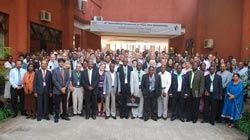
Image of international forumThe 12th International Plant Virus Epidemiology (IPVE) symposium with the theme “Evolution, Ecology and Control of Plant Viruses,” started on the 28th January, bringing together over 200 scientists and leading experts on plant viruses from 40 countries all around the world.

Dr Lava Kumar, a virologist with the International Institute of Tropical Agriculture (IITA) and chair of the 12th IPVE Symposium said in the next five days the delegates will share experiences and the latest knowledge and technologies to control plant viruses and mull over a global strategy to combat emerging and reemerging plant virus diseases. They will especially focus on Africa.

“The event is very special as it is taking place in Africa for the first time and will therefore devote a lot of time to explore the key challenges facing the continent in tackling the key viral diseases to increase agricultural productivity, food availability, and economic development,” said Kumar.

Dr Elly Kafiriti, the Director of the Naliendele Research Institute, while officially opening the event, noted the negative impact of plant viruses on food security in the continent where they were fueled by poor agronomic practices of resource-poor small-holder farmers.

Dr Kafiriti, representing Dr Fidelis Myaka, the Director for Research and Development at the Ministry of Agriculture, Food Security and Cooperatives (MAFC), said the Tanzanian government is supportive of all efforts aimed at finding solutions to control plant viruses in the country to improve food security and especially research which provides knowledge and information to policymakers for informed decision making.

He pointed out the examples of the Cassava Brown Streak Disease (CBSD) and Cassava Mosaic Disease (CMD) which were spreading to new areas in Eastern Africa, ravaging the crop and affecting food security.

Dr Nteranya Sanginga, Director General, IITA, also speaking at the forum, noted that Africa was changing for the better and so was its leadership. Its future is thus looking bright. However, he said there were a number of challenges that need to be addressed including viral diseases of staple crops such as cassava, banana, and maize using advances in science.

He said cassava is going to be the crop of the future for Africa, noting that it is not just a food security crop but that it holds immense potential as an income earner as it is a source of industrial raw materials such as glucose and starch.

“Cassava production is picking up – in Nigeria, in Malawi, in Rw anda, and Tanzania. Countries are changing from overreliance on maize. The future of this crop in the continent is bright. However, it faces many challenges including the two viral diseases that are a headache to our farmers and policymakers,” he said. “We need science to solve these problems.”

Sanginga also emphasized the need to invest in building the capacity of young researchers for the future and said the symposium provided a great opportunity for young scientists and students to learn and interact with experienced researchers from all over the world.

Other speakers included Dr Joseph Nduguru from the Mikocheni Agricultural Research Institute (MARI), also one of the conference organizers. He said that researchers of plant diseases still had a lot of challenges ahead of them as diseases were spreading.

“We have more to do for the farmers I met at Mukono, Ug anda, who lost their entire cassava crop due to CBSD and CMD…more to do for farmers of Kenya, Tanzania, and Ug anda who are threatened by Maize Lethal Necrosis Disease,” he added.

Plant viruses are among the major factors that affect productivity and cause vast economic losses to staple crops in Africa and other developing regions across the tropics. Furthermore, new viruses, new strains of existing viruses, along with changing contexts due to agricultural intensification and climate change are creating new challenges and dem anding even greater effort to find novel, effective ways to tackle virus disease problems.

The meeting is co-organized by IITA, MARI Tanzania, the National Agricultural Research Organization (NARO) of Ug anda, AVRDC—The World Vegetable Center in Arusha, and CORAF under the auspices of the International Committee on Plant Virus Epidemiology (ICPVE).

The IPVE is a specialist committee on plant virus epidemiology of the International Society of Plant Pathology (ISPP). The IPVE Committee has previously conducted 11 international symposia in different parts of the world.

###

About IITA (www.iita.org)
Africa has complex problems that plague agriculture and people’s lives. We develop agricultural solutions with our partners to tackle hunger and poverty. Our award winning research for development (R4D) is based on focused, authoritative thinking anchored on the development needs of sub-Saharan Africa. We work with partners in Africa and beyond to reduce producer and consumer risks, enhance crop quality and productivity, and generate wealth from agriculture. IITA is an international non-profit R4D organization established in 1967, governed by a Board of Trustees, and supported primarily by CGIAR.

CGIAR is a global agriculture research partnership for a food secure future. Its science is carried out by the 15 research centers who are members of the CGIAR Consortium in collaboration with hundreds of partner organizations. www.cgiar.org

For more information, contact:

P. Lava Kumar at l.kumar@cgiar.org
Catherine Njuguna at c.njuguna@cgiar.org
www.iita.org/web/ipve


Contributed by

Recent stories

No items found

Leave a Reply

Your email address will not be published. Required fields are marked *

Scroll to Top
Olaosebikan, Olamide

Olamide Deborah Nwanze is a Senior Research Associate specializing in gender mainstreaming research to inform participatory and inclusive breeding, variety development, and seed systems policies regarding root, tuber, and banana (RTB) crops in the International Institute of Tropical Agriculture Headquarters, Ibadan, Nigeria. She is a PhD candidate at the University of Ibadan and holds an MSc and B. Agric in Agricultural Extension and Rural Development. Olamide is a fellow of the African Women in Agricultural Research and Development – Gender Responsive Agricultural Systems Policy (AWARD-GRASP) and the Gender Responsive Researchers Equipped for Agricultural Transformation (GREAT). She seeks to apply her gender-mainstreaming learnings, gender-responsive research, and policy development, and review expertise to facilitate women, youth, children, and vulnerable social group’s access to and adoption of agricultural Innovations that guarantee food, nutrition, income, and livelihood security in Africa. Her current roles include mentoring research fellows, development of guides and training manuals, implementation and adaptation of gender frameworks and tools, value chain actors’ engagement as citizen science partners, policy review and redesign, data management, and analysis. Her current research explores mixed methods and participatory and interdisciplinary approaches to capture and highlight gender dynamics, needs, preferences, and challenges stakeholders face within the agricultural livelihood value chain to prioritize gender-inclusive strategies in breeding programs, policy design, and implementation.

At IITA, she contributes to the implementation of the CGIAR Accelerated Breeding Initiative and Genetic Innovation Programs; participatory and gender research within the NextGen CassavaHarvestPlusRTBFoods, and Tricot-ClimMob 1000Farms Projects; and gender knowledge communication via the G-LENS webinar series, video documentary, policy briefspublications, and blogs.


Recent publications

de Sousa, K., van Etten, J., Manners, R. Bello, A., Teeken, B., Olaosebikan, O., et al. 2024. The tricot approach: an agile framework for decentralized on-farm testing supported by citizen science. A retrospective. Agron. Sustain. Dev. 44, 8. https://doi.org/10.1007/s13593-023-00937-1

Madu, T., Onwuka, S., Nwafor, S., Onyemauwa, N., Ejechi, M., Ofoeze, M., Ukeje, B., Eluagu, C., Olaosebikan, O., Okoye, B., 2024. Gender-Inclusive Consumer Studies Improve Cassava Breeding in Nigeria in: Frontiers in Sociology, volume 9, number: 1224504, doi: 10.3389/fsoc.2024.1224504

Olaosebikan, O.; Bello, A.; Utoblo, O.; Okoye, B.; Olutegbe, N.; Garner, E.; Teeken, B.; Bryan, E.; Forsythe, L.; Cole, S.; Madu, T. 2023.  Stressors and Resilience within the Cassava Value Chain in Nigeria: Preferred Cassava Variety Traits and Response Strategies of Men and Women to Inform Breeding. Sustainability 15, 7837. https://doi.org/10.3390/su15107837

Okoye, B., Ofoeze, M., Ejechi, M., Onwuka, S., Nwafor, S., Onyemauwa, N., Ukeje, B., Eluagu, C., Obidiegwu, J.*, Olaosebikan, O., Madu, T.* 2023. Prioritizing preferred traits in the yam value chain in Nigeria: a gender situation analysis in: Frontiers in Sociology, volume 8, number: 1232626, pages 1 – 9, ISSN 2297-7775, 2023. https://www.frontiersin.org/articles/10.3389/fsoc.2023.1232626/full

Olaosebikan, O., Bello, A. A., de Sousa, K., Ndjouenkeu, R., Adesokan, M., Alamu, E. O., Agbona, A., van Etten, J., Kegah, F. N.*, Dufour, D., Bouniol, A., Teeken, B. 2023. Consumer acceptability of cassava gari-eba food products across cultural and environmental settings using the triadic comparison of technologies approach (tricot) in: Journal of the Science of Food and Agriculture,

Teeken, B., Olaosebikan, O., Bello, A. A., Madu, T.*, Cole, S. M. 2023. Qualitative assessment on the positionality and preferences of dyads in relation to cassava-related activities: working with tricot trial citizen scientists https://hdl.handle.net/10568/138326 Type: Manual

Bouniol, A., Ceballos, H., Bello, A. A., Teeken, B., Olaosebikan, O., Owoade, D., Agbona, A., Fotso Kuate, A., Madu, T.*, Okoye, B.*, Ofoeze, M.*, Nwafor, S.*, Onyemauwa, N.*, Adinsi, L.*, Forsythe, L., Dufour, D. 2023. Varietal impact on women’s labour, workload and related drudgery in processing root, tuber and banana crops: focus on cassava in sub-Saharan Africa in: Journal of the Science of Food and Agriculture, pages 1 – 25, ISSN 0022-5142,

Bello, A. A., Agbona, A., Olaosebikan, O., Edughaen, G., Dufour, D., Bouniol, A., Iluebbey, P., Ndjouenkeu, R.*, Rabbi, I. Y., Teeken, B. 2023. Genetic and environmental effects on processing productivity and food product yield: drudgery of women’s work in: Journal of the Science of Food and Agriculture, pages 1 – 32, ISSN 0022-5142, 5

Cavicchioli, M., Zimbiti, T., Teeken, B., Nwanze, D.O., Liani, M., Parkes, E. & Bello, A. 2023. IITA-Gender Responsive Breeding Training Report. Genetic Resources Center, IITA-HQ, Ibadan, 21-23 September, 2022. Ibadan, Nigeria: IITA, (34 p.).https://hdl.handle.net/10568/131368

Agbona, A. Peteti P., Teeken B., Olaosebikan O. Bello, A. A., Parkes, E., Rabbi, I. Y., Mueller, L., Egesi, C., Kulakow, P. 2022. Data Management in Multi-disciplinary African RTB Crop Breeding Programs. In: Williamson, H.F., Leonelli, S. (eds) Towards Responsible Plant Data Linkage: Data Challenges for Agricultural Research and Development. Springer, Cham. https://doi.org/10.1007/978-3-031-13276-6_5

Lora Forsythe, Pricilla Marimo, Sarah Mayanja, Olamide D. Olaosebikan, Esme Stuart, Bela Teeken, Benjamin Okoye, Tessy Madu, (2021). Cross-product Gender Analysis of RTBfoods Step 2 Gendered Food Mapping on RTB Products. Understanding the Drivers of Trait Preferences and the Development of Multi-user RTB Product Profiles, WP1. London, UK: RTBfoods Field Scientific Report, 30 p.

Teeken, B., Garner, E., Agbona, A., Balogun, I., Olaosebikan, O., Bello, A., Madu, T., Okoye, B., Egesi, C., Kulakow, P. and Tufan, H.A. 2021. Beyond “Women’s Traits”: Exploring How Gender, Social Difference, and Household Characteristics Influence Trait Preferences. Frontiers Sustainable Food Systems 5:740926. https://doi.org/10.3389/fsufs.2021.740926

Teeken, B., Agbona, A., Bello, A., Olaosebikan, O., Alamu, E., Adesokan, M., Awoyale, W., Madu, T., Okoye, B., Chijioke, U., Owoade, D., Okoro, M., Bouniol, A., Dufour, D., Hershey, C., Rabbi, I., Maziya‐Dixon, B., Egesi, C., Tufan, H. and Kulakow, P. (020. Understanding cassava varietal preferences through pairwise ranking of gari‐eba and fufu prepared by local farmer–processors. Int J Food Sci Technol. https://doi.org/10.1111/ijfs.14862

Bela Teeken, Olamide Olaosebikan, Ireti Balogun, Benjamin Okoye, Tessy Madu, Steven Cole, Abolore Bello, Elizabeth Parkes. (2020). Piloting the G+ customer and product profile tools for gender-responsive cassava breeding in Nigeria. Nigeria: International Institute of Tropical Agriculture (IITA). https://hdl.handle.net/20.500.11766/13000