
IITA NEWS

Leveraging social media to drive agricultural research and achieve digital milestones
December 13, 2024

In a world where digital platforms are reshaping communication and knowledge dissemination, IITACGIAR is a beacon of innovation scaling, and leveraging social media for agricultural transformation. By strategically utilizing these platforms, IITA has brought its research closer to the people it serves and achieved remarkable milestones that affirm its digital leadership. 

Social media platforms with IITA's presence.
Social media platforms with IITA’s presence.

Social media has become a vital tool for breaking barriers in research communication, providing a direct line to diverse audiences, including farmers, policymakers, scientists, donors, and the general public. For IITA, it is a vehicle for showcasing innovations, sharing success stories, advocating for agricultural policies, and engaging stakeholders across the globe. By tapping into the interactive and visual nature of platforms like LinkedIn, Flickr, YouTube, X (formerly Twitter), and Instagram, IITA ensures that its work resonates with audiences far beyond traditional boundaries. 

With consistent and strategic efforts, IITA has reached significant milestones that underscore its impact in the digital space for agricultural research. 

IITA’s Flickr account, a treasure trove of vivid imagery, captures the essence of agricultural research—from the trials in the field to the triumphs of innovation. With over 10 million views, these images have documented the institute’s activities and inspired global audiences with the beauty and importance of agricultural research. 

The research institute’s LinkedIn account, with over 140,000 followers, is a space for researchers and agriculture professionals worldwide who are seeking agricultural science and research knowledge.  

IITA’s YouTube channel is a virtual hub of engaging video content, including documentaries, farmer success stories, research findings, and expert interviews. With 1 million views, the channel serves as an educational resource, empowering farmers, students, and researchers with actionable information.  

On X, IITA leads critical conversations about food security, climate change, and agricultural innovation. The 62,000 followers on X receive timely updates, thought-provoking insights, and real-time event coverage. IITA fosters dialogue among key stakeholders and partners in global agriculture on X.  

With close to 7,000 followers on Instagram, IITA’s Instagram account deploys visually compelling content to appeal to younger audiences and those new to agriculture. The platform highlights stories of resilience, the role of youth in agriculture, and the institute’s community impact, fostering a deeper connection with its followers. 

Using visual storytelling by focusing on compelling images and videos, IITA’s social media strategy is rooted in principles like knowledge sharing, engagement, and real-time advocacy. 
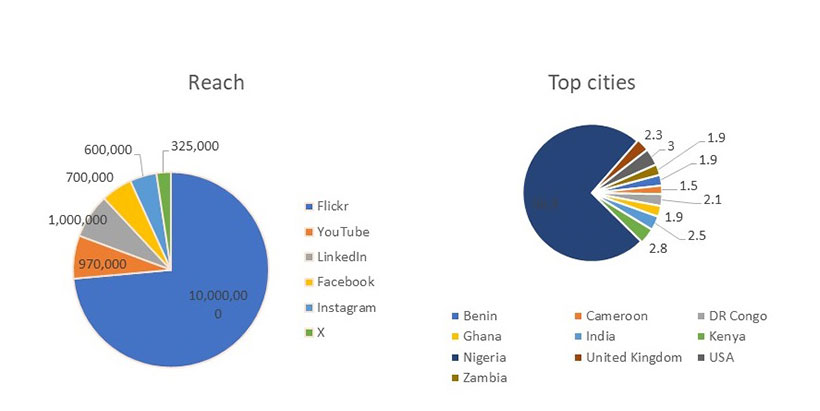
Data showing IITA's milestones on social media.
Data showing IITA’s milestones on social media.

IITA captures the attention of a wide audience across Africa, America, Asia, and Europe, conveying complex research outcomes in relatable ways. Platforms like Flickr, Instagram, and YouTube have been particularly instrumental in this approach. 

Platforms like X provide avenues for disseminating actionable knowledge. Whether a video on climate-smart farming practices or a thread unpacking the latest research, IITA ensures its content is informative and impactful. 

From scientists to farmers and young aspiring agriculturists, IITA tailors content to meet the needs of various audience segments, ensuring inclusivity and relevance. 

During global events like World Food Day or International Women’s Day, IITA’s social media campaigns amplify critical issues and advocate for sustainable solutions, further solidifying its role as a thought leader. 

With these strategies, IITA’s social media efforts have increased its visibility and strengthened partnerships and collaborations. By showcasing success stories and ongoing projects, IITA attracts the attention of donors, development agencies, and governments, facilitating impactful collaborations that drive agricultural transformation across the continent. 

As the digital landscape evolves, IITA is poised to adopt emerging trends to further its mission. Initiatives on the horizon would include leveraging platforms like TikTok and Instagram reels to share quick, digestible content tailored for younger audiences; hosting X Spaces, webinars, and virtual tours to create immersive experiences for its audience; and utilizing AI tools to personalize content and measure impact. All of these will ensure that IITA’s social media strategy remains data-driven and effective. 

IITA’s social media journey is evidence of digital platforms’ power in advancing agricultural research and fostering global connections. As the institute continues to innovate, it invites everyone to join the movement by following its social media channels. Together, we can amplify the impact of agricultural research and cultivate a better future for Africa. 

Contributed by ’Timilehin Osunde 


Contributed by

Recent stories

No items found

Leave a Reply

Your email address will not be published. Required fields are marked *

Scroll to Top
Olaosebikan, Olamide

Olamide Deborah Nwanze is a Senior Research Associate specializing in gender mainstreaming research to inform participatory and inclusive breeding, variety development, and seed systems policies regarding root, tuber, and banana (RTB) crops in the International Institute of Tropical Agriculture Headquarters, Ibadan, Nigeria. She is a PhD candidate at the University of Ibadan and holds an MSc and B. Agric in Agricultural Extension and Rural Development. Olamide is a fellow of the African Women in Agricultural Research and Development – Gender Responsive Agricultural Systems Policy (AWARD-GRASP) and the Gender Responsive Researchers Equipped for Agricultural Transformation (GREAT). She seeks to apply her gender-mainstreaming learnings, gender-responsive research, and policy development, and review expertise to facilitate women, youth, children, and vulnerable social group’s access to and adoption of agricultural Innovations that guarantee food, nutrition, income, and livelihood security in Africa. Her current roles include mentoring research fellows, development of guides and training manuals, implementation and adaptation of gender frameworks and tools, value chain actors’ engagement as citizen science partners, policy review and redesign, data management, and analysis. Her current research explores mixed methods and participatory and interdisciplinary approaches to capture and highlight gender dynamics, needs, preferences, and challenges stakeholders face within the agricultural livelihood value chain to prioritize gender-inclusive strategies in breeding programs, policy design, and implementation.

At IITA, she contributes to the implementation of the CGIAR Accelerated Breeding Initiative and Genetic Innovation Programs; participatory and gender research within the NextGen CassavaHarvestPlusRTBFoods, and Tricot-ClimMob 1000Farms Projects; and gender knowledge communication via the G-LENS webinar series, video documentary, policy briefspublications, and blogs.


Recent publications

de Sousa, K., van Etten, J., Manners, R. Bello, A., Teeken, B., Olaosebikan, O., et al. 2024. The tricot approach: an agile framework for decentralized on-farm testing supported by citizen science. A retrospective. Agron. Sustain. Dev. 44, 8. https://doi.org/10.1007/s13593-023-00937-1

Madu, T., Onwuka, S., Nwafor, S., Onyemauwa, N., Ejechi, M., Ofoeze, M., Ukeje, B., Eluagu, C., Olaosebikan, O., Okoye, B., 2024. Gender-Inclusive Consumer Studies Improve Cassava Breeding in Nigeria in: Frontiers in Sociology, volume 9, number: 1224504, doi: 10.3389/fsoc.2024.1224504

Olaosebikan, O.; Bello, A.; Utoblo, O.; Okoye, B.; Olutegbe, N.; Garner, E.; Teeken, B.; Bryan, E.; Forsythe, L.; Cole, S.; Madu, T. 2023.  Stressors and Resilience within the Cassava Value Chain in Nigeria: Preferred Cassava Variety Traits and Response Strategies of Men and Women to Inform Breeding. Sustainability 15, 7837. https://doi.org/10.3390/su15107837

Okoye, B., Ofoeze, M., Ejechi, M., Onwuka, S., Nwafor, S., Onyemauwa, N., Ukeje, B., Eluagu, C., Obidiegwu, J.*, Olaosebikan, O., Madu, T.* 2023. Prioritizing preferred traits in the yam value chain in Nigeria: a gender situation analysis in: Frontiers in Sociology, volume 8, number: 1232626, pages 1 – 9, ISSN 2297-7775, 2023. https://www.frontiersin.org/articles/10.3389/fsoc.2023.1232626/full

Olaosebikan, O., Bello, A. A., de Sousa, K., Ndjouenkeu, R., Adesokan, M., Alamu, E. O., Agbona, A., van Etten, J., Kegah, F. N.*, Dufour, D., Bouniol, A., Teeken, B. 2023. Consumer acceptability of cassava gari-eba food products across cultural and environmental settings using the triadic comparison of technologies approach (tricot) in: Journal of the Science of Food and Agriculture,

Teeken, B., Olaosebikan, O., Bello, A. A., Madu, T.*, Cole, S. M. 2023. Qualitative assessment on the positionality and preferences of dyads in relation to cassava-related activities: working with tricot trial citizen scientists https://hdl.handle.net/10568/138326 Type: Manual

Bouniol, A., Ceballos, H., Bello, A. A., Teeken, B., Olaosebikan, O., Owoade, D., Agbona, A., Fotso Kuate, A., Madu, T.*, Okoye, B.*, Ofoeze, M.*, Nwafor, S.*, Onyemauwa, N.*, Adinsi, L.*, Forsythe, L., Dufour, D. 2023. Varietal impact on women’s labour, workload and related drudgery in processing root, tuber and banana crops: focus on cassava in sub-Saharan Africa in: Journal of the Science of Food and Agriculture, pages 1 – 25, ISSN 0022-5142,

Bello, A. A., Agbona, A., Olaosebikan, O., Edughaen, G., Dufour, D., Bouniol, A., Iluebbey, P., Ndjouenkeu, R.*, Rabbi, I. Y., Teeken, B. 2023. Genetic and environmental effects on processing productivity and food product yield: drudgery of women’s work in: Journal of the Science of Food and Agriculture, pages 1 – 32, ISSN 0022-5142, 5

Cavicchioli, M., Zimbiti, T., Teeken, B., Nwanze, D.O., Liani, M., Parkes, E. & Bello, A. 2023. IITA-Gender Responsive Breeding Training Report. Genetic Resources Center, IITA-HQ, Ibadan, 21-23 September, 2022. Ibadan, Nigeria: IITA, (34 p.).https://hdl.handle.net/10568/131368

Agbona, A. Peteti P., Teeken B., Olaosebikan O. Bello, A. A., Parkes, E., Rabbi, I. Y., Mueller, L., Egesi, C., Kulakow, P. 2022. Data Management in Multi-disciplinary African RTB Crop Breeding Programs. In: Williamson, H.F., Leonelli, S. (eds) Towards Responsible Plant Data Linkage: Data Challenges for Agricultural Research and Development. Springer, Cham. https://doi.org/10.1007/978-3-031-13276-6_5

Lora Forsythe, Pricilla Marimo, Sarah Mayanja, Olamide D. Olaosebikan, Esme Stuart, Bela Teeken, Benjamin Okoye, Tessy Madu, (2021). Cross-product Gender Analysis of RTBfoods Step 2 Gendered Food Mapping on RTB Products. Understanding the Drivers of Trait Preferences and the Development of Multi-user RTB Product Profiles, WP1. London, UK: RTBfoods Field Scientific Report, 30 p.

Teeken, B., Garner, E., Agbona, A., Balogun, I., Olaosebikan, O., Bello, A., Madu, T., Okoye, B., Egesi, C., Kulakow, P. and Tufan, H.A. 2021. Beyond “Women’s Traits”: Exploring How Gender, Social Difference, and Household Characteristics Influence Trait Preferences. Frontiers Sustainable Food Systems 5:740926. https://doi.org/10.3389/fsufs.2021.740926

Teeken, B., Agbona, A., Bello, A., Olaosebikan, O., Alamu, E., Adesokan, M., Awoyale, W., Madu, T., Okoye, B., Chijioke, U., Owoade, D., Okoro, M., Bouniol, A., Dufour, D., Hershey, C., Rabbi, I., Maziya‐Dixon, B., Egesi, C., Tufan, H. and Kulakow, P. (020. Understanding cassava varietal preferences through pairwise ranking of gari‐eba and fufu prepared by local farmer–processors. Int J Food Sci Technol. https://doi.org/10.1111/ijfs.14862

Bela Teeken, Olamide Olaosebikan, Ireti Balogun, Benjamin Okoye, Tessy Madu, Steven Cole, Abolore Bello, Elizabeth Parkes. (2020). Piloting the G+ customer and product profile tools for gender-responsive cassava breeding in Nigeria. Nigeria: International Institute of Tropical Agriculture (IITA). https://hdl.handle.net/20.500.11766/13000