
IITA NEWS

Major breakthrough for farmers and scientists as Nigerian biotech body approves commercial release of genetically modified cowpea
February 9, 2019

Following more than two decades of research, field trials, and risk assessment by multiple organizations, on 29 January, the Nigerian Biosafety Management Agency (NBMA) approved the commercial release of the resulting genetically modified cowpea to farmers in Nigeria. This places the country on the path to becoming the first country ever to cultivate biotech cowpea. This development adds a new crop to the global biotech basket from Africa.
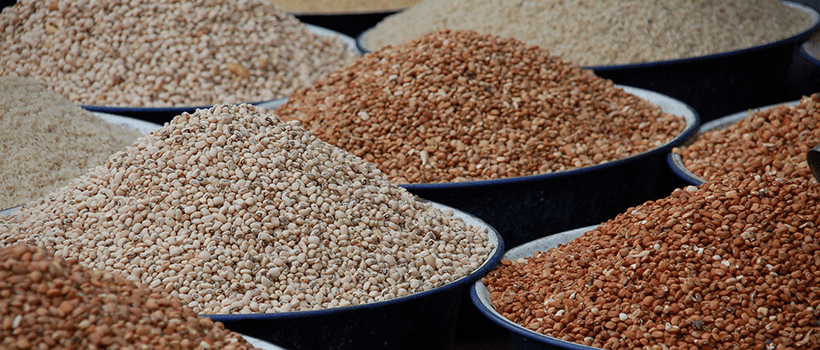
A selection of cowpea varieties.

NBMA’s approval allows the Institute for Agricultural Research (IAR) to commercially release Pod Borer-Resistant Cowpea (PBR Cowpea)-event AAT709A, genetically improved to resist Maruca vitrata. This permit is valid until the end of 2022. The release provides a relief to millions of Nigerian farmers who depend on cowpea for food and income, as well as the consumers of cowpea.

Leena Tripathi, IITA Principal Scientist in Plant Biotechnology, expressed delight stating, “This is indeed good news for IITA and Nigeria at large, as the first GM food crop will be available for commercialization.”

Cowpea is an important staple crop in sub-Saharan Africa, serving human consumption needs as well as being a good source of quality fodder for livestock. However, cowpea farmers face a challenge with a traditionally low yield factor due to its susceptibility to many insect pests at different stages of its production lifecycle. As a result, if farmers want to get a good yield they need to apply multiple insecticide sprays during the course of the production in the fields.

One of the most damaging insect pests that attack the cowpea plant is the Maruca vitrata, commonly called the maruca pod borer, which causes 70–90% yield loss for farmers. Due to high costs and, sometimes, unavailability of suitable insecticides, many cowpea farmers resort to harmful cotton insecticides to spray cowpea fields. This has unfortunately led to significant numbers of intoxication and deaths.

IITA, which has cowpea as one of its m andate crops, along with other research partners, decided to focus on developing an improved cowpea variety that would be resistant to maruca. To achieve this, more than 15,000 cowpea varieties in the IITA germplasm bank were evaluated for resistance to maruca.

Giving an overview on the project, IITA Legume Geneticist and Breeder Christian Fatokun stated that the researchers also evaluated wild relatives of cowpea and although a gene from one of the species called Vigna vexillata was identified to be resistant to maruca, crossing this to cowpea proved unsuccessful.

With the lack of success of conventional breeding for resistance, the collaborators on the project decided to adopt a biotech approach that would result in genetically modified cowpea.

Previous research using a bacterium called Bacillus thuringiensis (Bt) to confer resistance in maize crops had proved quite successful and some of the Bt gene strains have been found to be resistant to maruca.

With genes provided by Monsanto and initial phases of product development conducted at the Commonwealth Scientific and Industrial Research Organisation (CSIRO) in Australia, significant milestones were achieved in developing cowpea lines expressing the Bt (Cry1Ab) gene that confers resistance to maruca pests. The successes graduated to confined field trials (CFT) which were conducted successfully at IAR in Zaria, Nigeria.

Results from the research have shown that Bt cowpea will reduce the use of pesticides from eight sprays per season to about two targeted sprays and increase yield by up to 20%. This means that Nigeria will record a revenue increase of more than ₦48 billion (US$132 million) annually from cowpea. Extensive safety studies have shown that the Bt cowpea is safe for both human and livestock consumption.

The research was led by IAR in partnership with the African Agricultural Technology Foundation (AATF) to which Monsanto licensed the Bt gene for use in the project. Other collaborators include Purdue University, USA, CSIRO, Australia, Network for Genetic Improvement of Cowpea for Africa (NGICA), the IFPRI-facilitated Program for Biosafety Systems (PBS), and IITA with support from United States Agency for International Development (USAID).

In a document dated 22 January 2019, NBMA stated that it issued the permit after taking into consideration the advice of National Biosafety Committee, National Biosafety Technical subcommittee, and the risk assessment and risk management report provided by IAR. “After a thorough analysis of the application dossier which included Risk Assessment and Risk Management Plan prepared in connection with assessment of the application, it is unlikely that the proposed release will have an adverse impact on the environment and human health,” read part of the document.


Contributed by

Related news

No items found

Leave a Reply

Your email address will not be published. Required fields are marked *

Scroll to Top
Olaosebikan, Olamide

Olamide Deborah Nwanze is a Senior Research Associate specializing in gender mainstreaming research to inform participatory and inclusive breeding, variety development, and seed systems policies regarding root, tuber, and banana (RTB) crops in the International Institute of Tropical Agriculture Headquarters, Ibadan, Nigeria. She is a PhD candidate at the University of Ibadan and holds an MSc and B. Agric in Agricultural Extension and Rural Development. Olamide is a fellow of the African Women in Agricultural Research and Development – Gender Responsive Agricultural Systems Policy (AWARD-GRASP) and the Gender Responsive Researchers Equipped for Agricultural Transformation (GREAT). She seeks to apply her gender-mainstreaming learnings, gender-responsive research, and policy development, and review expertise to facilitate women, youth, children, and vulnerable social group’s access to and adoption of agricultural Innovations that guarantee food, nutrition, income, and livelihood security in Africa. Her current roles include mentoring research fellows, development of guides and training manuals, implementation and adaptation of gender frameworks and tools, value chain actors’ engagement as citizen science partners, policy review and redesign, data management, and analysis. Her current research explores mixed methods and participatory and interdisciplinary approaches to capture and highlight gender dynamics, needs, preferences, and challenges stakeholders face within the agricultural livelihood value chain to prioritize gender-inclusive strategies in breeding programs, policy design, and implementation.

At IITA, she contributes to the implementation of the CGIAR Accelerated Breeding Initiative and Genetic Innovation Programs; participatory and gender research within the NextGen CassavaHarvestPlusRTBFoods, and Tricot-ClimMob 1000Farms Projects; and gender knowledge communication via the G-LENS webinar series, video documentary, policy briefspublications, and blogs.


Recent publications

de Sousa, K., van Etten, J., Manners, R. Bello, A., Teeken, B., Olaosebikan, O., et al. 2024. The tricot approach: an agile framework for decentralized on-farm testing supported by citizen science. A retrospective. Agron. Sustain. Dev. 44, 8. https://doi.org/10.1007/s13593-023-00937-1

Madu, T., Onwuka, S., Nwafor, S., Onyemauwa, N., Ejechi, M., Ofoeze, M., Ukeje, B., Eluagu, C., Olaosebikan, O., Okoye, B., 2024. Gender-Inclusive Consumer Studies Improve Cassava Breeding in Nigeria in: Frontiers in Sociology, volume 9, number: 1224504, doi: 10.3389/fsoc.2024.1224504

Olaosebikan, O.; Bello, A.; Utoblo, O.; Okoye, B.; Olutegbe, N.; Garner, E.; Teeken, B.; Bryan, E.; Forsythe, L.; Cole, S.; Madu, T. 2023.  Stressors and Resilience within the Cassava Value Chain in Nigeria: Preferred Cassava Variety Traits and Response Strategies of Men and Women to Inform Breeding. Sustainability 15, 7837. https://doi.org/10.3390/su15107837

Okoye, B., Ofoeze, M., Ejechi, M., Onwuka, S., Nwafor, S., Onyemauwa, N., Ukeje, B., Eluagu, C., Obidiegwu, J.*, Olaosebikan, O., Madu, T.* 2023. Prioritizing preferred traits in the yam value chain in Nigeria: a gender situation analysis in: Frontiers in Sociology, volume 8, number: 1232626, pages 1 – 9, ISSN 2297-7775, 2023. https://www.frontiersin.org/articles/10.3389/fsoc.2023.1232626/full

Olaosebikan, O., Bello, A. A., de Sousa, K., Ndjouenkeu, R., Adesokan, M., Alamu, E. O., Agbona, A., van Etten, J., Kegah, F. N.*, Dufour, D., Bouniol, A., Teeken, B. 2023. Consumer acceptability of cassava gari-eba food products across cultural and environmental settings using the triadic comparison of technologies approach (tricot) in: Journal of the Science of Food and Agriculture,

Teeken, B., Olaosebikan, O., Bello, A. A., Madu, T.*, Cole, S. M. 2023. Qualitative assessment on the positionality and preferences of dyads in relation to cassava-related activities: working with tricot trial citizen scientists https://hdl.handle.net/10568/138326 Type: Manual

Bouniol, A., Ceballos, H., Bello, A. A., Teeken, B., Olaosebikan, O., Owoade, D., Agbona, A., Fotso Kuate, A., Madu, T.*, Okoye, B.*, Ofoeze, M.*, Nwafor, S.*, Onyemauwa, N.*, Adinsi, L.*, Forsythe, L., Dufour, D. 2023. Varietal impact on women’s labour, workload and related drudgery in processing root, tuber and banana crops: focus on cassava in sub-Saharan Africa in: Journal of the Science of Food and Agriculture, pages 1 – 25, ISSN 0022-5142,

Bello, A. A., Agbona, A., Olaosebikan, O., Edughaen, G., Dufour, D., Bouniol, A., Iluebbey, P., Ndjouenkeu, R.*, Rabbi, I. Y., Teeken, B. 2023. Genetic and environmental effects on processing productivity and food product yield: drudgery of women’s work in: Journal of the Science of Food and Agriculture, pages 1 – 32, ISSN 0022-5142, 5

Cavicchioli, M., Zimbiti, T., Teeken, B., Nwanze, D.O., Liani, M., Parkes, E. & Bello, A. 2023. IITA-Gender Responsive Breeding Training Report. Genetic Resources Center, IITA-HQ, Ibadan, 21-23 September, 2022. Ibadan, Nigeria: IITA, (34 p.).https://hdl.handle.net/10568/131368

Agbona, A. Peteti P., Teeken B., Olaosebikan O. Bello, A. A., Parkes, E., Rabbi, I. Y., Mueller, L., Egesi, C., Kulakow, P. 2022. Data Management in Multi-disciplinary African RTB Crop Breeding Programs. In: Williamson, H.F., Leonelli, S. (eds) Towards Responsible Plant Data Linkage: Data Challenges for Agricultural Research and Development. Springer, Cham. https://doi.org/10.1007/978-3-031-13276-6_5

Lora Forsythe, Pricilla Marimo, Sarah Mayanja, Olamide D. Olaosebikan, Esme Stuart, Bela Teeken, Benjamin Okoye, Tessy Madu, (2021). Cross-product Gender Analysis of RTBfoods Step 2 Gendered Food Mapping on RTB Products. Understanding the Drivers of Trait Preferences and the Development of Multi-user RTB Product Profiles, WP1. London, UK: RTBfoods Field Scientific Report, 30 p.

Teeken, B., Garner, E., Agbona, A., Balogun, I., Olaosebikan, O., Bello, A., Madu, T., Okoye, B., Egesi, C., Kulakow, P. and Tufan, H.A. 2021. Beyond “Women’s Traits”: Exploring How Gender, Social Difference, and Household Characteristics Influence Trait Preferences. Frontiers Sustainable Food Systems 5:740926. https://doi.org/10.3389/fsufs.2021.740926

Teeken, B., Agbona, A., Bello, A., Olaosebikan, O., Alamu, E., Adesokan, M., Awoyale, W., Madu, T., Okoye, B., Chijioke, U., Owoade, D., Okoro, M., Bouniol, A., Dufour, D., Hershey, C., Rabbi, I., Maziya‐Dixon, B., Egesi, C., Tufan, H. and Kulakow, P. (020. Understanding cassava varietal preferences through pairwise ranking of gari‐eba and fufu prepared by local farmer–processors. Int J Food Sci Technol. https://doi.org/10.1111/ijfs.14862

Bela Teeken, Olamide Olaosebikan, Ireti Balogun, Benjamin Okoye, Tessy Madu, Steven Cole, Abolore Bello, Elizabeth Parkes. (2020). Piloting the G+ customer and product profile tools for gender-responsive cassava breeding in Nigeria. Nigeria: International Institute of Tropical Agriculture (IITA). https://hdl.handle.net/20.500.11766/13000