
Manioc 21: Changing lives of farmers in Central Africa
August 28, 2020
The project Cassava of the Twenty-First Century, code named Manioc 21, has helped improve the lives of farmers in Cameroon and the Democratic Republic of Congo (DRC). Manioc 21 was jointly executed by the Technical Center for Agricultural and Rural Cooperation (CTA), IITA, and the Regional Platform of the Farmers Organizations of Central Africa (PROPAC). The final implementation phase of the project ran between May and July 2020.
 IITA supported the upgrade of farmers’ cooperatives by providing processing equipment, training farmers on how to use them, and training cooperatives members on the use of ICT tools. The project identified two sets of equipment for the cooperatives: those for local fabrication and others to be bought from the market.
To ensure quality and the effectiveness of the fabricated equipment, a team of experts from Nigeria led by Suraj A. Adegbite and Adeniyi Ogunkoya visited the equipment fabricators in Cameroon and the DRC. Some of the fabricated equipment included cassava paste mills, cassava flour mills, and hydraulic press. Equipment bought directly from the market were distributed to all selected cooperatives in Cameroon and the DRC. The equipment included aluminum pots, weighing scales, buckets, water drums, push trucks, bag carriers, sealing machines, plastic basins, wheelbarrows, etc.
IITA supported the upgrade of farmers’ cooperatives by providing processing equipment, training farmers on how to use them, and training cooperatives members on the use of ICT tools. The project identified two sets of equipment for the cooperatives: those for local fabrication and others to be bought from the market.
To ensure quality and the effectiveness of the fabricated equipment, a team of experts from Nigeria led by Suraj A. Adegbite and Adeniyi Ogunkoya visited the equipment fabricators in Cameroon and the DRC. Some of the fabricated equipment included cassava paste mills, cassava flour mills, and hydraulic press. Equipment bought directly from the market were distributed to all selected cooperatives in Cameroon and the DRC. The equipment included aluminum pots, weighing scales, buckets, water drums, push trucks, bag carriers, sealing machines, plastic basins, wheelbarrows, etc.
 Manioc 21 organized capacity building sessions at different levels in Cameroon and the DRC. A training workshop for cooperative representatives brought in technicians to empower them with skills and techniques on how to operate the fabricated equipment. Potential enumerators also received coaching to assist the cooperatives in data collection, processing, and decision making by setting up tools on information and communication technology (ICT).
At the end of the training, 133 persons were trained (66 from Cameroon and 67 from DRC) to optimize development strategies for the cassava supply chain and management of the 10 cooperatives. The ICT tools have the Open Data Kit (ODK) forms used for data collection, Short Message Service (SMS) tool used for communication between farmers and the system, and the dashboard used to get information that is accessible on the website https://iitamanioc21.com.
Ten main cooperatives made up of over 5006 members were selected within the Central Africa Region, five from Cameroon and five from DRC. The Cameroonian cooperatives selected include Union des GIC de LENDOM (UGILE), Société coopérative avec conseil d`administration des producteur de manioc d’oganisoa (SOCOOPROMOS), Société coopérative de manioc, autres tubercules produits agricoles (SOCOOPMATPA), Société coopérative de fumage et de sechage au Cameroun (DEFUSCAM), Société coopérative de manioc (SCOOPMAN / ODEFCOM). In DRC, the selcted cooperatives include Coopérative d`action communautaire pour le dévéloppement et l`assistance socio-économique (CACODASE), Consortium ASA -CADECVIM (CADECVIM), Regroupement des femmes payanne (REP), Coopérative paysanne agricultures, éleveurs et multiplicateurs des semences (COOPAEMUS), and Fédération de coopératives Congo (FECCO).
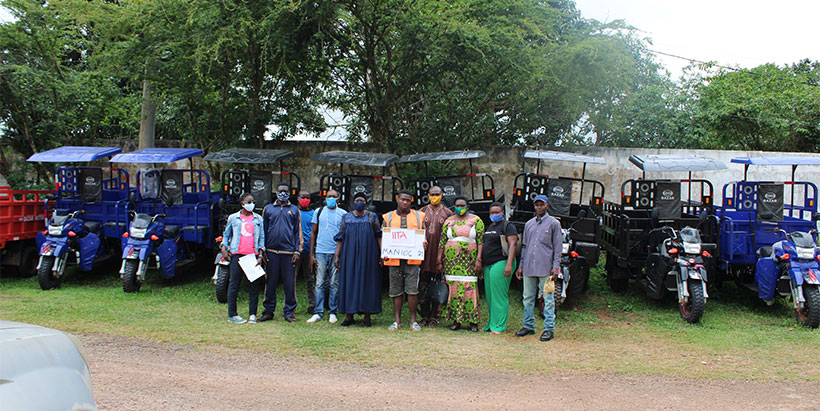
In Cameroon, the project delivered 11 brand new tricycles to the cooperative representatives at the IITA Cameroon campus. The President of the SOCOOPROMOS Cooperative, Ebogo Essinidi Gisèle, said, “Our hearts are full of joy since we came to collect our tricycles. Manioc 21 has put smiles on our faces.”
Gisèle spoke of the project’s work, highlighting the support cooperatives had received since 2017 when the project Manioc 21, showed up. “We have been trained and later received equipment, including these tricycles. In the heat of COVID-19, the team visited us, they restructured our transformation site, and gave us materials like bag carriers, wheelbarrows, generators, and many other things,” she continued.
In an interview, Ondoua Joseph from SCOOPMAN Cooperative highlighted the difficulties they had with transporting their products using motorbikes. “Before now, we could transport a sack of cassava at a time and later struggled to take the transformed products to the market. But today, thanks to IITA and Manioc 21, with the help of the tricycle, we are able to transport not less than a ton of cassava from our farms to the transformation site and then to the markets much faster and easier,” he said.
Manioc 21 organized capacity building sessions at different levels in Cameroon and the DRC. A training workshop for cooperative representatives brought in technicians to empower them with skills and techniques on how to operate the fabricated equipment. Potential enumerators also received coaching to assist the cooperatives in data collection, processing, and decision making by setting up tools on information and communication technology (ICT).
At the end of the training, 133 persons were trained (66 from Cameroon and 67 from DRC) to optimize development strategies for the cassava supply chain and management of the 10 cooperatives. The ICT tools have the Open Data Kit (ODK) forms used for data collection, Short Message Service (SMS) tool used for communication between farmers and the system, and the dashboard used to get information that is accessible on the website https://iitamanioc21.com.
Ten main cooperatives made up of over 5006 members were selected within the Central Africa Region, five from Cameroon and five from DRC. The Cameroonian cooperatives selected include Union des GIC de LENDOM (UGILE), Société coopérative avec conseil d`administration des producteur de manioc d’oganisoa (SOCOOPROMOS), Société coopérative de manioc, autres tubercules produits agricoles (SOCOOPMATPA), Société coopérative de fumage et de sechage au Cameroun (DEFUSCAM), Société coopérative de manioc (SCOOPMAN / ODEFCOM). In DRC, the selcted cooperatives include Coopérative d`action communautaire pour le dévéloppement et l`assistance socio-économique (CACODASE), Consortium ASA -CADECVIM (CADECVIM), Regroupement des femmes payanne (REP), Coopérative paysanne agricultures, éleveurs et multiplicateurs des semences (COOPAEMUS), and Fédération de coopératives Congo (FECCO).
In Cameroon, the project delivered 11 brand new tricycles to the cooperative representatives at the IITA Cameroon campus. The President of the SOCOOPROMOS Cooperative, Ebogo Essinidi Gisèle, said, “Our hearts are full of joy since we came to collect our tricycles. Manioc 21 has put smiles on our faces.”
Gisèle spoke of the project’s work, highlighting the support cooperatives had received since 2017 when the project Manioc 21, showed up. “We have been trained and later received equipment, including these tricycles. In the heat of COVID-19, the team visited us, they restructured our transformation site, and gave us materials like bag carriers, wheelbarrows, generators, and many other things,” she continued.
In an interview, Ondoua Joseph from SCOOPMAN Cooperative highlighted the difficulties they had with transporting their products using motorbikes. “Before now, we could transport a sack of cassava at a time and later struggled to take the transformed products to the market. But today, thanks to IITA and Manioc 21, with the help of the tricycle, we are able to transport not less than a ton of cassava from our farms to the transformation site and then to the markets much faster and easier,” he said.

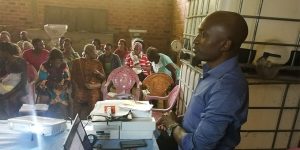
Manioc 21 staff, Kemga Adolph, teaching farmers on the use of ICT in 2019.
Some members of the cooperatives trying out the triclyces.
Contributed by
Recent stories
No items found