
NEWS

N2Africa’s technology helping kick out hunger in Kongwa District, Tanzania
May 30, 2018
Legumes such as cowpea, beans, and groundnuts are not only beneficial to human health as they are a rich and affordable source of protein; they are also beneficial to the soil. They fix nitrogen from the air into the soil improving its fertility thus, increasing the yield of other crops such as maize and sorghum when they are intercropped or in rotation. IITA has partnered with Kongwa District in their initiative dubbed “Eradicate hunger in Kongwa” (Ondoa Njaa Kongwa in Kiswahili) and are promoting legume production to not only improve the nutrition of the people but also boost overall farm productivity. This is through N2Africa, a large-scale, science-based “research-in-development” project focused on putting nitrogen fixation to work for smallholder farmers growing legume crops in Africa. In collaboration with Kongwa District authorities, N2Africa has established at least 150 pilot large-scale fields of about one acre each in 15 villages with lead farmers. In 10 villages, the lead farmers are demonstrating intercropping of improved varieties of cowpea (Vuli and Raha) and sorghum (Nako), whereas in the other five villages, the improved variety of groundnuts (Pendo) is being intercropped with an improved sorghum variety. The project is also demonstrating improved agronomy practices such as application of phosphorus fertilizers and use of herbicides for weed control. According to Mr Jackson Shija, the District Agriculture, Irrigation and Cooperative Officer (DAICO)–the district is expecting a good crop this year due to the use of improved varieties and intercropping with legumes and use of good agronomic practices. He said that farmers’ perception toward the intercropping of staple crops with legumes is positive following the good yield they are getting. “We need to continue training farmers to improve production and productivity,” said Shija. On the other hand, he said there is a need to continue ensuring consistent availability of seeds of the new improved varieties, building on the community seed growers approach that N2Africa has initiated in the area. From the farmers’ mouth: Benefits of intercropping with legumes Silvanus Andrews was happy with the intercropping system as it allowed him to harvest different crops at the same time. This was echoed by Jane Diamon, a groundnuts and sorghum farmer from Sagara B village: “The improved farming methods we are learning are far much better compared to the traditional ways we have been using. For example, I grew groundnuts using the new ways I was taught on a small area and I harvested a lot more compared to previous years. I expect to harvest even more in this coming season,” she said.
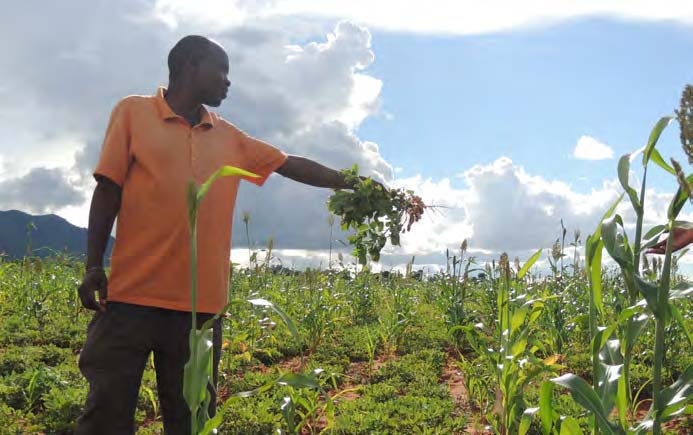
Picture of Silvanus Andrew, a groundnut and sorghum farmer from Iduo village, shows off his intercrop.

Silvanus Andrew, a groundnut and sorghum farmer from Iduo village, shows off his intercrop.

Christina Madege from Mlanga village tried the cowpea and sorghum intercropping and was quite impressed. “This is a good farming approach and has the potential to increase our income and empower us. Last year I had planted in a small land, and I harvested a lot of produce. This year, I have faith that I will get a good harvest as well.” A notable result is that cowpea gives them an early crop and shortens the period of food scarcity. She identified some of her major concerns as pest attack on cowpea and sorghum but said the project has supported them in knowing the right pesticide to use.
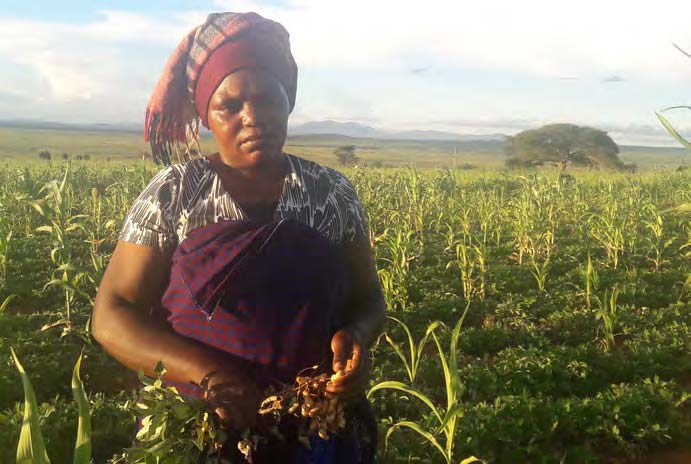
Picture of Bilha Mtembozi from Sagara A, grows groundnuts and sorghum

Bilha Mtembozi from Sagara A, grows groundnuts and sorghum

Bilha Mtembozi, groundnuts and sorghum farmer from Sagara said, “When you mix sorghum and groundnut, you will gain from harvesting both crops. However, the challenge we are facing is the type of soils that we have that is highly exhausted of nutrients.” She acknowledged learning different ways to restore soil fertility including use of legumes, animal manure, and mineral fertilizers but points out availability and high prices of fertilizers as big limitations in their use.

Contributed by

Recent stories

No items found

Leave a Reply

Your email address will not be published. Required fields are marked *

Scroll to Top
Olaosebikan, Olamide

Olamide Deborah Nwanze is a Senior Research Associate specializing in gender mainstreaming research to inform participatory and inclusive breeding, variety development, and seed systems policies regarding root, tuber, and banana (RTB) crops in the International Institute of Tropical Agriculture Headquarters, Ibadan, Nigeria. She is a PhD candidate at the University of Ibadan and holds an MSc and B. Agric in Agricultural Extension and Rural Development. Olamide is a fellow of the African Women in Agricultural Research and Development – Gender Responsive Agricultural Systems Policy (AWARD-GRASP) and the Gender Responsive Researchers Equipped for Agricultural Transformation (GREAT). She seeks to apply her gender-mainstreaming learnings, gender-responsive research, and policy development, and review expertise to facilitate women, youth, children, and vulnerable social group’s access to and adoption of agricultural Innovations that guarantee food, nutrition, income, and livelihood security in Africa. Her current roles include mentoring research fellows, development of guides and training manuals, implementation and adaptation of gender frameworks and tools, value chain actors’ engagement as citizen science partners, policy review and redesign, data management, and analysis. Her current research explores mixed methods and participatory and interdisciplinary approaches to capture and highlight gender dynamics, needs, preferences, and challenges stakeholders face within the agricultural livelihood value chain to prioritize gender-inclusive strategies in breeding programs, policy design, and implementation.

At IITA, she contributes to the implementation of the CGIAR Accelerated Breeding Initiative and Genetic Innovation Programs; participatory and gender research within the NextGen CassavaHarvestPlusRTBFoods, and Tricot-ClimMob 1000Farms Projects; and gender knowledge communication via the G-LENS webinar series, video documentary, policy briefspublications, and blogs.


Recent publications

de Sousa, K., van Etten, J., Manners, R. Bello, A., Teeken, B., Olaosebikan, O., et al. 2024. The tricot approach: an agile framework for decentralized on-farm testing supported by citizen science. A retrospective. Agron. Sustain. Dev. 44, 8. https://doi.org/10.1007/s13593-023-00937-1

Madu, T., Onwuka, S., Nwafor, S., Onyemauwa, N., Ejechi, M., Ofoeze, M., Ukeje, B., Eluagu, C., Olaosebikan, O., Okoye, B., 2024. Gender-Inclusive Consumer Studies Improve Cassava Breeding in Nigeria in: Frontiers in Sociology, volume 9, number: 1224504, doi: 10.3389/fsoc.2024.1224504

Olaosebikan, O.; Bello, A.; Utoblo, O.; Okoye, B.; Olutegbe, N.; Garner, E.; Teeken, B.; Bryan, E.; Forsythe, L.; Cole, S.; Madu, T. 2023.  Stressors and Resilience within the Cassava Value Chain in Nigeria: Preferred Cassava Variety Traits and Response Strategies of Men and Women to Inform Breeding. Sustainability 15, 7837. https://doi.org/10.3390/su15107837

Okoye, B., Ofoeze, M., Ejechi, M., Onwuka, S., Nwafor, S., Onyemauwa, N., Ukeje, B., Eluagu, C., Obidiegwu, J.*, Olaosebikan, O., Madu, T.* 2023. Prioritizing preferred traits in the yam value chain in Nigeria: a gender situation analysis in: Frontiers in Sociology, volume 8, number: 1232626, pages 1 – 9, ISSN 2297-7775, 2023. https://www.frontiersin.org/articles/10.3389/fsoc.2023.1232626/full

Olaosebikan, O., Bello, A. A., de Sousa, K., Ndjouenkeu, R., Adesokan, M., Alamu, E. O., Agbona, A., van Etten, J., Kegah, F. N.*, Dufour, D., Bouniol, A., Teeken, B. 2023. Consumer acceptability of cassava gari-eba food products across cultural and environmental settings using the triadic comparison of technologies approach (tricot) in: Journal of the Science of Food and Agriculture,

Teeken, B., Olaosebikan, O., Bello, A. A., Madu, T.*, Cole, S. M. 2023. Qualitative assessment on the positionality and preferences of dyads in relation to cassava-related activities: working with tricot trial citizen scientists https://hdl.handle.net/10568/138326 Type: Manual

Bouniol, A., Ceballos, H., Bello, A. A., Teeken, B., Olaosebikan, O., Owoade, D., Agbona, A., Fotso Kuate, A., Madu, T.*, Okoye, B.*, Ofoeze, M.*, Nwafor, S.*, Onyemauwa, N.*, Adinsi, L.*, Forsythe, L., Dufour, D. 2023. Varietal impact on women’s labour, workload and related drudgery in processing root, tuber and banana crops: focus on cassava in sub-Saharan Africa in: Journal of the Science of Food and Agriculture, pages 1 – 25, ISSN 0022-5142,

Bello, A. A., Agbona, A., Olaosebikan, O., Edughaen, G., Dufour, D., Bouniol, A., Iluebbey, P., Ndjouenkeu, R.*, Rabbi, I. Y., Teeken, B. 2023. Genetic and environmental effects on processing productivity and food product yield: drudgery of women’s work in: Journal of the Science of Food and Agriculture, pages 1 – 32, ISSN 0022-5142, 5

Cavicchioli, M., Zimbiti, T., Teeken, B., Nwanze, D.O., Liani, M., Parkes, E. & Bello, A. 2023. IITA-Gender Responsive Breeding Training Report. Genetic Resources Center, IITA-HQ, Ibadan, 21-23 September, 2022. Ibadan, Nigeria: IITA, (34 p.).https://hdl.handle.net/10568/131368

Agbona, A. Peteti P., Teeken B., Olaosebikan O. Bello, A. A., Parkes, E., Rabbi, I. Y., Mueller, L., Egesi, C., Kulakow, P. 2022. Data Management in Multi-disciplinary African RTB Crop Breeding Programs. In: Williamson, H.F., Leonelli, S. (eds) Towards Responsible Plant Data Linkage: Data Challenges for Agricultural Research and Development. Springer, Cham. https://doi.org/10.1007/978-3-031-13276-6_5

Lora Forsythe, Pricilla Marimo, Sarah Mayanja, Olamide D. Olaosebikan, Esme Stuart, Bela Teeken, Benjamin Okoye, Tessy Madu, (2021). Cross-product Gender Analysis of RTBfoods Step 2 Gendered Food Mapping on RTB Products. Understanding the Drivers of Trait Preferences and the Development of Multi-user RTB Product Profiles, WP1. London, UK: RTBfoods Field Scientific Report, 30 p.

Teeken, B., Garner, E., Agbona, A., Balogun, I., Olaosebikan, O., Bello, A., Madu, T., Okoye, B., Egesi, C., Kulakow, P. and Tufan, H.A. 2021. Beyond “Women’s Traits”: Exploring How Gender, Social Difference, and Household Characteristics Influence Trait Preferences. Frontiers Sustainable Food Systems 5:740926. https://doi.org/10.3389/fsufs.2021.740926

Teeken, B., Agbona, A., Bello, A., Olaosebikan, O., Alamu, E., Adesokan, M., Awoyale, W., Madu, T., Okoye, B., Chijioke, U., Owoade, D., Okoro, M., Bouniol, A., Dufour, D., Hershey, C., Rabbi, I., Maziya‐Dixon, B., Egesi, C., Tufan, H. and Kulakow, P. (020. Understanding cassava varietal preferences through pairwise ranking of gari‐eba and fufu prepared by local farmer–processors. Int J Food Sci Technol. https://doi.org/10.1111/ijfs.14862

Bela Teeken, Olamide Olaosebikan, Ireti Balogun, Benjamin Okoye, Tessy Madu, Steven Cole, Abolore Bello, Elizabeth Parkes. (2020). Piloting the G+ customer and product profile tools for gender-responsive cassava breeding in Nigeria. Nigeria: International Institute of Tropical Agriculture (IITA). https://hdl.handle.net/20.500.11766/13000