
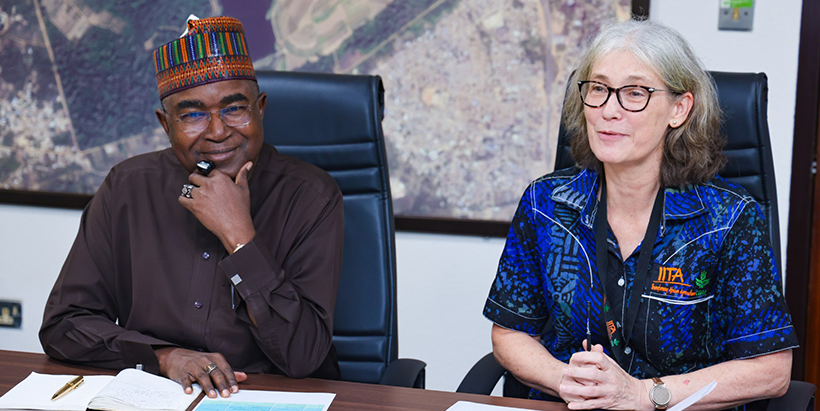
IITA–CGIAR recently hosted the Chairman/Chief Executive Officer of the National Drug Law Enforcement Agency (NDLEA), Brigadier General Mohammed Buba Marwa (Rtd.), CON, OFR, on a working visit aimed at acknowledging IITA’s longstanding support and exploring collaborative pathways around sustainable livelihoods, youth empowerment, and alternatives to illicit crop production.
The NDLEA delegation was formally introduced and comprised key officials, including the Agency Secretary, Barrister Shadrach Haruna; the Chairman’s Chief of Staff, Colonel Aminu; Director of Accounts and Finance, Lucas Sunday; the Zonal Commander, Oba Obaniyi Adeoye; the Oyo State Commander, Adetula Oluwarotimi; the Osun State Commander, Yinka Joe-Fadile; coordinators of specialized units; officers of the Oyo State Command; and the Director of Media and Advocacy, Femi Babafemi, among others.
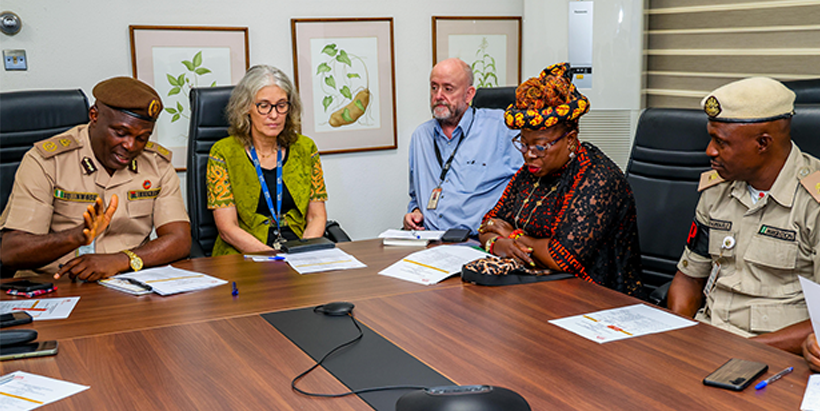
Welcoming the delegation on behalf of the Director General, IITA Deputy Director General Corporate Services, Hilde Koper-Limbourg, highlighted IITA’s unique mandate as an agricultural research-for-development institute that not only generates innovations but also deliberately works to ensure those innovations reach end users. She referenced IITA’s experience with alternative crops programming, noting that when agriculture thrives as a business, it offers powerful, sustainable options for economic empowerment.
An introductory video showcased IITA’s footprint and impact, after which the Director of Strategic Planning and the Chief of Staff to the IITA Director General, Dr Ibnou Dieng, provided deeper insights into IITA’s global positioning. He explained that IITA, as part of the CGIAR-wide partnership, has access to nearly 9,000 scientists worldwide, working predominantly across the Global South. IITA currently operates in 25 countries, delivering end-to-end agricultural solutions spanning land, water, genetics, nutrition, and livelihoods.
Dr Dieng further spotlighted IITA’s 2024–2030 Strategy, which prioritizes nutrition security, job creation, climate resilience, and sustainable food systems. He noted that IITA holds the largest cowpea collection in the world, supports the reintroduction of improved varieties in conflict-affected regions, and is developing climate-smart, pest and disease-resistant crop varieties under its core pillars of Genetic Innovation, Resilient Agri-food Systems, and System Transformation.
The delegation was also introduced to a wide range of IITA innovations, including high-yielding and stress-resilient maize varieties; nutritious maize; early maturing cowpea; dual-purpose soybean varieties; Nodumax bio-inoculants; rapid cassava seed multiplication systems; Aflasafe for aflatoxin control; and Seed Tracker technologies, among others. Dieng concluded that there are over 100 technologies developed by IITA to explore.
Speaking on youth engagement, Noel Mulinganya, Program Coordinator, IITA Youth in Agribusiness, emphasized that young people are often the first adopters of IITA technologies. Through the IITA Youth in Agribusiness (IYA) program—now active in 19 locations—IITA provides training, access to finance, market linkages, tailored business opportunities, and mentorship, backed by location-specific needs assessment to recommend economically viable businesses for youth.
In his remarks, Brigadier General Marwa reflected on his first visit to IITA in 1973, describing it as formative. He underscored NDLEA’s interest in promoting licit agricultural alternatives to cannabis cultivation, particularly in communities where illicit crop production thrives. He called for science-based solutions that offer farmers compelling economic incentives to transition to legal crops. Citing the exploration of our local resources for industrial food and drug solutions, like the artemisia plant, harnessed to treat malaria.
Discussions explored viable alternatives such as cassava, soybean, poultry, fisheries, and value-added cassava products—including flour for bread aligned with Nigeria’s cassava inclusion policy. The visit concluded with a shared commitment to deepen collaboration, leveraging science, innovation, and evidence to deliver sustainable livelihoods, strengthen food systems, and address complex social challenges at their roots.
Contributed by Folake Oduntan
Contributed by
Recent stories