
New project to build commercially sustainable cassava seed system
May 10, 2016
A four-year project (2015–2019) to develop a commercially sustainable cassava seed value chain in Nigeria, was launched on 18 April at IITA headquarters in Ibadan, Nigeria.
Titled ‘Building a Sustainable, Integrated Seed System for Cassava in Nigeria’ (BASICS), the US$11.6 million project is funded by the Bill & Melinda Gates Foundation and led by the CGIAR Research Program on Roots, Tubers and Bananas (RTB).
 Despite being the largest cassava producer in Africa, Nigeria only averages a yield of 14 t/ha–less than half of what is attainable.
The project aims to help Nigerian producers reach this potential by developing a commercially sustainable cassava seed value chain based on the purchase of quality seed by farmers. Seeds would be provided by vibrant and profitable village seed entrepreneurs and basic seed production linked to processors.
These seed businesses will provide healthy seed of more productive varieties leading to adoption of new varieties to improve productivity and food security, increase incomes of cassava growers and seed entrepreneurs, and enhance gender equity.
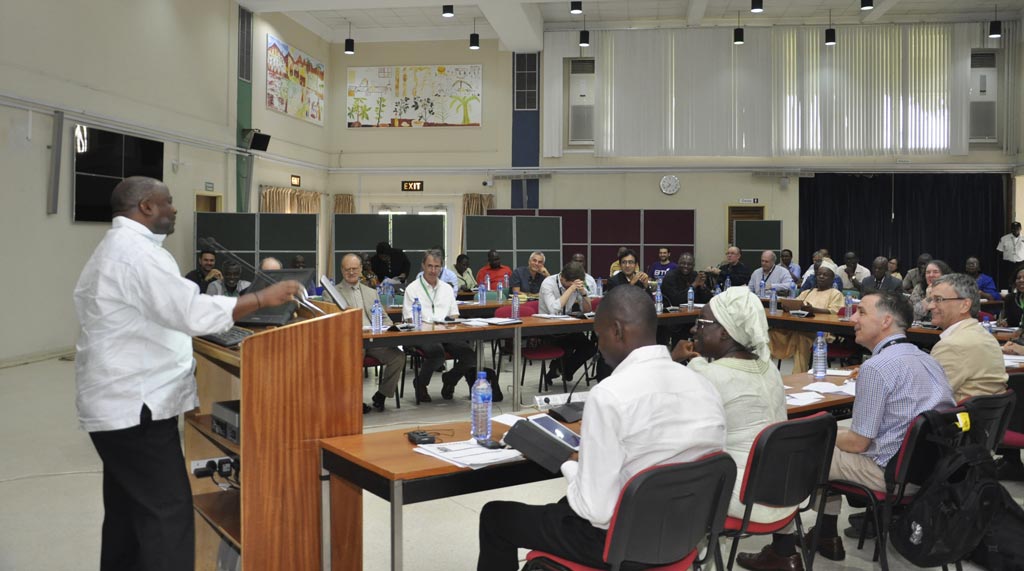
Kicking off the launch, Nteranya Sanginga, IITA Director General, explained that the key to industrializing cassava is to increase productivity, and this means addressing the problem with weeds, improving agronomy, and providing quality seed.
Graham Thiele, RTB Program Director, said: “Our vision is that by 2019 smallholder growers could buy high quality stems of their preferred varieties and plant them using improved agronomic practices. As a result yields would have jumped by at least 40% and farmers would have more secure markets for expanded production… Vibrant new businesses would have been created all along the value chain creating employment for women and youth.”
Doyin Awe, representative of Nigeria’s Federal Ministry of Agriculture and Rural Development, noted that exciting new opportunities were opening for cassava. She committed the full support of the Ministry to the new project.
Julius Okonkwo, Executive Director, National Root Crops and Research Institute (NRCRI), said that NRCRI was pleased to take part in developing a modern seed system for cassava.
Yemi Akinbamijo, Executive Director, Forum for Agricultural Research in Africa (FARA) said: “I am excited to get back to BASICS so that we could
move to a food secure Nigeria.” He underscored the need to work on the entire innovation-to-impact pathway, and stressed that today “history is being made” .
Louw Burger of Thai Farms, a cassava flour processing company, explained that better roots were easier to harvest and that it is important to start with the right seed.
Following the launch, project partners including National Agricultural Seed Council, NRCRI, IITA, Catholic Relief Services, Context Network, and FERA (UK) took part in a workshop to finalize work plans.
Despite being the largest cassava producer in Africa, Nigeria only averages a yield of 14 t/ha–less than half of what is attainable.
The project aims to help Nigerian producers reach this potential by developing a commercially sustainable cassava seed value chain based on the purchase of quality seed by farmers. Seeds would be provided by vibrant and profitable village seed entrepreneurs and basic seed production linked to processors.
These seed businesses will provide healthy seed of more productive varieties leading to adoption of new varieties to improve productivity and food security, increase incomes of cassava growers and seed entrepreneurs, and enhance gender equity.
Kicking off the launch, Nteranya Sanginga, IITA Director General, explained that the key to industrializing cassava is to increase productivity, and this means addressing the problem with weeds, improving agronomy, and providing quality seed.
Graham Thiele, RTB Program Director, said: “Our vision is that by 2019 smallholder growers could buy high quality stems of their preferred varieties and plant them using improved agronomic practices. As a result yields would have jumped by at least 40% and farmers would have more secure markets for expanded production… Vibrant new businesses would have been created all along the value chain creating employment for women and youth.”
Doyin Awe, representative of Nigeria’s Federal Ministry of Agriculture and Rural Development, noted that exciting new opportunities were opening for cassava. She committed the full support of the Ministry to the new project.
Julius Okonkwo, Executive Director, National Root Crops and Research Institute (NRCRI), said that NRCRI was pleased to take part in developing a modern seed system for cassava.
Yemi Akinbamijo, Executive Director, Forum for Agricultural Research in Africa (FARA) said: “I am excited to get back to BASICS so that we could
move to a food secure Nigeria.” He underscored the need to work on the entire innovation-to-impact pathway, and stressed that today “history is being made” .
Louw Burger of Thai Farms, a cassava flour processing company, explained that better roots were easier to harvest and that it is important to start with the right seed.
Following the launch, project partners including National Agricultural Seed Council, NRCRI, IITA, Catholic Relief Services, Context Network, and FERA (UK) took part in a workshop to finalize work plans.
IITA DG Nteranya Sanginga talks about how to increase cassava productivity.
Contributed by
Recent stories
No items found