NextGen Cassava project develops new gari product for consumers in Benue, Imo, and Osun states
March 29, 2021
Traditionally, the cassava mash used for gari production in Nigeria is left to ferment between 48 and 96 hours, depending on its quality. Thus, there is high variability in the sensory attributes and consumer acceptability of the gari Additionally, the fermentation process takes longer in some communities where highly sour gari is preferred, reducing the quantity of gari produced within a specific period.
The backslopped method of fermentation, where portions of the previously fermented cassava mash are added to a freshly prepared cassava mash to act as an inoculum, allows for the gradual selection of lactic acid bacteria and accelerated fermentation.
Developing the new gari product for Benue, Imo, and Osun consumers.
Backslopped fermentation has been used for cassava products such as fufu, lafun, and stored cassava chips gari, but little or no information is available on backslopped fermented gari (BFG) produced from freshly grated cassava roots and the consumer acceptability of the gari/eba. Consequently, Design-Expert software was used to get the mixing ratios of the fresh cassava mash (FCM) and backslopped cassava mash (BCM) to produce a laboratory-scale gari. Results showed that the optimum combinations of FCM and BCM for gari were 88 g FCM: 20 g BCM after 24 h, 90 g FCM: 20 g BCM after 48 h, 87 g FCM: 20 g BCM after 72 h, and 70 g FCM: 16 g BCM after 96 h.
The outcome of the laboratory scale gari was used for the training on the production and consumer acceptability of BFG in three different locations each in Benue (Gwei-east, Konshisha, and Makurdi LGAs), Imo (Ikeduru, Mbaitoli, and Owerri North LGAs), and Osun (Ifelodun, Olaoluwa, and Orolu LGAs) states in Nigeria. The FCM and the BCM combinations that look like the 24 h, 48 h, and 72 h fermented gari were used in Benue and Imo states. This is because these states do not like gari that is too sour. In Osun State, the combinations of the FCM and the BCM that produced gari that looks like the 48 h, 72 h, and 96 h fermented gari were used as the people in the state like a more sour gari. The control sample was produced using the traditional methods of gari production in each location.
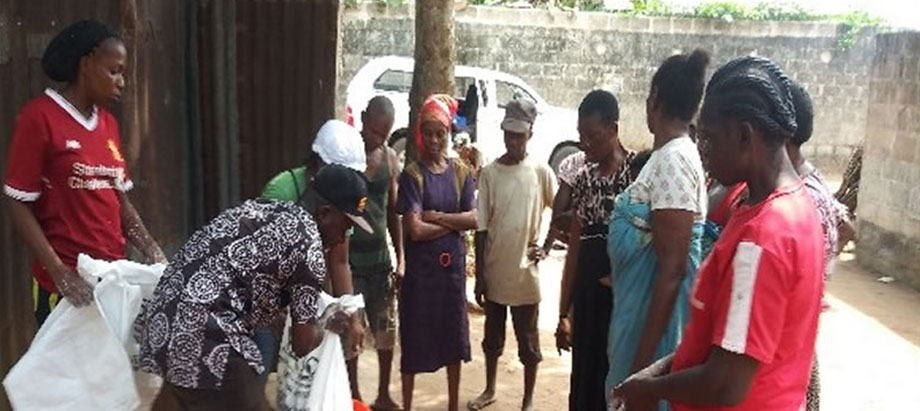
Training local gari producers on the BFG production method.
The consumer acceptability study showed that most of the gari consumers in Benue State preferred the 72 h BFG compared to the control sample produced in each location. Gari/eba consumers in Ikeduru and Mbiatoli LGAs of Imo State preferred the 48 h BFG and the 72 h BFG compared to the control sample, respectively. In contrast, the consumers in Owerri-North preferred the control sample compared to the eba prepared from all the BFG samples. More than 55% of the gari/eba consumers in Osun State liked the control sample compared to all the BFG.
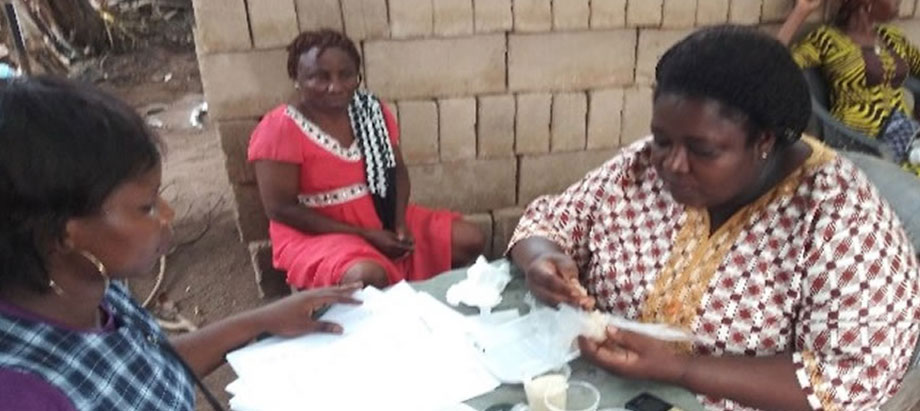
Carrying out consumer acceptability testing.
Therefore, BFG was well accepted in Benue and Imo states. Still, there is a need to increase the length of fermentation of BCM and the quantity of BCM added to FCM in producing BFG in Osun State for proper adoption and commercialization.
The NextGen Cassava Breeding project (NextGen Cassava) seeks to modernize partner cassava breeding institutions in Africa and use cutting-edge tools to deliver improved cassava varieties.
Olamide Deborah Nwanze is a Senior Research Associate specializing in gender mainstreaming research to inform participatory and inclusive breeding, variety development, and seed systems policies regarding root, tuber, and banana (RTB) crops in the International Institute of Tropical Agriculture Headquarters, Ibadan, Nigeria. She is a PhD candidate at the University of Ibadan and holds an MSc and B. Agric in Agricultural Extension and Rural Development. Olamide is a fellow of the African Women in Agricultural Research and Development – Gender Responsive Agricultural Systems Policy (AWARD-GRASP) and the Gender Responsive Researchers Equipped for Agricultural Transformation (GREAT). She seeks to apply her gender-mainstreaming learnings, gender-responsive research, and policy development, and review expertise to facilitate women, youth, children, and vulnerable social group’s access to and adoption of agricultural Innovations that guarantee food, nutrition, income, and livelihood security in Africa. Her current roles include mentoring research fellows, development of guides and training manuals, implementation and adaptation of gender frameworks and tools, value chain actors’ engagement as citizen science partners, policy review and redesign, data management, and analysis. Her current research explores mixed methods and participatory and interdisciplinary approaches to capture and highlight gender dynamics, needs, preferences, and challenges stakeholders face within the agricultural livelihood value chain to prioritize gender-inclusive strategies in breeding programs, policy design, and implementation.
de Sousa, K., van Etten, J., Manners, R. Bello, A., Teeken, B., Olaosebikan, O., et al. 2024. The tricot approach: an agile framework for decentralized on-farm testing supported by citizen science. A retrospective. Agron. Sustain. Dev. 44, 8. https://doi.org/10.1007/s13593-023-00937-1
Madu, T., Onwuka, S., Nwafor, S., Onyemauwa, N., Ejechi, M., Ofoeze, M., Ukeje, B., Eluagu, C., Olaosebikan, O., Okoye, B., 2024. Gender-Inclusive Consumer Studies Improve Cassava Breeding in Nigeria in: Frontiers in Sociology, volume 9, number: 1224504, doi: 10.3389/fsoc.2024.1224504
Olaosebikan, O.; Bello, A.; Utoblo, O.; Okoye, B.; Olutegbe, N.; Garner, E.; Teeken, B.; Bryan, E.; Forsythe, L.; Cole, S.; Madu, T. 2023. Stressors and Resilience within the Cassava Value Chain in Nigeria: Preferred Cassava Variety Traits and Response Strategies of Men and Women to Inform Breeding. Sustainability 15, 7837. https://doi.org/10.3390/su15107837
Okoye, B., Ofoeze, M., Ejechi, M., Onwuka, S., Nwafor, S., Onyemauwa, N., Ukeje, B., Eluagu, C., Obidiegwu, J.*, Olaosebikan, O., Madu, T.* 2023. Prioritizing preferred traits in the yam value chain in Nigeria: a gender situation analysis in: Frontiers in Sociology, volume 8, number: 1232626, pages 1 – 9, ISSN 2297-7775, 2023. https://www.frontiersin.org/articles/10.3389/fsoc.2023.1232626/full
Olaosebikan, O., Bello, A. A., de Sousa, K., Ndjouenkeu, R., Adesokan, M., Alamu, E. O., Agbona, A., van Etten, J., Kegah, F. N.*, Dufour, D., Bouniol, A., Teeken, B. 2023. Consumer acceptability of cassava gari-eba food products across cultural and environmental settings using the triadic comparison of technologies approach (tricot) in: Journal of the Science of Food and Agriculture,
Teeken, B., Olaosebikan, O., Bello, A. A., Madu, T.*, Cole, S. M. 2023. Qualitative assessment on the positionality and preferences of dyads in relation to cassava-related activities: working with tricot trial citizen scientists https://hdl.handle.net/10568/138326 Type: Manual
Bouniol, A., Ceballos, H., Bello, A. A., Teeken, B., Olaosebikan, O., Owoade, D., Agbona, A., Fotso Kuate, A., Madu, T.*, Okoye, B.*, Ofoeze, M.*, Nwafor, S.*, Onyemauwa, N.*, Adinsi, L.*, Forsythe, L., Dufour, D. 2023. Varietal impact on women’s labour, workload and related drudgery in processing root, tuber and banana crops: focus on cassava in sub-Saharan Africa in: Journal of the Science of Food and Agriculture, pages 1 – 25, ISSN 0022-5142,
Bello, A. A., Agbona, A., Olaosebikan, O., Edughaen, G., Dufour, D., Bouniol, A., Iluebbey, P., Ndjouenkeu, R.*, Rabbi, I. Y., Teeken, B. 2023. Genetic and environmental effects on processing productivity and food product yield: drudgery of women’s work in: Journal of the Science of Food and Agriculture, pages 1 – 32, ISSN 0022-5142, 5
Cavicchioli, M., Zimbiti, T., Teeken, B., Nwanze, D.O., Liani, M., Parkes, E. & Bello, A. 2023. IITA-Gender Responsive Breeding Training Report. Genetic Resources Center, IITA-HQ, Ibadan, 21-23 September, 2022. Ibadan, Nigeria: IITA, (34 p.).https://hdl.handle.net/10568/131368
Agbona, A. Peteti P., Teeken B., Olaosebikan O. Bello, A. A., Parkes, E., Rabbi, I. Y., Mueller, L., Egesi, C., Kulakow, P. 2022. Data Management in Multi-disciplinary African RTB Crop Breeding Programs. In: Williamson, H.F., Leonelli, S. (eds) Towards Responsible Plant Data Linkage: Data Challenges for Agricultural Research and Development. Springer, Cham. https://doi.org/10.1007/978-3-031-13276-6_5
Lora Forsythe, Pricilla Marimo, Sarah Mayanja, Olamide D. Olaosebikan, Esme Stuart, Bela Teeken, Benjamin Okoye, Tessy Madu, (2021). Cross-product Gender Analysis of RTBfoods Step 2 Gendered Food Mapping on RTB Products. Understanding the Drivers of Trait Preferences and the Development of Multi-user RTB Product Profiles, WP1. London, UK: RTBfoods Field Scientific Report, 30 p.
Teeken, B., Garner, E., Agbona, A., Balogun, I., Olaosebikan, O., Bello, A., Madu, T., Okoye, B., Egesi, C., Kulakow, P. and Tufan, H.A. 2021. Beyond “Women’s Traits”: Exploring How Gender, Social Difference, and Household Characteristics Influence Trait Preferences. Frontiers Sustainable Food Systems 5:740926. https://doi.org/10.3389/fsufs.2021.740926
Teeken, B., Agbona, A., Bello, A., Olaosebikan, O., Alamu, E., Adesokan, M., Awoyale, W., Madu, T., Okoye, B., Chijioke, U., Owoade, D., Okoro, M., Bouniol, A., Dufour, D., Hershey, C., Rabbi, I., Maziya‐Dixon, B., Egesi, C., Tufan, H. and Kulakow, P. (020. Understanding cassava varietal preferences through pairwise ranking of gari‐eba and fufu prepared by local farmer–processors. Int J Food Sci Technol.https://doi.org/10.1111/ijfs.14862
Bela Teeken, Olamide Olaosebikan, Ireti Balogun, Benjamin Okoye, Tessy Madu, Steven Cole, Abolore Bello, Elizabeth Parkes. (2020). Piloting the G+ customer and product profile tools for gender-responsive cassava breeding in Nigeria. Nigeria: International Institute of Tropical Agriculture (IITA). https://hdl.handle.net/20.500.11766/13000


 The consumer acceptability study showed that most of the gari consumers in Benue State preferred the 72 h BFG compared to the control sample produced in each location. Gari/eba consumers in Ikeduru and Mbiatoli LGAs of Imo State preferred the 48 h BFG and the 72 h BFG compared to the control sample, respectively. In contrast, the consumers in Owerri-North preferred the control sample compared to the eba prepared from all the BFG samples. More than 55% of the gari/eba consumers in Osun State liked the control sample compared to all the BFG.
 Therefore, BFG was well accepted in Benue and Imo states. Still, there is a need to increase the length of fermentation of BCM and the quantity of BCM added to FCM in producing BFG in Osun State for proper adoption and commercialization.
The NextGen Cassava Breeding project (NextGen Cassava) seeks to modernize partner cassava breeding institutions in Africa and use cutting-edge tools to deliver improved cassava varieties.
Therefore, BFG was well accepted in Benue and Imo states. Still, there is a need to increase the length of fermentation of BCM and the quantity of BCM added to FCM in producing BFG in Osun State for proper adoption and commercialization.
The NextGen Cassava Breeding project (NextGen Cassava) seeks to modernize partner cassava breeding institutions in Africa and use cutting-edge tools to deliver improved cassava varieties.