
IITA NEWS

Nigeria approves new names for top performing cassava varieties
September 26, 2020

The Federal Government of Nigeria on Wednesday evening approved new names for 10 improved cassava varieties, as part of efforts to brand the root crop for easy identification, cultivation and marketing of cassava stems.

The branded varieties comprise 6 released varieties and 4 yet-to be-released varieties. The released varieties and their new names are as follows: IBA961632 (Farmer’s Pride), IBA980581 (Dixon), CR36-5 (Ayaya), IBA070593 (Sunshine), and IBA980505 (Fine face). TME 419, a variety already popular among farmers, remained unchanged as TME419. The yet-to-be-released (pre-release) varieties and their new names are TMS13F1160P0004 (Game Changer), TMS13F1343P0022 (Obasanjo-2), NR130124 (Hope) and TMEB693 (Poundable).
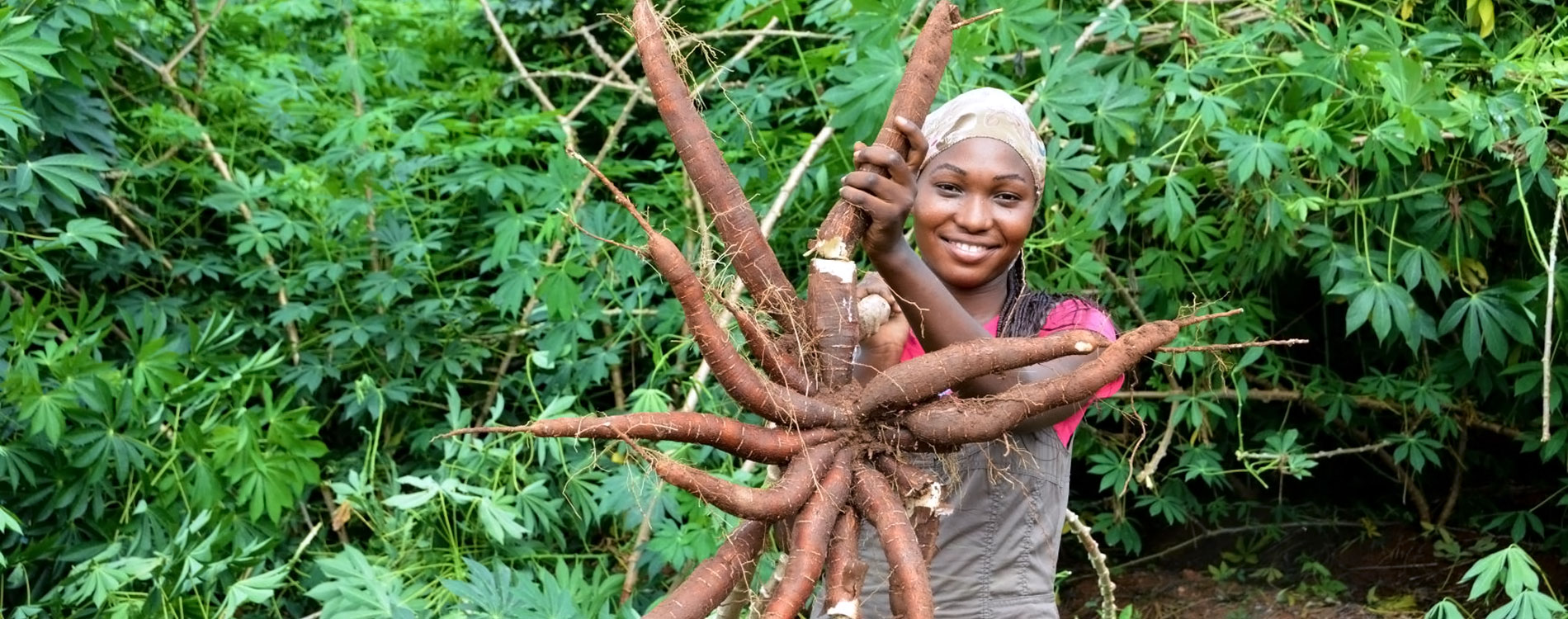
A farmer proudly displays TME419 cassava variety

The Director, Federal Department of Agriculture, Mrs Karima Babanginda, who moved for the adoption of the names on behalf of the government of Nigeria described the move as a ‘welcome development.’

“Our farmers can now be able to identify the different cassava varieties,” Mrs Babanginda said.

The naming of the varieties was facilitated by the Building an Economically Sustainable, Integrated and Economically Sustainable Cassava Seed System, Phase 2 (BASICS-II), that is being led by the International Institute of Tropical Agriculture (IITA) and the NextGen Cassava Breeding project (NextGen Cassava).

Results on common names of the varieties from focus groups were collated and screened by an independent committee. The best three names that resonate with the market were subjected to voting by cassava farmers and names with the highest votes were finally picked.

In his welcome address, the Executive Director, National Root Crops Research Institute (NRCRI) Umudike, Prof. Ukpabi Joseph Ukpabi expressed optimism that the naming of varieties using common names would continue, stressing that “it will also help to change the game in the seed system of root and tuber crops in Nigeria and also serve as a model for other African countries.”

Re-echoing the significance of the event, IITA Deputy Director General (Partnerships for Delivery), Dr Kenton Dashiell noted that the re-naming of the varieties was imperative.

“It will help the cassava sector in a big way,” Dr Dashiell added. The brand names mark a departure from codes that are usually handed to farmers by researchers and often difficult to memorize.

Prof. Chiedozie Egesi, Project Manager for NextGen Cassava Project observed that code names are hard to remember or confusing which can lead to loss of identity of a variety or mixtures in farms.

“Substituting the official names of the varieties with simpler or more relatable brand names will make farmers more familiar and closer to the varieties. From the BASICS-II project, two early generation seed companies, IITA GoSeed and Umudike Seeds, have been set up to ensure the production and commercialization of breeders and foundation seeds in a sustainable manner to ensure constant access to quality planting material of improved varieties,” he explained.

BASICS-II Project Manager, Prof Lateef Sanni said the variety naming would enhance the cassava stems promotion activities of the project since farmers would be able to identify and relate better with the new names, especially as the farmers also participated in the naming process.

All the varieties named are high yielding, Cassava Mosaic Disease-resistant and are in high demand by farmers.

For more information, please contact: Godwin Atser, g.atser@cgiar.org, Digital Extension & Advisory Services Specialist

About BASICS-II

The five-year Building an Economically Sustainable. Integrated Cassava Seed System, Phase 2, (BASICS-II) project aims to transform the cassava seed sector by promoting the dissemination of improved varieties thereby creating a community of seed entrepreneurs across the cassava value chain. The project will focus on Nigeria and Tanzania with spin off to other African Countries.


Contributed by

Related news

No items found

Leave a Reply

Your email address will not be published. Required fields are marked *

Scroll to Top
Olaosebikan, Olamide

Olamide Deborah Nwanze is a Senior Research Associate specializing in gender mainstreaming research to inform participatory and inclusive breeding, variety development, and seed systems policies regarding root, tuber, and banana (RTB) crops in the International Institute of Tropical Agriculture Headquarters, Ibadan, Nigeria. She is a PhD candidate at the University of Ibadan and holds an MSc and B. Agric in Agricultural Extension and Rural Development. Olamide is a fellow of the African Women in Agricultural Research and Development – Gender Responsive Agricultural Systems Policy (AWARD-GRASP) and the Gender Responsive Researchers Equipped for Agricultural Transformation (GREAT). She seeks to apply her gender-mainstreaming learnings, gender-responsive research, and policy development, and review expertise to facilitate women, youth, children, and vulnerable social group’s access to and adoption of agricultural Innovations that guarantee food, nutrition, income, and livelihood security in Africa. Her current roles include mentoring research fellows, development of guides and training manuals, implementation and adaptation of gender frameworks and tools, value chain actors’ engagement as citizen science partners, policy review and redesign, data management, and analysis. Her current research explores mixed methods and participatory and interdisciplinary approaches to capture and highlight gender dynamics, needs, preferences, and challenges stakeholders face within the agricultural livelihood value chain to prioritize gender-inclusive strategies in breeding programs, policy design, and implementation.

At IITA, she contributes to the implementation of the CGIAR Accelerated Breeding Initiative and Genetic Innovation Programs; participatory and gender research within the NextGen CassavaHarvestPlusRTBFoods, and Tricot-ClimMob 1000Farms Projects; and gender knowledge communication via the G-LENS webinar series, video documentary, policy briefspublications, and blogs.


Recent publications

de Sousa, K., van Etten, J., Manners, R. Bello, A., Teeken, B., Olaosebikan, O., et al. 2024. The tricot approach: an agile framework for decentralized on-farm testing supported by citizen science. A retrospective. Agron. Sustain. Dev. 44, 8. https://doi.org/10.1007/s13593-023-00937-1

Madu, T., Onwuka, S., Nwafor, S., Onyemauwa, N., Ejechi, M., Ofoeze, M., Ukeje, B., Eluagu, C., Olaosebikan, O., Okoye, B., 2024. Gender-Inclusive Consumer Studies Improve Cassava Breeding in Nigeria in: Frontiers in Sociology, volume 9, number: 1224504, doi: 10.3389/fsoc.2024.1224504

Olaosebikan, O.; Bello, A.; Utoblo, O.; Okoye, B.; Olutegbe, N.; Garner, E.; Teeken, B.; Bryan, E.; Forsythe, L.; Cole, S.; Madu, T. 2023.  Stressors and Resilience within the Cassava Value Chain in Nigeria: Preferred Cassava Variety Traits and Response Strategies of Men and Women to Inform Breeding. Sustainability 15, 7837. https://doi.org/10.3390/su15107837

Okoye, B., Ofoeze, M., Ejechi, M., Onwuka, S., Nwafor, S., Onyemauwa, N., Ukeje, B., Eluagu, C., Obidiegwu, J.*, Olaosebikan, O., Madu, T.* 2023. Prioritizing preferred traits in the yam value chain in Nigeria: a gender situation analysis in: Frontiers in Sociology, volume 8, number: 1232626, pages 1 – 9, ISSN 2297-7775, 2023. https://www.frontiersin.org/articles/10.3389/fsoc.2023.1232626/full

Olaosebikan, O., Bello, A. A., de Sousa, K., Ndjouenkeu, R., Adesokan, M., Alamu, E. O., Agbona, A., van Etten, J., Kegah, F. N.*, Dufour, D., Bouniol, A., Teeken, B. 2023. Consumer acceptability of cassava gari-eba food products across cultural and environmental settings using the triadic comparison of technologies approach (tricot) in: Journal of the Science of Food and Agriculture,

Teeken, B., Olaosebikan, O., Bello, A. A., Madu, T.*, Cole, S. M. 2023. Qualitative assessment on the positionality and preferences of dyads in relation to cassava-related activities: working with tricot trial citizen scientists https://hdl.handle.net/10568/138326 Type: Manual

Bouniol, A., Ceballos, H., Bello, A. A., Teeken, B., Olaosebikan, O., Owoade, D., Agbona, A., Fotso Kuate, A., Madu, T.*, Okoye, B.*, Ofoeze, M.*, Nwafor, S.*, Onyemauwa, N.*, Adinsi, L.*, Forsythe, L., Dufour, D. 2023. Varietal impact on women’s labour, workload and related drudgery in processing root, tuber and banana crops: focus on cassava in sub-Saharan Africa in: Journal of the Science of Food and Agriculture, pages 1 – 25, ISSN 0022-5142,

Bello, A. A., Agbona, A., Olaosebikan, O., Edughaen, G., Dufour, D., Bouniol, A., Iluebbey, P., Ndjouenkeu, R.*, Rabbi, I. Y., Teeken, B. 2023. Genetic and environmental effects on processing productivity and food product yield: drudgery of women’s work in: Journal of the Science of Food and Agriculture, pages 1 – 32, ISSN 0022-5142, 5

Cavicchioli, M., Zimbiti, T., Teeken, B., Nwanze, D.O., Liani, M., Parkes, E. & Bello, A. 2023. IITA-Gender Responsive Breeding Training Report. Genetic Resources Center, IITA-HQ, Ibadan, 21-23 September, 2022. Ibadan, Nigeria: IITA, (34 p.).https://hdl.handle.net/10568/131368

Agbona, A. Peteti P., Teeken B., Olaosebikan O. Bello, A. A., Parkes, E., Rabbi, I. Y., Mueller, L., Egesi, C., Kulakow, P. 2022. Data Management in Multi-disciplinary African RTB Crop Breeding Programs. In: Williamson, H.F., Leonelli, S. (eds) Towards Responsible Plant Data Linkage: Data Challenges for Agricultural Research and Development. Springer, Cham. https://doi.org/10.1007/978-3-031-13276-6_5

Lora Forsythe, Pricilla Marimo, Sarah Mayanja, Olamide D. Olaosebikan, Esme Stuart, Bela Teeken, Benjamin Okoye, Tessy Madu, (2021). Cross-product Gender Analysis of RTBfoods Step 2 Gendered Food Mapping on RTB Products. Understanding the Drivers of Trait Preferences and the Development of Multi-user RTB Product Profiles, WP1. London, UK: RTBfoods Field Scientific Report, 30 p.

Teeken, B., Garner, E., Agbona, A., Balogun, I., Olaosebikan, O., Bello, A., Madu, T., Okoye, B., Egesi, C., Kulakow, P. and Tufan, H.A. 2021. Beyond “Women’s Traits”: Exploring How Gender, Social Difference, and Household Characteristics Influence Trait Preferences. Frontiers Sustainable Food Systems 5:740926. https://doi.org/10.3389/fsufs.2021.740926

Teeken, B., Agbona, A., Bello, A., Olaosebikan, O., Alamu, E., Adesokan, M., Awoyale, W., Madu, T., Okoye, B., Chijioke, U., Owoade, D., Okoro, M., Bouniol, A., Dufour, D., Hershey, C., Rabbi, I., Maziya‐Dixon, B., Egesi, C., Tufan, H. and Kulakow, P. (020. Understanding cassava varietal preferences through pairwise ranking of gari‐eba and fufu prepared by local farmer–processors. Int J Food Sci Technol. https://doi.org/10.1111/ijfs.14862

Bela Teeken, Olamide Olaosebikan, Ireti Balogun, Benjamin Okoye, Tessy Madu, Steven Cole, Abolore Bello, Elizabeth Parkes. (2020). Piloting the G+ customer and product profile tools for gender-responsive cassava breeding in Nigeria. Nigeria: International Institute of Tropical Agriculture (IITA). https://hdl.handle.net/20.500.11766/13000