
IITA NEWS

Nigerian Finance Minister visits IITA
June 11, 2017

Min Kemi Adeosun convinced that the ENABLE program should be rolled out in Nigeria

Ibadan, Nigeria – The Nigerian Minister of Finance, Honorable Kemi Adeosun, visited the International Institute of Tropical Agriculture (IITA) on 10 June to learn about the IITA Agripreneurs Program (IYA) and the African Development Bank-funded ENABLE Youth (Empowering Novel Agri-Business-Led Employment) Program.

The Minister and her party were welcomed by IITA Director General Nteranya Sanginga and senior staff, including members of the IYA.

Picture of IITA Director General Nteranya Sanginga (right) welcomes the Nigerian Minister of Finance, the Hon. Kemi Adeosun (left) to IITA, Ibadan.
IITA Director General Nteranya Sanginga (right) welcomes the Nigerian Minister of Finance, the Hon. Kemi Adeosun (left) to IITA, Ibadan.

“This is the first time that a Minister of Finance from the Federal Republic of Nigeria visited IITA in its 50 years of existence,” Sanginga said. “We have hosted Presidents, Ministers of Agriculture, Environment, and other officials, but you are the first Minister of Finance to come and see for yourself what IITA is doing…. You have made our day!”

After a short discussion with the director general and the IITA team, the Minister met the Agripeneurs—about a 100 of them—all graduates of different disciplines, some of who talked about how the IYA program had changed their mindsets about agriculture and agribusiness, and how it is now transforming their lives. Several youths provided testimonials on how they, in the different locations in Nigeria, have succeeded in their start-up businesses, thanks to the training and initial support received from IITA and various partners from the private sector, development partners, and international organizations.

Mercy Wakawa from Biu, Borno state, for example, talked about how a training provided by IITA’s N2Africa project funded by the Bill & Melinda Gates Foundation that she attended 2 years ago had helped her establish a groundnut oil processing cottage industry that now provides employment for seven other youths and supports the local groundnut industry being run by women.
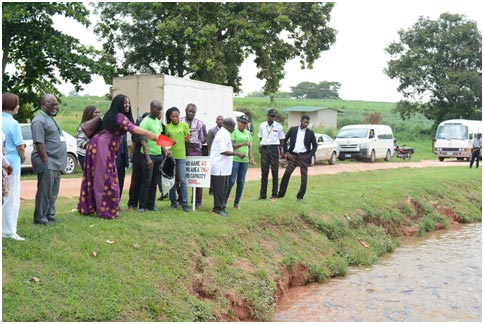
Picture of Officials from the Federal Ministry of Finance during a tour of the catfish ponds in IITA, Ibadan, established  and maintained by youth Agripreneurs.
Officials from the Federal Ministry of Finance during a tour of the catfish ponds in IITA, Ibadan, established and maintained by youth Agripreneurs.

Ajibola Olaniyi leads a team of two other young people who ventured into catfish farming. Without prior knowledge about fish farming but with support from IITA, Ajibola and her team resuscitated four ab andoned ponds and later exp anded to 17 with a capacity of 150 tons. The expansion of the business has created jobs for short-term staff who work with the team in managing the ponds. The business is growing with clients coming from the various geo-political zones in Nigeria to patronize the products.

TOFAN Foods is a subsidiary of IITA Youth Agripreneurs. The business, which is owned by three young people who were trained under the processing unit of IYA, is producing Tidbit, a snack. The snack is made from high quality cassava flour and cowpea. TOFAN Foods has been established in Ijebu-Ode, Ogun State, and will be scaling out the technology learned during the incubation period in IYA.

Oyindamola Asaaju, another Agripreneur, used to serve on tables, but after getting involved with IYA, she now leads a group of Agripreneurs in Onne, Rivers State, in cassava, rice, plantain, and catfish production. The group is using the IITA Station in Onne to develop new agribusiness enterprises in poultry, catfish, and micropropagation of plantain, and serve as an incubation center for young people.

In an interview after the meeting, Minister Adeosun said she and her team came to IITA to “see what the youth and IITA are doing (in the area of youth engagement in agriculture), and how we can get people into agribusiness, which is key for job creation and food security.”

“We came here (to IITA) to assess a project (ENABLE Youth) being considered by the Federal Government. From what I have seen today, I am extremely impressed and inspired! … We should work on how we can roll out this project nationally!” the Minister concluded at the end of the visit.

The African Development Bank Group (AfDB) had approved the ENABLE Youth Nigeria program, and will provide a US$300 million as a loan to contribute to job creation, food security and nutrition, rural income generation and improved livelihoods for youths in both urban and rural areas in the country.

ENABLE Youth is expected to create business opportunities and decent employment for 1000 young women and men along priority agricultural value chains of various enterprises (aquaculture, crops farming, marketing, processing, etc.) per state, including Abuja, the Federal Capital Territory.

The Minister’s team included Ahmed Aliyu, Director, International Economic Relations, Special Adviser Adora Asonye, Technical Assistant Tolulope Kasali, and Chief Administrative Officer (Agriculture) Abubabkar Ibrahim Matazu, among others.

###

About IITA, iita.org

The International Institute of Tropical Agriculture (IITA) is a not-for-profit institution that generates agricultural innovations to meet Africa’s most pressing challenges of hunger, malnutrition, poverty, and natural resource degradation. Working with various partners across sub-Saharan Africa, we improve livelihoods, enhance food and nutrition security, increase employment, and preserve natural resource integrity. IITA is a member of CGIAR, a global agriculture research partnership for a food secure future.

Media contact: Katherine Lopez, Head of Communication, k.lopez@cgiar.org, +234 803 978 4454

Evelyn Ohanwusi, Interim Head, Youth in Agribusiness Office, e.ohanwusi@cgiar.org, +234 708 434 0252


Contributed by

Recent stories

No items found

Leave a Reply

Your email address will not be published. Required fields are marked *

Scroll to Top
Olaosebikan, Olamide

Olamide Deborah Nwanze is a Senior Research Associate specializing in gender mainstreaming research to inform participatory and inclusive breeding, variety development, and seed systems policies regarding root, tuber, and banana (RTB) crops in the International Institute of Tropical Agriculture Headquarters, Ibadan, Nigeria. She is a PhD candidate at the University of Ibadan and holds an MSc and B. Agric in Agricultural Extension and Rural Development. Olamide is a fellow of the African Women in Agricultural Research and Development – Gender Responsive Agricultural Systems Policy (AWARD-GRASP) and the Gender Responsive Researchers Equipped for Agricultural Transformation (GREAT). She seeks to apply her gender-mainstreaming learnings, gender-responsive research, and policy development, and review expertise to facilitate women, youth, children, and vulnerable social group’s access to and adoption of agricultural Innovations that guarantee food, nutrition, income, and livelihood security in Africa. Her current roles include mentoring research fellows, development of guides and training manuals, implementation and adaptation of gender frameworks and tools, value chain actors’ engagement as citizen science partners, policy review and redesign, data management, and analysis. Her current research explores mixed methods and participatory and interdisciplinary approaches to capture and highlight gender dynamics, needs, preferences, and challenges stakeholders face within the agricultural livelihood value chain to prioritize gender-inclusive strategies in breeding programs, policy design, and implementation.

At IITA, she contributes to the implementation of the CGIAR Accelerated Breeding Initiative and Genetic Innovation Programs; participatory and gender research within the NextGen CassavaHarvestPlusRTBFoods, and Tricot-ClimMob 1000Farms Projects; and gender knowledge communication via the G-LENS webinar series, video documentary, policy briefspublications, and blogs.


Recent publications

de Sousa, K., van Etten, J., Manners, R. Bello, A., Teeken, B., Olaosebikan, O., et al. 2024. The tricot approach: an agile framework for decentralized on-farm testing supported by citizen science. A retrospective. Agron. Sustain. Dev. 44, 8. https://doi.org/10.1007/s13593-023-00937-1

Madu, T., Onwuka, S., Nwafor, S., Onyemauwa, N., Ejechi, M., Ofoeze, M., Ukeje, B., Eluagu, C., Olaosebikan, O., Okoye, B., 2024. Gender-Inclusive Consumer Studies Improve Cassava Breeding in Nigeria in: Frontiers in Sociology, volume 9, number: 1224504, doi: 10.3389/fsoc.2024.1224504

Olaosebikan, O.; Bello, A.; Utoblo, O.; Okoye, B.; Olutegbe, N.; Garner, E.; Teeken, B.; Bryan, E.; Forsythe, L.; Cole, S.; Madu, T. 2023.  Stressors and Resilience within the Cassava Value Chain in Nigeria: Preferred Cassava Variety Traits and Response Strategies of Men and Women to Inform Breeding. Sustainability 15, 7837. https://doi.org/10.3390/su15107837

Okoye, B., Ofoeze, M., Ejechi, M., Onwuka, S., Nwafor, S., Onyemauwa, N., Ukeje, B., Eluagu, C., Obidiegwu, J.*, Olaosebikan, O., Madu, T.* 2023. Prioritizing preferred traits in the yam value chain in Nigeria: a gender situation analysis in: Frontiers in Sociology, volume 8, number: 1232626, pages 1 – 9, ISSN 2297-7775, 2023. https://www.frontiersin.org/articles/10.3389/fsoc.2023.1232626/full

Olaosebikan, O., Bello, A. A., de Sousa, K., Ndjouenkeu, R., Adesokan, M., Alamu, E. O., Agbona, A., van Etten, J., Kegah, F. N.*, Dufour, D., Bouniol, A., Teeken, B. 2023. Consumer acceptability of cassava gari-eba food products across cultural and environmental settings using the triadic comparison of technologies approach (tricot) in: Journal of the Science of Food and Agriculture,

Teeken, B., Olaosebikan, O., Bello, A. A., Madu, T.*, Cole, S. M. 2023. Qualitative assessment on the positionality and preferences of dyads in relation to cassava-related activities: working with tricot trial citizen scientists https://hdl.handle.net/10568/138326 Type: Manual

Bouniol, A., Ceballos, H., Bello, A. A., Teeken, B., Olaosebikan, O., Owoade, D., Agbona, A., Fotso Kuate, A., Madu, T.*, Okoye, B.*, Ofoeze, M.*, Nwafor, S.*, Onyemauwa, N.*, Adinsi, L.*, Forsythe, L., Dufour, D. 2023. Varietal impact on women’s labour, workload and related drudgery in processing root, tuber and banana crops: focus on cassava in sub-Saharan Africa in: Journal of the Science of Food and Agriculture, pages 1 – 25, ISSN 0022-5142,

Bello, A. A., Agbona, A., Olaosebikan, O., Edughaen, G., Dufour, D., Bouniol, A., Iluebbey, P., Ndjouenkeu, R.*, Rabbi, I. Y., Teeken, B. 2023. Genetic and environmental effects on processing productivity and food product yield: drudgery of women’s work in: Journal of the Science of Food and Agriculture, pages 1 – 32, ISSN 0022-5142, 5

Cavicchioli, M., Zimbiti, T., Teeken, B., Nwanze, D.O., Liani, M., Parkes, E. & Bello, A. 2023. IITA-Gender Responsive Breeding Training Report. Genetic Resources Center, IITA-HQ, Ibadan, 21-23 September, 2022. Ibadan, Nigeria: IITA, (34 p.).https://hdl.handle.net/10568/131368

Agbona, A. Peteti P., Teeken B., Olaosebikan O. Bello, A. A., Parkes, E., Rabbi, I. Y., Mueller, L., Egesi, C., Kulakow, P. 2022. Data Management in Multi-disciplinary African RTB Crop Breeding Programs. In: Williamson, H.F., Leonelli, S. (eds) Towards Responsible Plant Data Linkage: Data Challenges for Agricultural Research and Development. Springer, Cham. https://doi.org/10.1007/978-3-031-13276-6_5

Lora Forsythe, Pricilla Marimo, Sarah Mayanja, Olamide D. Olaosebikan, Esme Stuart, Bela Teeken, Benjamin Okoye, Tessy Madu, (2021). Cross-product Gender Analysis of RTBfoods Step 2 Gendered Food Mapping on RTB Products. Understanding the Drivers of Trait Preferences and the Development of Multi-user RTB Product Profiles, WP1. London, UK: RTBfoods Field Scientific Report, 30 p.

Teeken, B., Garner, E., Agbona, A., Balogun, I., Olaosebikan, O., Bello, A., Madu, T., Okoye, B., Egesi, C., Kulakow, P. and Tufan, H.A. 2021. Beyond “Women’s Traits”: Exploring How Gender, Social Difference, and Household Characteristics Influence Trait Preferences. Frontiers Sustainable Food Systems 5:740926. https://doi.org/10.3389/fsufs.2021.740926

Teeken, B., Agbona, A., Bello, A., Olaosebikan, O., Alamu, E., Adesokan, M., Awoyale, W., Madu, T., Okoye, B., Chijioke, U., Owoade, D., Okoro, M., Bouniol, A., Dufour, D., Hershey, C., Rabbi, I., Maziya‐Dixon, B., Egesi, C., Tufan, H. and Kulakow, P. (020. Understanding cassava varietal preferences through pairwise ranking of gari‐eba and fufu prepared by local farmer–processors. Int J Food Sci Technol. https://doi.org/10.1111/ijfs.14862

Bela Teeken, Olamide Olaosebikan, Ireti Balogun, Benjamin Okoye, Tessy Madu, Steven Cole, Abolore Bello, Elizabeth Parkes. (2020). Piloting the G+ customer and product profile tools for gender-responsive cassava breeding in Nigeria. Nigeria: International Institute of Tropical Agriculture (IITA). https://hdl.handle.net/20.500.11766/13000