
Obasanjo urges industrial scale agriculture for self-sufficiency in Africa
November 12, 2019
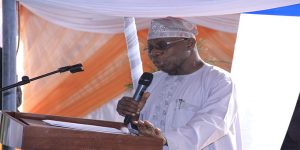
Former Nigerian President and IITA Goodwill Ambassador, Chief Olusegun Obasanjo has called for the adoption of agriculture as a business, which when implemented on an industrial scale will generate employment, especially among youth, as well as drastically reduce national food import bills. He made the remarks in Kalambo, Democratic Republic of Congo, during the inauguration of IITA’s research station, which was named after him.
Chief Obasanjo reminisced about being deployed to DR Congo 59 years ago as a young soldier with the United Nations Peacekeeping and noted with nostalgia how honored he was to be back and to have the campus named after him.
 He lauded IITA’s research and innovation in agribusiness stating, “I cannot be better honored than to be associated with the work and stations of IITA as a foremost agricultural research undertaking in Africa.”
“As the honorary ambassador of IITA,” he continued, “what makes me particularly happy is that the product of the research in this campus will soon be discharged all around in this country and in the adjoining countries.”
He spoke of the growth of the cassava value chain in Nigeria during his presidency and enjoined President Felix Tshisekedi of DR Congo to support IITA’s work to ensure such progress, and even more, is replicated in DRC. “When I became the President of Nigeria, we were producing 30 million metric tons. By the time I left, it moved to 50 million metric tons and there was no reason why we could not go on to reach 100 million metric tons.”
He noted there was room for more growth as cassava has gone from simply being a food crop to being used in industrial production of ethanol and other products.
He spoke of three other crops that he considered important cash crops namely, soybean, cowpea, and plantain/banana and noted that, “If we can be self-sufficient in them, I believe that we will drastically reduce the 50 billion dollars that we are spending every year in Africa to import food.”
In an exclusive interview with Radio IITA, Chief Obasanjo spoke of his love for agriculture, which he says, “I have been practicing very seriously for the last 40 years when I first left public office, and it is something that gives me joy.” However, he repeatedly advocates for the adoption of agriculture as a business and not just as a development issue.
“As a development project or program, agriculture is slow to address hitches but as a business, the planning and execution would be more urgent to achieve business goals”,. he said. To meet the food security needs of Africa now and in the future, particularly with the expected population explosion, this urgency needs to drive agriculture to the next level of productivity.
“Agriculture as a business will create employment especially among the youth, who need to start participating more in the sector to guarantee the commercial and nutrition stability of Africa in the present and in future.” According to Chief Obasanjo, it has been difficult to appeal to youth by treating agriculture as a development issue, but agribusiness stands a better chance of attracting young people, particularly the educated ones.
Chief Obasanjo’s final words at the inauguration focused on harnessing the human resources of Africa. He encouraged leaders to look out for competent Africans in diaspora and take advantage of their expertise for the benefit of African countries and the continent as a whole.
He lauded IITA’s research and innovation in agribusiness stating, “I cannot be better honored than to be associated with the work and stations of IITA as a foremost agricultural research undertaking in Africa.”
“As the honorary ambassador of IITA,” he continued, “what makes me particularly happy is that the product of the research in this campus will soon be discharged all around in this country and in the adjoining countries.”
He spoke of the growth of the cassava value chain in Nigeria during his presidency and enjoined President Felix Tshisekedi of DR Congo to support IITA’s work to ensure such progress, and even more, is replicated in DRC. “When I became the President of Nigeria, we were producing 30 million metric tons. By the time I left, it moved to 50 million metric tons and there was no reason why we could not go on to reach 100 million metric tons.”
He noted there was room for more growth as cassava has gone from simply being a food crop to being used in industrial production of ethanol and other products.
He spoke of three other crops that he considered important cash crops namely, soybean, cowpea, and plantain/banana and noted that, “If we can be self-sufficient in them, I believe that we will drastically reduce the 50 billion dollars that we are spending every year in Africa to import food.”
In an exclusive interview with Radio IITA, Chief Obasanjo spoke of his love for agriculture, which he says, “I have been practicing very seriously for the last 40 years when I first left public office, and it is something that gives me joy.” However, he repeatedly advocates for the adoption of agriculture as a business and not just as a development issue.
“As a development project or program, agriculture is slow to address hitches but as a business, the planning and execution would be more urgent to achieve business goals”,. he said. To meet the food security needs of Africa now and in the future, particularly with the expected population explosion, this urgency needs to drive agriculture to the next level of productivity.
“Agriculture as a business will create employment especially among the youth, who need to start participating more in the sector to guarantee the commercial and nutrition stability of Africa in the present and in future.” According to Chief Obasanjo, it has been difficult to appeal to youth by treating agriculture as a development issue, but agribusiness stands a better chance of attracting young people, particularly the educated ones.
Chief Obasanjo’s final words at the inauguration focused on harnessing the human resources of Africa. He encouraged leaders to look out for competent Africans in diaspora and take advantage of their expertise for the benefit of African countries and the continent as a whole.
Chief Olusegun Obasanjo giving his remarks at the inauguration of the IITA campus in Kalambo.
Contributed by
Recent stories
No items found