
IITA NEWS

Orange-fleshed sweet potatoes spawn multi-level prosperity in Burundi
July 1, 2024

In Burundi, a new project is rapidly transforming the agricultural sector, bringing many farmers hope, prosperity, and improved food security. The Great Lakes Accelerated Innovation Delivery Initiative Rapid Delivery Hub (AID-I GLR) Project—locally dubbed Kugwiza Project (which means ‘to increase’ in Kirundi)—through its partnership with the International Potato Center (CIP) and local and international scaling organizations, including World Vision, Welthungerhilfe (WHH), One Acre Fund, CoopEden, and Cooperative Haguruka, is at the forefront of this transformation. AID-I GLR is strengthening the orange-fleshed sweet potato (OFSP) value chain and changing lives.
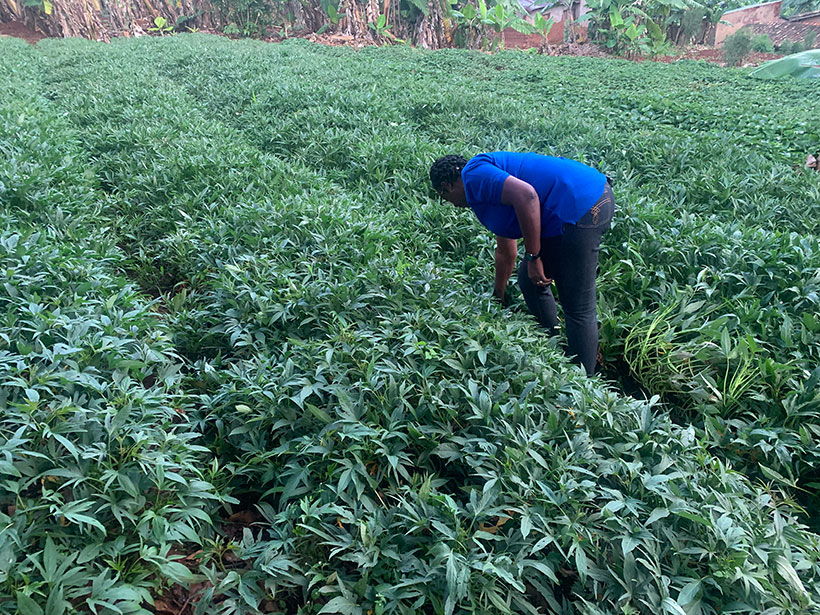
Burundi’s agricultural sector has long been a cornerstone of its economy. However, challenges such as inadequate access to quality planting materials and modern farming techniques have hindered progress.

Within a relatively short time, the Kugwiza Project has undertaken extensive capacity-building activities to ensure the availability of clean OFSP vines across Burundi. Collaborating with the Institut des Sciences Agronomique du Burundi (ISABU), CIP has trained laboratory technicians in producing early-generation seeds and their distribution to seed multipliers for further multiplication. This initiative is crucial for establishing a robust and sustainable seed system.

More than 80 private seed multipliers have been engaged to produce high-quality certified seeds in large quantities, ensuring that farmers can access superior planting materials. Ten mini-screen houses with ten vine multipliers have been established to support this effort, marking a significant milestone in Burundi’s agricultural development.

A seed multiplier from Vumbi Commune in Kirundo Province, Monique Rwasa, attests: “Through training by the Kugwiza Project, I have learned seed multiplication techniques and certification processes. Based on the knowledge I gained, I now explore better market opportunities through connections with potential buyers I met during various project workshops.”

Before the project, Monique faced significant challenges in sourcing pre-basic seeds, often traveling far to ISABU’s research stations. Establishing a mini screen house in her plot has revolutionized her operations.

“With the support of the Kugwiza Project, I can now produce early-generation seeds myself, which has economically improved my farming enterprise,” Monique elaborates.
Monique highlights the advantages of the new vine rapid multiplication technique introduced by CIP, which uses 20cm x 10cm plant spacing. This technique allows seeds that would typically be multiplied on one hectare to be planted and multiplied on about 1,000 sqm of land, significantly reducing labor, input, and land use. As a result, Monique has expanded her farm from 0.5 hectares to 7 hectares. With the additional income from the project, she has purchased 5 hectares of land, built a family house, repaid loans, and funded her children’s university education.

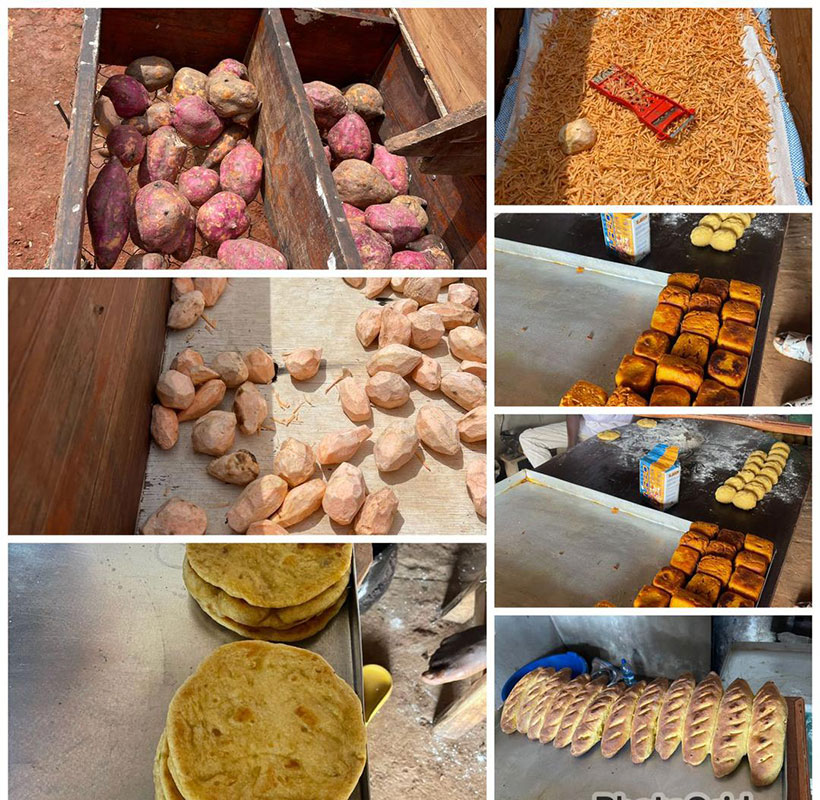
However, peculiar challenges remain in finding a sustainable market for all produced vines and conserving OFSP storage roots after vine cutting. Therefore, the Kugwiza Project has initiated interventions downstream on the value chain to pull vines’ demand. The project introduced OFSP puree to the bakery innovation package. This innovation helps bakeries reduce costs while enhancing their products. Five of the 12 entrepreneurs trained in bakery innovation have already incorporated OFSP puree into their products, with positive results.

“OFSP-based production is very profitable,” attests Vianney Munyemana, a bakery owner and one of the early adopters mentioned above. “Currently, wheat flour is quite expensive: a 25-kilo sack of wheat flour now costs between 105,000 and 110,000 francs [USD 37 and 39]. In comparison, we buy OFSP at 800 or 1,000 francs [USD 0.28 or 0.35] per kilo. Therefore, a 100-kilo bag costs approximately 100,000 francs [USD 35], equivalent to almost four bags of wheat flour. The difference is substantial. Using OFSP puree has significantly reduced production costs and improved the quality of our products. We can now offer healthier options to our customers while increasing our profits.”

Hear more from Vianney and his OFSP puree bakery experience in this video:

[embedyt] https://www.youtube.com/watch?v=FreQo9Nukak[/embedyt]


Contributed by Bertin Nduwayo, Ritha Bumwe, and Jean Claude Nshimiyimana


Contributed by

Related news

No items found

Leave a Reply

Your email address will not be published. Required fields are marked *

Scroll to Top
Olaosebikan, Olamide

Olamide Deborah Nwanze is a Senior Research Associate specializing in gender mainstreaming research to inform participatory and inclusive breeding, variety development, and seed systems policies regarding root, tuber, and banana (RTB) crops in the International Institute of Tropical Agriculture Headquarters, Ibadan, Nigeria. She is a PhD candidate at the University of Ibadan and holds an MSc and B. Agric in Agricultural Extension and Rural Development. Olamide is a fellow of the African Women in Agricultural Research and Development – Gender Responsive Agricultural Systems Policy (AWARD-GRASP) and the Gender Responsive Researchers Equipped for Agricultural Transformation (GREAT). She seeks to apply her gender-mainstreaming learnings, gender-responsive research, and policy development, and review expertise to facilitate women, youth, children, and vulnerable social group’s access to and adoption of agricultural Innovations that guarantee food, nutrition, income, and livelihood security in Africa. Her current roles include mentoring research fellows, development of guides and training manuals, implementation and adaptation of gender frameworks and tools, value chain actors’ engagement as citizen science partners, policy review and redesign, data management, and analysis. Her current research explores mixed methods and participatory and interdisciplinary approaches to capture and highlight gender dynamics, needs, preferences, and challenges stakeholders face within the agricultural livelihood value chain to prioritize gender-inclusive strategies in breeding programs, policy design, and implementation.

At IITA, she contributes to the implementation of the CGIAR Accelerated Breeding Initiative and Genetic Innovation Programs; participatory and gender research within the NextGen CassavaHarvestPlusRTBFoods, and Tricot-ClimMob 1000Farms Projects; and gender knowledge communication via the G-LENS webinar series, video documentary, policy briefspublications, and blogs.


Recent publications

de Sousa, K., van Etten, J., Manners, R. Bello, A., Teeken, B., Olaosebikan, O., et al. 2024. The tricot approach: an agile framework for decentralized on-farm testing supported by citizen science. A retrospective. Agron. Sustain. Dev. 44, 8. https://doi.org/10.1007/s13593-023-00937-1

Madu, T., Onwuka, S., Nwafor, S., Onyemauwa, N., Ejechi, M., Ofoeze, M., Ukeje, B., Eluagu, C., Olaosebikan, O., Okoye, B., 2024. Gender-Inclusive Consumer Studies Improve Cassava Breeding in Nigeria in: Frontiers in Sociology, volume 9, number: 1224504, doi: 10.3389/fsoc.2024.1224504

Olaosebikan, O.; Bello, A.; Utoblo, O.; Okoye, B.; Olutegbe, N.; Garner, E.; Teeken, B.; Bryan, E.; Forsythe, L.; Cole, S.; Madu, T. 2023.  Stressors and Resilience within the Cassava Value Chain in Nigeria: Preferred Cassava Variety Traits and Response Strategies of Men and Women to Inform Breeding. Sustainability 15, 7837. https://doi.org/10.3390/su15107837

Okoye, B., Ofoeze, M., Ejechi, M., Onwuka, S., Nwafor, S., Onyemauwa, N., Ukeje, B., Eluagu, C., Obidiegwu, J.*, Olaosebikan, O., Madu, T.* 2023. Prioritizing preferred traits in the yam value chain in Nigeria: a gender situation analysis in: Frontiers in Sociology, volume 8, number: 1232626, pages 1 – 9, ISSN 2297-7775, 2023. https://www.frontiersin.org/articles/10.3389/fsoc.2023.1232626/full

Olaosebikan, O., Bello, A. A., de Sousa, K., Ndjouenkeu, R., Adesokan, M., Alamu, E. O., Agbona, A., van Etten, J., Kegah, F. N.*, Dufour, D., Bouniol, A., Teeken, B. 2023. Consumer acceptability of cassava gari-eba food products across cultural and environmental settings using the triadic comparison of technologies approach (tricot) in: Journal of the Science of Food and Agriculture,

Teeken, B., Olaosebikan, O., Bello, A. A., Madu, T.*, Cole, S. M. 2023. Qualitative assessment on the positionality and preferences of dyads in relation to cassava-related activities: working with tricot trial citizen scientists https://hdl.handle.net/10568/138326 Type: Manual

Bouniol, A., Ceballos, H., Bello, A. A., Teeken, B., Olaosebikan, O., Owoade, D., Agbona, A., Fotso Kuate, A., Madu, T.*, Okoye, B.*, Ofoeze, M.*, Nwafor, S.*, Onyemauwa, N.*, Adinsi, L.*, Forsythe, L., Dufour, D. 2023. Varietal impact on women’s labour, workload and related drudgery in processing root, tuber and banana crops: focus on cassava in sub-Saharan Africa in: Journal of the Science of Food and Agriculture, pages 1 – 25, ISSN 0022-5142,

Bello, A. A., Agbona, A., Olaosebikan, O., Edughaen, G., Dufour, D., Bouniol, A., Iluebbey, P., Ndjouenkeu, R.*, Rabbi, I. Y., Teeken, B. 2023. Genetic and environmental effects on processing productivity and food product yield: drudgery of women’s work in: Journal of the Science of Food and Agriculture, pages 1 – 32, ISSN 0022-5142, 5

Cavicchioli, M., Zimbiti, T., Teeken, B., Nwanze, D.O., Liani, M., Parkes, E. & Bello, A. 2023. IITA-Gender Responsive Breeding Training Report. Genetic Resources Center, IITA-HQ, Ibadan, 21-23 September, 2022. Ibadan, Nigeria: IITA, (34 p.).https://hdl.handle.net/10568/131368

Agbona, A. Peteti P., Teeken B., Olaosebikan O. Bello, A. A., Parkes, E., Rabbi, I. Y., Mueller, L., Egesi, C., Kulakow, P. 2022. Data Management in Multi-disciplinary African RTB Crop Breeding Programs. In: Williamson, H.F., Leonelli, S. (eds) Towards Responsible Plant Data Linkage: Data Challenges for Agricultural Research and Development. Springer, Cham. https://doi.org/10.1007/978-3-031-13276-6_5

Lora Forsythe, Pricilla Marimo, Sarah Mayanja, Olamide D. Olaosebikan, Esme Stuart, Bela Teeken, Benjamin Okoye, Tessy Madu, (2021). Cross-product Gender Analysis of RTBfoods Step 2 Gendered Food Mapping on RTB Products. Understanding the Drivers of Trait Preferences and the Development of Multi-user RTB Product Profiles, WP1. London, UK: RTBfoods Field Scientific Report, 30 p.

Teeken, B., Garner, E., Agbona, A., Balogun, I., Olaosebikan, O., Bello, A., Madu, T., Okoye, B., Egesi, C., Kulakow, P. and Tufan, H.A. 2021. Beyond “Women’s Traits”: Exploring How Gender, Social Difference, and Household Characteristics Influence Trait Preferences. Frontiers Sustainable Food Systems 5:740926. https://doi.org/10.3389/fsufs.2021.740926

Teeken, B., Agbona, A., Bello, A., Olaosebikan, O., Alamu, E., Adesokan, M., Awoyale, W., Madu, T., Okoye, B., Chijioke, U., Owoade, D., Okoro, M., Bouniol, A., Dufour, D., Hershey, C., Rabbi, I., Maziya‐Dixon, B., Egesi, C., Tufan, H. and Kulakow, P. (020. Understanding cassava varietal preferences through pairwise ranking of gari‐eba and fufu prepared by local farmer–processors. Int J Food Sci Technol. https://doi.org/10.1111/ijfs.14862

Bela Teeken, Olamide Olaosebikan, Ireti Balogun, Benjamin Okoye, Tessy Madu, Steven Cole, Abolore Bello, Elizabeth Parkes. (2020). Piloting the G+ customer and product profile tools for gender-responsive cassava breeding in Nigeria. Nigeria: International Institute of Tropical Agriculture (IITA). https://hdl.handle.net/20.500.11766/13000