
Oyo State partners with IITA and NISER to develop agricultural policy and establish agribusiness park
September 7, 2018
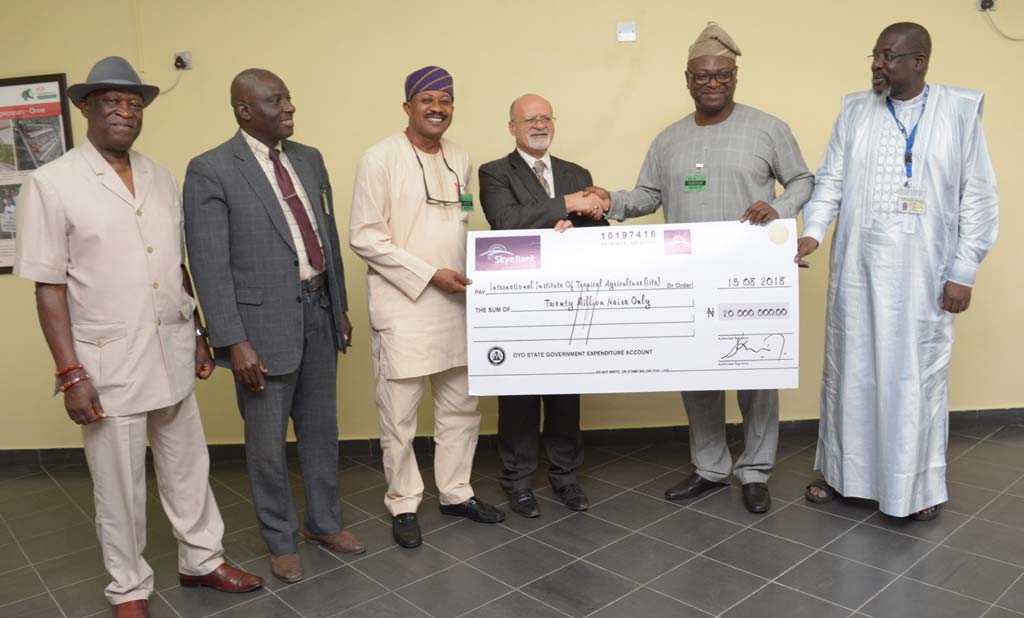
The government of Oyo State has formally signed the release of funds to IITA for the development of a 20-year agricultural policy roadmap. This signaled the immediate start of the development of the framework, which is a collaboration between IITA, Nigerian Institute of Social and Economic Research (NISER), and the Oyo State Ministry of Agriculture, Natural Resources, and Rural Development.
The official check handover ceremony was held at IITA in Ibadan on 15 August and attended by a delegation from the Oyo State government led by the Honorable Commissioner of Agriculture, Natural Resources, and Rural Development, Prince Oyewole Oyewumi; the Permanent Secretary of the Ministry, Victor Atilola; and the Special Adviser on Agriculture to the Governor of Oyo State, Prof Oluwasegun Adekunle.
 In his welcome address, IITA Deputy Director General, Partnerships for Delivery, Kenton Dashiell stated: “We sincerely appreciate the strong support and partnerships we have with the government of Oyo State, who today is raising the bar of that partnership and collaboration to a whole new level that we haven’t seen in 51 years. So it’s quite a significant day.”
Dashiell described the joint program as an excellent long-term vision of His Excellency, the Governor of Oyo State and his team because they have seen that it is important for the government to “have consistently good agricultural policies as a foundation for development. The development of the roadmap is the first task in this partnership, which when finished, can be used by the present government and hopefully by subsequent administrations.”
The second major effort is to develop an agroindustrial park in two different locations in Oyo State. Dashiell also considers this aspect of the vision to be outstanding because it “will serve multiple purposes, one of which is to develop a standard model farm and agro-processing center so that investors can come to Oyo State and see what is possible and be inspired to do more.”
IITA Senior Agricultural Economist Tahirou Abdoulaye gave an overview of the processes that led to the development of the framework, which originated with a request for support from Oyo State Governor Abiola Isiaka Ajimobi to IITA Director General Nteranya Sanginga.
From this, various conversations have taken place over several months, culminating in the invitation to both IITA and NISER to collaborate on developing the framework.
IITA Director of Development and Delivery, Alfred Dixon, gave a breakdown of the second component of the Oyo State agricultural transformation—the development of the agroindustrial park. He said the park will attract private sector investment, which will improve the agricultural system in Oyo State, create jobs for the populace of the State, and alleviate poverty. “With the funding now available, we are getting into the field immediately to commence the soil and land survey and suitability assessment,” he said.
Prof Adekunle expressed delight at the unfolding development. He described the framework document as the first of its kind in Nigeria and lauded Oyo State for living up to its moniker as The Pacesetter by being the first state to collaborate with IITA and NISER to develop an agricultural roadmap.
Commissioner Oyewumi said that the government’s collaboration with IITA has been long overdue considering the Institute has been in Ibadan for over 50 years. He said, “We cannot overemphasize the role that IITA, as a research institute, has been playing all across tropical Africa in terms of improving the quality and the quantity of our crop yield. Various farming groups and different practitioners along the agricultural value chain have benefited tremendously from the outputs from this Institute.”
In his welcome address, IITA Deputy Director General, Partnerships for Delivery, Kenton Dashiell stated: “We sincerely appreciate the strong support and partnerships we have with the government of Oyo State, who today is raising the bar of that partnership and collaboration to a whole new level that we haven’t seen in 51 years. So it’s quite a significant day.”
Dashiell described the joint program as an excellent long-term vision of His Excellency, the Governor of Oyo State and his team because they have seen that it is important for the government to “have consistently good agricultural policies as a foundation for development. The development of the roadmap is the first task in this partnership, which when finished, can be used by the present government and hopefully by subsequent administrations.”
The second major effort is to develop an agroindustrial park in two different locations in Oyo State. Dashiell also considers this aspect of the vision to be outstanding because it “will serve multiple purposes, one of which is to develop a standard model farm and agro-processing center so that investors can come to Oyo State and see what is possible and be inspired to do more.”
IITA Senior Agricultural Economist Tahirou Abdoulaye gave an overview of the processes that led to the development of the framework, which originated with a request for support from Oyo State Governor Abiola Isiaka Ajimobi to IITA Director General Nteranya Sanginga.
From this, various conversations have taken place over several months, culminating in the invitation to both IITA and NISER to collaborate on developing the framework.
IITA Director of Development and Delivery, Alfred Dixon, gave a breakdown of the second component of the Oyo State agricultural transformation—the development of the agroindustrial park. He said the park will attract private sector investment, which will improve the agricultural system in Oyo State, create jobs for the populace of the State, and alleviate poverty. “With the funding now available, we are getting into the field immediately to commence the soil and land survey and suitability assessment,” he said.
Prof Adekunle expressed delight at the unfolding development. He described the framework document as the first of its kind in Nigeria and lauded Oyo State for living up to its moniker as The Pacesetter by being the first state to collaborate with IITA and NISER to develop an agricultural roadmap.
Commissioner Oyewumi said that the government’s collaboration with IITA has been long overdue considering the Institute has been in Ibadan for over 50 years. He said, “We cannot overemphasize the role that IITA, as a research institute, has been playing all across tropical Africa in terms of improving the quality and the quantity of our crop yield. Various farming groups and different practitioners along the agricultural value chain have benefited tremendously from the outputs from this Institute.”
 Although this is seen as a long- term approach to agricultural transformation, the merits are immediately apparent. According to Dashiell, “I would say over the next one year that we should start to see the benefits of the improved policies and the reason for that is we will start to see investments come in at a faster rate than before.”
DDG-P4D Kenton Dashiell (center) receiving one of the checks from Honorable.
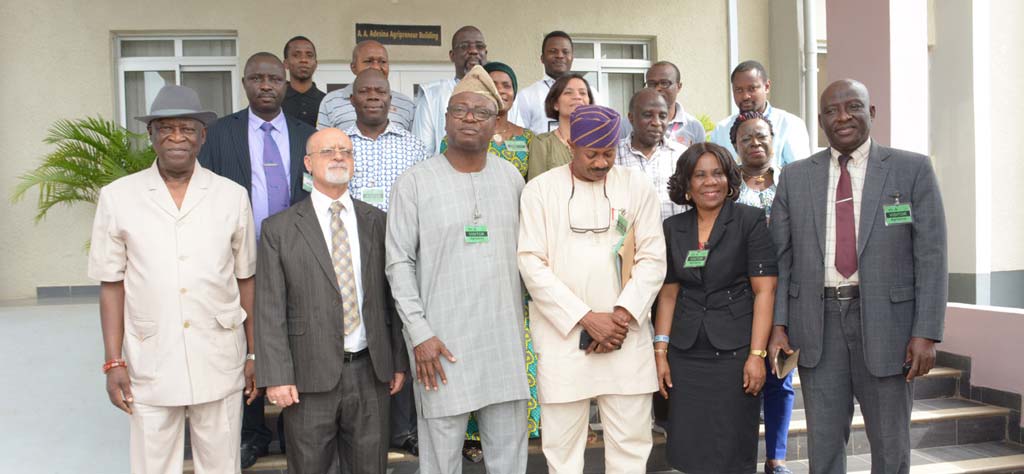
Group photo of attendees at the funds release ceremony.
Contributed by
Recent stories
No items found