
NEWS

PIDMA delivers technologies to farmers’ organizations for sustainable cassava and maize production in Cameroon
November 2, 2020
The IITA Cassava and Maize Breeding Units in Nigeria have developed multiple cassava and maize genotypes with improved yields, starch content, resistance/tolerance to major pests and diseases, and other characteristics that will satisfy industry requirements, such as improved nutritional content (e.g., higher provitamin A content). The deployment of these newly developed varieties into Cameroon required a basic understanding of their performance in relation to contrasting environments. These selected varieties were then disseminated through development projects like the Agricultural Investment and Market Development Project (PIDMA).
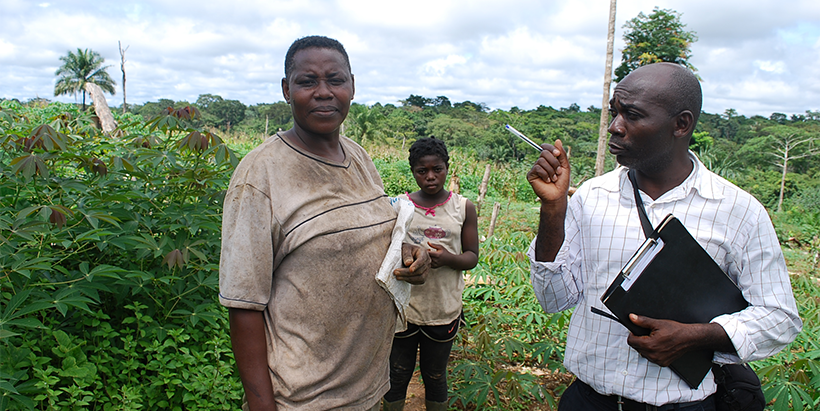
PIDMA delivers technologies to farmers’ organizations for sustainable cassava and maize production in Cameroon

Maize selection by women in the Far North region

PIDMA is a joint operation of the World Bank and the Cameroonian government to transform the low productivity and subsistence-oriented cassava, maize, and sorghum subsector into commercially oriented and competitive value chains that are inclusive of smallholder farmers, sustainable and resilient to climate change, and create rural employment. Another objective is to improve access of beneficiary farmer groups (including women and youth) to value chain finance and quality food. IITA and PIDMA signed a partnership agreement to ensure that gender-equitable benefits reach smallholder farmers by providing cooperatives with technologies for sustainable production, such as improved pre-foundation and foundation cassava seedlings and maize (including biofortified varieties) with the following characteristics: high yielding, disease resistant, and adapted to targeted production zones. The project addresses the challenges related to low productivity of cassava and maize landraces, vitamin A deficiency, yield loss caused by emerging pests and diseases, and low soil fertility. PIDMA is implementing it in collaboration with the Institute of Agricultural Research for Development-Cameroon and the Ministry of Agriculture and Rural Development.
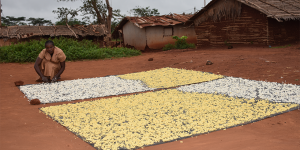
Woman drying yellow cassava for fufu in the East region.
Successes recorded include introduction of 27 cassava and 13 maize genotypes from IITA-Ibadan, which were evaluated in multilocation trials conducted with IRAD. From the trials, the project selected nine cassava genotypes that had an average fresh root yield between 25 and 30 t/ha in four agroecologies, and two maize genotypes yielding between 2.5 and 3.5 t/ha in two agroecologies. Average fresh cassava root yield for 17 improved varieties over two cropping seasons was 26.9 t/ha against 16.65 t/ha for the best local variety. In 2018, some 4,395,000 cassava cuttings and 8 tons of improved maize seeds of selected genotypes (including biofortified varieties) were delivered to 37 farmer groups. The cumulative number of improved cassava cuttings supplied by IITA for subsequent multiplication into certified seeds is estimated at 8,525,000. Cassava yields in PIDMA cooperatives increased from 8 t/ha in 2014 (baseline study) to 23.51 t/ha, against an expected project target value of 20 t/ha, while maize yield increased from 1.5  to 3.8 t/ha against an expected target value of 4 t/ha. On the nutrition component, biofortified cassava genotypes were selected for having mean total carotenoid content in fresh yellow cassava roots reaching 10.96 µg/g with genotype I070593. In collaboration with CIRAD, processing this yellow cassava into local cassava-based food (“fufu”) was successfully conducted in the East region where vitamin A deficiency is among the country’s highest. Field surveys and trials were carried out to backstop the project. Results included: (1) Various strains of the Cassava Mosaic Virus mapped in various cassava production basin and cooperative farms, with a lower incidence recorded on improved varieties (9%) compared to local varieties (79%); (2) None of the samples collected tested positive for Cassava Brown Streak Disease; (3) Distribution of fall armyworm was mapped in the country with the identification of strains and host plants; (4) Five booklets and five brochures on sustainable cassava and maize production and integrated pest management were distributed to cooperatives. Further research could be conducted on the Provitamin A (PVA) cassava introduced in rural communities to (1) evaluate the effect of cassava pests and diseases on PVA content, (2) assess the impact of processing technologies on PVA retention, and (3) understand the drivers of adoption of PVA cassava among farming households.

Contributed by

Recent stories

No items found

Leave a Reply

Your email address will not be published. Required fields are marked *

Scroll to Top
Olaosebikan, Olamide

Olamide Deborah Nwanze is a Senior Research Associate specializing in gender mainstreaming research to inform participatory and inclusive breeding, variety development, and seed systems policies regarding root, tuber, and banana (RTB) crops in the International Institute of Tropical Agriculture Headquarters, Ibadan, Nigeria. She is a PhD candidate at the University of Ibadan and holds an MSc and B. Agric in Agricultural Extension and Rural Development. Olamide is a fellow of the African Women in Agricultural Research and Development – Gender Responsive Agricultural Systems Policy (AWARD-GRASP) and the Gender Responsive Researchers Equipped for Agricultural Transformation (GREAT). She seeks to apply her gender-mainstreaming learnings, gender-responsive research, and policy development, and review expertise to facilitate women, youth, children, and vulnerable social group’s access to and adoption of agricultural Innovations that guarantee food, nutrition, income, and livelihood security in Africa. Her current roles include mentoring research fellows, development of guides and training manuals, implementation and adaptation of gender frameworks and tools, value chain actors’ engagement as citizen science partners, policy review and redesign, data management, and analysis. Her current research explores mixed methods and participatory and interdisciplinary approaches to capture and highlight gender dynamics, needs, preferences, and challenges stakeholders face within the agricultural livelihood value chain to prioritize gender-inclusive strategies in breeding programs, policy design, and implementation.

At IITA, she contributes to the implementation of the CGIAR Accelerated Breeding Initiative and Genetic Innovation Programs; participatory and gender research within the NextGen CassavaHarvestPlusRTBFoods, and Tricot-ClimMob 1000Farms Projects; and gender knowledge communication via the G-LENS webinar series, video documentary, policy briefspublications, and blogs.


Recent publications

de Sousa, K., van Etten, J., Manners, R. Bello, A., Teeken, B., Olaosebikan, O., et al. 2024. The tricot approach: an agile framework for decentralized on-farm testing supported by citizen science. A retrospective. Agron. Sustain. Dev. 44, 8. https://doi.org/10.1007/s13593-023-00937-1

Madu, T., Onwuka, S., Nwafor, S., Onyemauwa, N., Ejechi, M., Ofoeze, M., Ukeje, B., Eluagu, C., Olaosebikan, O., Okoye, B., 2024. Gender-Inclusive Consumer Studies Improve Cassava Breeding in Nigeria in: Frontiers in Sociology, volume 9, number: 1224504, doi: 10.3389/fsoc.2024.1224504

Olaosebikan, O.; Bello, A.; Utoblo, O.; Okoye, B.; Olutegbe, N.; Garner, E.; Teeken, B.; Bryan, E.; Forsythe, L.; Cole, S.; Madu, T. 2023.  Stressors and Resilience within the Cassava Value Chain in Nigeria: Preferred Cassava Variety Traits and Response Strategies of Men and Women to Inform Breeding. Sustainability 15, 7837. https://doi.org/10.3390/su15107837

Okoye, B., Ofoeze, M., Ejechi, M., Onwuka, S., Nwafor, S., Onyemauwa, N., Ukeje, B., Eluagu, C., Obidiegwu, J.*, Olaosebikan, O., Madu, T.* 2023. Prioritizing preferred traits in the yam value chain in Nigeria: a gender situation analysis in: Frontiers in Sociology, volume 8, number: 1232626, pages 1 – 9, ISSN 2297-7775, 2023. https://www.frontiersin.org/articles/10.3389/fsoc.2023.1232626/full

Olaosebikan, O., Bello, A. A., de Sousa, K., Ndjouenkeu, R., Adesokan, M., Alamu, E. O., Agbona, A., van Etten, J., Kegah, F. N.*, Dufour, D., Bouniol, A., Teeken, B. 2023. Consumer acceptability of cassava gari-eba food products across cultural and environmental settings using the triadic comparison of technologies approach (tricot) in: Journal of the Science of Food and Agriculture,

Teeken, B., Olaosebikan, O., Bello, A. A., Madu, T.*, Cole, S. M. 2023. Qualitative assessment on the positionality and preferences of dyads in relation to cassava-related activities: working with tricot trial citizen scientists https://hdl.handle.net/10568/138326 Type: Manual

Bouniol, A., Ceballos, H., Bello, A. A., Teeken, B., Olaosebikan, O., Owoade, D., Agbona, A., Fotso Kuate, A., Madu, T.*, Okoye, B.*, Ofoeze, M.*, Nwafor, S.*, Onyemauwa, N.*, Adinsi, L.*, Forsythe, L., Dufour, D. 2023. Varietal impact on women’s labour, workload and related drudgery in processing root, tuber and banana crops: focus on cassava in sub-Saharan Africa in: Journal of the Science of Food and Agriculture, pages 1 – 25, ISSN 0022-5142,

Bello, A. A., Agbona, A., Olaosebikan, O., Edughaen, G., Dufour, D., Bouniol, A., Iluebbey, P., Ndjouenkeu, R.*, Rabbi, I. Y., Teeken, B. 2023. Genetic and environmental effects on processing productivity and food product yield: drudgery of women’s work in: Journal of the Science of Food and Agriculture, pages 1 – 32, ISSN 0022-5142, 5

Cavicchioli, M., Zimbiti, T., Teeken, B., Nwanze, D.O., Liani, M., Parkes, E. & Bello, A. 2023. IITA-Gender Responsive Breeding Training Report. Genetic Resources Center, IITA-HQ, Ibadan, 21-23 September, 2022. Ibadan, Nigeria: IITA, (34 p.).https://hdl.handle.net/10568/131368

Agbona, A. Peteti P., Teeken B., Olaosebikan O. Bello, A. A., Parkes, E., Rabbi, I. Y., Mueller, L., Egesi, C., Kulakow, P. 2022. Data Management in Multi-disciplinary African RTB Crop Breeding Programs. In: Williamson, H.F., Leonelli, S. (eds) Towards Responsible Plant Data Linkage: Data Challenges for Agricultural Research and Development. Springer, Cham. https://doi.org/10.1007/978-3-031-13276-6_5

Lora Forsythe, Pricilla Marimo, Sarah Mayanja, Olamide D. Olaosebikan, Esme Stuart, Bela Teeken, Benjamin Okoye, Tessy Madu, (2021). Cross-product Gender Analysis of RTBfoods Step 2 Gendered Food Mapping on RTB Products. Understanding the Drivers of Trait Preferences and the Development of Multi-user RTB Product Profiles, WP1. London, UK: RTBfoods Field Scientific Report, 30 p.

Teeken, B., Garner, E., Agbona, A., Balogun, I., Olaosebikan, O., Bello, A., Madu, T., Okoye, B., Egesi, C., Kulakow, P. and Tufan, H.A. 2021. Beyond “Women’s Traits”: Exploring How Gender, Social Difference, and Household Characteristics Influence Trait Preferences. Frontiers Sustainable Food Systems 5:740926. https://doi.org/10.3389/fsufs.2021.740926

Teeken, B., Agbona, A., Bello, A., Olaosebikan, O., Alamu, E., Adesokan, M., Awoyale, W., Madu, T., Okoye, B., Chijioke, U., Owoade, D., Okoro, M., Bouniol, A., Dufour, D., Hershey, C., Rabbi, I., Maziya‐Dixon, B., Egesi, C., Tufan, H. and Kulakow, P. (020. Understanding cassava varietal preferences through pairwise ranking of gari‐eba and fufu prepared by local farmer–processors. Int J Food Sci Technol. https://doi.org/10.1111/ijfs.14862

Bela Teeken, Olamide Olaosebikan, Ireti Balogun, Benjamin Okoye, Tessy Madu, Steven Cole, Abolore Bello, Elizabeth Parkes. (2020). Piloting the G+ customer and product profile tools for gender-responsive cassava breeding in Nigeria. Nigeria: International Institute of Tropical Agriculture (IITA). https://hdl.handle.net/20.500.11766/13000