PlantVillage NuruAI app among key innovations supporting poor farmers to cope with climate change
February 23, 2021
In his newly launched book, How to Avoid a Climate Disaster: The Solutions We Have and the Breakthroughs We Need,” Bill Gates singled out CGIAR centers, which have been at the forefront of supporting the world to feed itself through research including developing improved higher-yielding varieties of important staples such as maize and rice, as doing work that is “indispensable in creating new climate-smart crops and livestock for the world’s poor farmers.”
In his book, Gates mentions some of the other innovations that CGIAR centers have developed to help smallholder farmers cope with the climate crisis. This includes a smartphone app that allows farmers to use the camera on their phones to identify specific pests and diseases attacking cassava, an important food and cash crop in Africa.
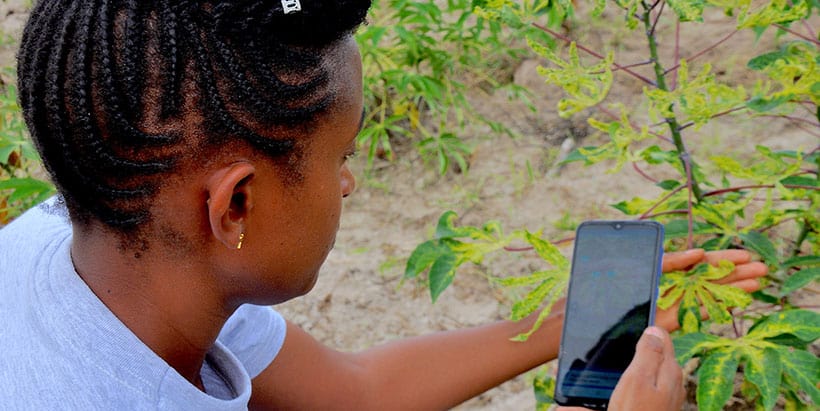
Using the Nuru app to detect diseases on cassava.IITA, one of the CGIAR centers, has been addressing the threats posed by climate change to income and food security for smallholder farmers using a multi-pronged approach. This includes identifying and promoting crops that can build farmers’ resilience to climate change, such as drought-tolerant varieties and crops.
IITA’s basket of digital tools to tackle climate change
The Institute has, in collaboration with its partners, developed or co-developed a series of digital tools to boost productivity of important staples for smallholder farmers in sub-Saharan Africa. These tools address some of the most important challenges faced by farmers including lack of knowledge on good agronomic practices that can optimize yield, attack by pests and diseases and access to seeds of improved varieties. These digital tools include:
Cassava SeedTracker—an innovative web-based app linking cassava seed producers and farmers, which also facilitates quality control through electronic seed certification conducted by national authorities.
Akilimo—a set of tools developed to support farmers in making informed decisions on various agronomic practices such as fertilizer use, optimal planting dates, intercropping, and optimal weed management strategies.
PlantVillage Nuru—an artificial intelligence platform for detecting cassava pests and diseases and providing advice on how to control them.
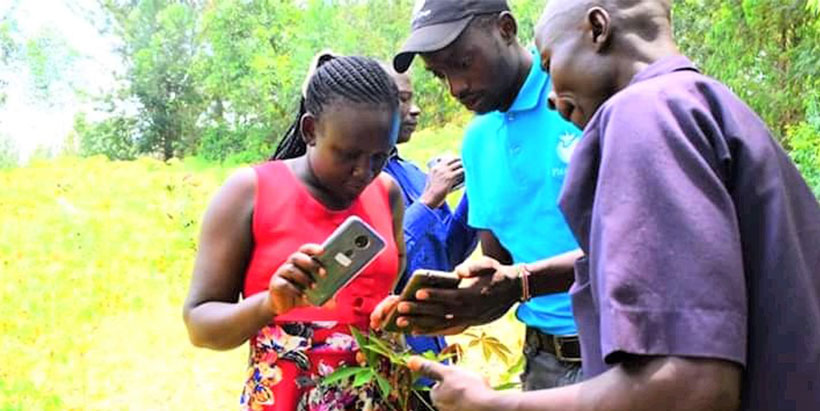
Mercy Tsuma and John Mayieka, Field Officers training farmers on how to use NuruAI in diagnosing diseases in Kenya (Credit: James Mugo)
Artificial Intelligence for disease detection
“NuruAI helps me to easily identify diseases on my crops, especially during the selection of planting material. I have used it multiple times to select disease-free cassava cuttings used in demo sites. I also use it to train farmers or while diagnosing the cassava performance in the demo site,” says James Mugo, a Field Officer and Media Coordinator at PlantVillage Kenya.
Nuru, which means light in Swahili, uses Artificial Intelligence (AI) to support farmers to correctly diagnose major pests and diseases affecting their crops using their smartphones to capture images of diseased leaves. The app identifies the disease and pest damage and provides farmers with advice on control measures.
Mercy Tsuma and John Mayieka, Field Officers training farmers on how to use NuruAI in diagnosing diseases in Kenya (Credit: James Mugo)
The PlantVillage team at Penn State University in the USA applied AI with machine learning to train computers to recognize symptoms of cassava brown streak disease, cassava mosaic disease, cassava green mite damage, and the healthy condition from images of cassava leaves recorded and annotated by the IITA team in Tanzania.
An instant and offline disease recognition capability was then built into the smartphone app ‘Nuru’ which is now being widely used across Africa. The app can also diagnose the devastating invasive fall armyworm (FAW) on maize which is helpful as farmers often grow maize and cassava together.
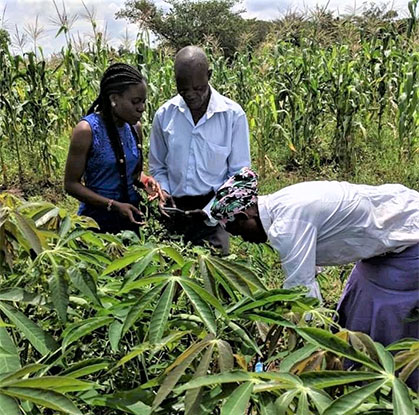
The IITA team has been working with extension officers and farmers to validate the performance and popularize the technology. These include training the researchers, extension officers, seed inspection officers, and farmers in Kenya, Rwanda, Tanzania, and Uganda. The app has been found to significantly outperform trained extension officers in diagnosing cassava diseases.
An essential feature of NuruAI is that it links with the SeedTracker, another digital tool developed by IITA, which helps farmers identify the nearest source of healthy planting materials of improved cassava varieties. NuruAI has been used to monitor cassava diseases in 19 African countries, with Ivory Coast, Kenya, and Tanzania being the hotspots. The app is available for download from Google Play as ‘PlantVillage Nuru’.
This suite of cassava-focused digital tools will help to revolutionize information provision for farmers to enable them to improve their productivity.
IITA scientist James Legg, who has been working on the Nuru and Seed Tacker tools in Tanzania, says “Farmers across Africa face an unprecedented challenge from climate change. But we know that cassava is a crop that will be resilient to these changes. This new package of digital tools will put the power in farmers’ hands to boost their cassava yields and win at least one battle in the war against the menace of climate change.”
The future may actually be brighter than we think!
Watch this video to get an overview of IITA’s digital agricultural tools: https://bigdata.cgiar.org/blog-post/a-glimpse-of-digital-dynamism-for-adaptive-food-systems-across-cgiar-iita/
Olamide Deborah Nwanze is a Senior Research Associate specializing in gender mainstreaming research to inform participatory and inclusive breeding, variety development, and seed systems policies regarding root, tuber, and banana (RTB) crops in the International Institute of Tropical Agriculture Headquarters, Ibadan, Nigeria. She is a PhD candidate at the University of Ibadan and holds an MSc and B. Agric in Agricultural Extension and Rural Development. Olamide is a fellow of the African Women in Agricultural Research and Development – Gender Responsive Agricultural Systems Policy (AWARD-GRASP) and the Gender Responsive Researchers Equipped for Agricultural Transformation (GREAT). She seeks to apply her gender-mainstreaming learnings, gender-responsive research, and policy development, and review expertise to facilitate women, youth, children, and vulnerable social group’s access to and adoption of agricultural Innovations that guarantee food, nutrition, income, and livelihood security in Africa. Her current roles include mentoring research fellows, development of guides and training manuals, implementation and adaptation of gender frameworks and tools, value chain actors’ engagement as citizen science partners, policy review and redesign, data management, and analysis. Her current research explores mixed methods and participatory and interdisciplinary approaches to capture and highlight gender dynamics, needs, preferences, and challenges stakeholders face within the agricultural livelihood value chain to prioritize gender-inclusive strategies in breeding programs, policy design, and implementation.
de Sousa, K., van Etten, J., Manners, R. Bello, A., Teeken, B., Olaosebikan, O., et al. 2024. The tricot approach: an agile framework for decentralized on-farm testing supported by citizen science. A retrospective. Agron. Sustain. Dev. 44, 8. https://doi.org/10.1007/s13593-023-00937-1
Madu, T., Onwuka, S., Nwafor, S., Onyemauwa, N., Ejechi, M., Ofoeze, M., Ukeje, B., Eluagu, C., Olaosebikan, O., Okoye, B., 2024. Gender-Inclusive Consumer Studies Improve Cassava Breeding in Nigeria in: Frontiers in Sociology, volume 9, number: 1224504, doi: 10.3389/fsoc.2024.1224504
Olaosebikan, O.; Bello, A.; Utoblo, O.; Okoye, B.; Olutegbe, N.; Garner, E.; Teeken, B.; Bryan, E.; Forsythe, L.; Cole, S.; Madu, T. 2023. Stressors and Resilience within the Cassava Value Chain in Nigeria: Preferred Cassava Variety Traits and Response Strategies of Men and Women to Inform Breeding. Sustainability 15, 7837. https://doi.org/10.3390/su15107837
Okoye, B., Ofoeze, M., Ejechi, M., Onwuka, S., Nwafor, S., Onyemauwa, N., Ukeje, B., Eluagu, C., Obidiegwu, J.*, Olaosebikan, O., Madu, T.* 2023. Prioritizing preferred traits in the yam value chain in Nigeria: a gender situation analysis in: Frontiers in Sociology, volume 8, number: 1232626, pages 1 – 9, ISSN 2297-7775, 2023. https://www.frontiersin.org/articles/10.3389/fsoc.2023.1232626/full
Olaosebikan, O., Bello, A. A., de Sousa, K., Ndjouenkeu, R., Adesokan, M., Alamu, E. O., Agbona, A., van Etten, J., Kegah, F. N.*, Dufour, D., Bouniol, A., Teeken, B. 2023. Consumer acceptability of cassava gari-eba food products across cultural and environmental settings using the triadic comparison of technologies approach (tricot) in: Journal of the Science of Food and Agriculture,
Teeken, B., Olaosebikan, O., Bello, A. A., Madu, T.*, Cole, S. M. 2023. Qualitative assessment on the positionality and preferences of dyads in relation to cassava-related activities: working with tricot trial citizen scientists https://hdl.handle.net/10568/138326 Type: Manual
Bouniol, A., Ceballos, H., Bello, A. A., Teeken, B., Olaosebikan, O., Owoade, D., Agbona, A., Fotso Kuate, A., Madu, T.*, Okoye, B.*, Ofoeze, M.*, Nwafor, S.*, Onyemauwa, N.*, Adinsi, L.*, Forsythe, L., Dufour, D. 2023. Varietal impact on women’s labour, workload and related drudgery in processing root, tuber and banana crops: focus on cassava in sub-Saharan Africa in: Journal of the Science of Food and Agriculture, pages 1 – 25, ISSN 0022-5142,
Bello, A. A., Agbona, A., Olaosebikan, O., Edughaen, G., Dufour, D., Bouniol, A., Iluebbey, P., Ndjouenkeu, R.*, Rabbi, I. Y., Teeken, B. 2023. Genetic and environmental effects on processing productivity and food product yield: drudgery of women’s work in: Journal of the Science of Food and Agriculture, pages 1 – 32, ISSN 0022-5142, 5
Cavicchioli, M., Zimbiti, T., Teeken, B., Nwanze, D.O., Liani, M., Parkes, E. & Bello, A. 2023. IITA-Gender Responsive Breeding Training Report. Genetic Resources Center, IITA-HQ, Ibadan, 21-23 September, 2022. Ibadan, Nigeria: IITA, (34 p.).https://hdl.handle.net/10568/131368
Agbona, A. Peteti P., Teeken B., Olaosebikan O. Bello, A. A., Parkes, E., Rabbi, I. Y., Mueller, L., Egesi, C., Kulakow, P. 2022. Data Management in Multi-disciplinary African RTB Crop Breeding Programs. In: Williamson, H.F., Leonelli, S. (eds) Towards Responsible Plant Data Linkage: Data Challenges for Agricultural Research and Development. Springer, Cham. https://doi.org/10.1007/978-3-031-13276-6_5
Lora Forsythe, Pricilla Marimo, Sarah Mayanja, Olamide D. Olaosebikan, Esme Stuart, Bela Teeken, Benjamin Okoye, Tessy Madu, (2021). Cross-product Gender Analysis of RTBfoods Step 2 Gendered Food Mapping on RTB Products. Understanding the Drivers of Trait Preferences and the Development of Multi-user RTB Product Profiles, WP1. London, UK: RTBfoods Field Scientific Report, 30 p.
Teeken, B., Garner, E., Agbona, A., Balogun, I., Olaosebikan, O., Bello, A., Madu, T., Okoye, B., Egesi, C., Kulakow, P. and Tufan, H.A. 2021. Beyond “Women’s Traits”: Exploring How Gender, Social Difference, and Household Characteristics Influence Trait Preferences. Frontiers Sustainable Food Systems 5:740926. https://doi.org/10.3389/fsufs.2021.740926
Teeken, B., Agbona, A., Bello, A., Olaosebikan, O., Alamu, E., Adesokan, M., Awoyale, W., Madu, T., Okoye, B., Chijioke, U., Owoade, D., Okoro, M., Bouniol, A., Dufour, D., Hershey, C., Rabbi, I., Maziya‐Dixon, B., Egesi, C., Tufan, H. and Kulakow, P. (020. Understanding cassava varietal preferences through pairwise ranking of gari‐eba and fufu prepared by local farmer–processors. Int J Food Sci Technol.https://doi.org/10.1111/ijfs.14862
Bela Teeken, Olamide Olaosebikan, Ireti Balogun, Benjamin Okoye, Tessy Madu, Steven Cole, Abolore Bello, Elizabeth Parkes. (2020). Piloting the G+ customer and product profile tools for gender-responsive cassava breeding in Nigeria. Nigeria: International Institute of Tropical Agriculture (IITA). https://hdl.handle.net/20.500.11766/13000