
Program coordinator leads stakeholders through TAAT framework in support of the program
February 9, 2018
During the 3-day (22–24 January) inauguration meeting of Technologies for African Agricultural Transformation (TAAT) that brought together national and international development partner institutes, agricultural experts, representatives from national agricultural research and extension systems (NARES), policy makers, and entrepreneurs from the private sector, Dr Jonas Chianu, TAAT Coordinator and Principal Agricultural Economist, African Development Bank (AfDB), provided a framework to support this complex, multi-partner program.
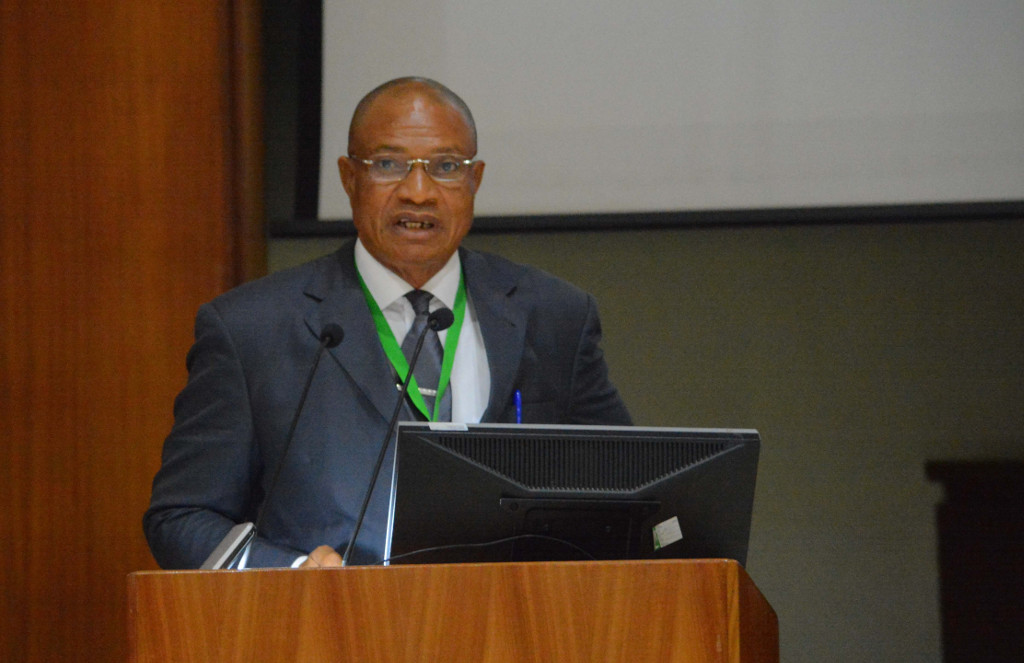 He talked about this in his presentation titled “Framework program in support of FEED AFRICA, which emphasized the level of malnutrition in Africa and the collective effort of various stakeholders to combat it through innovation, by bridging the gap between proven technologies and agricultural production and productivity for African transformation.
He said that more than 160 million Africans are food insecure and malnourished. He also pointed out that Africa’s recent economic gains are at risk if this continues, as low agricultural productivity and value addition are at the heart of the malnutrition, unemployment, and poverty challenges in Africa. TAAT is a knowledge- and innovation-based response to the need for scaling up proven technologies across Africa.
It aims to boost productivity and increase food production over the next 8–10 years through improved food security and income, and will make Africa self-sufficient in key commodities. It will benefit an estimated 11.7 million households over 10 years.
Chianu reiterated that if the technologies that exist to feed Africa are widely deployed today, there will be high-yielding crop varieties and livestock breeds; biofortified crops such as pro-vitamin A-rich cassava, high iron and zinc rice, and high zinc sorghum. If scaled up, these can help to address the problems of malnutrition and stunting of African bodies and minds. TAAT is expected to add 3.15 million direct farm jobs over eight years, add an estimated 120 million tons of food to Africa’s food production valued at US$1.71 to $2.8 billion, and contribute to lifting about 40 million people out of poverty.
Chianu highlighted that the reason technology has not moved to scale before in Africa is due to the absence of a well-coordinated regional effort or platform to deliver food production technologies across similar agroecological zones. Looking to the future, the TAAT program coordinator said that the Bank and its partners will seek to refocus the technically excellent efforts of CGIAR and its network with NARES to emphasize high priority commodities that will reach 40–50% of African farmers with the most relevant food production technologies by 2025.
Echoing the resolve to make it work, Chianu emphasized that the big opportunities in TAAT are strategic alliance/effective collaboration among key development partners to advance agricultural development in Africa, synergizing and capitalizing on their different strengths, bringing to bear the joint collective effort of international, regional, and national agricultural systems to improve connections between research, extension, and reform regulatory systems that impede speedy transfer of technologies across borders.
In conclusion, Chianu said that for TAAT to be the bedrock of Feed Africa, and for it to succeed, it must move African production much higher on the value chain, with agribusinesses producing and selling processed goods, not simply basic commodities, while providing markets for African farmers, through raising agricultural productivity along eight priority intervention areas (PIAs) and over 18 agricultural commodity value chains.
He talked about this in his presentation titled “Framework program in support of FEED AFRICA, which emphasized the level of malnutrition in Africa and the collective effort of various stakeholders to combat it through innovation, by bridging the gap between proven technologies and agricultural production and productivity for African transformation.
He said that more than 160 million Africans are food insecure and malnourished. He also pointed out that Africa’s recent economic gains are at risk if this continues, as low agricultural productivity and value addition are at the heart of the malnutrition, unemployment, and poverty challenges in Africa. TAAT is a knowledge- and innovation-based response to the need for scaling up proven technologies across Africa.
It aims to boost productivity and increase food production over the next 8–10 years through improved food security and income, and will make Africa self-sufficient in key commodities. It will benefit an estimated 11.7 million households over 10 years.
Chianu reiterated that if the technologies that exist to feed Africa are widely deployed today, there will be high-yielding crop varieties and livestock breeds; biofortified crops such as pro-vitamin A-rich cassava, high iron and zinc rice, and high zinc sorghum. If scaled up, these can help to address the problems of malnutrition and stunting of African bodies and minds. TAAT is expected to add 3.15 million direct farm jobs over eight years, add an estimated 120 million tons of food to Africa’s food production valued at US$1.71 to $2.8 billion, and contribute to lifting about 40 million people out of poverty.
Chianu highlighted that the reason technology has not moved to scale before in Africa is due to the absence of a well-coordinated regional effort or platform to deliver food production technologies across similar agroecological zones. Looking to the future, the TAAT program coordinator said that the Bank and its partners will seek to refocus the technically excellent efforts of CGIAR and its network with NARES to emphasize high priority commodities that will reach 40–50% of African farmers with the most relevant food production technologies by 2025.
Echoing the resolve to make it work, Chianu emphasized that the big opportunities in TAAT are strategic alliance/effective collaboration among key development partners to advance agricultural development in Africa, synergizing and capitalizing on their different strengths, bringing to bear the joint collective effort of international, regional, and national agricultural systems to improve connections between research, extension, and reform regulatory systems that impede speedy transfer of technologies across borders.
In conclusion, Chianu said that for TAAT to be the bedrock of Feed Africa, and for it to succeed, it must move African production much higher on the value chain, with agribusinesses producing and selling processed goods, not simply basic commodities, while providing markets for African farmers, through raising agricultural productivity along eight priority intervention areas (PIAs) and over 18 agricultural commodity value chains.
Dr Jonas Chianu gives an overview of the TAAT Program
Contributed by
Recent stories
No items found