
NEWS

R4D Special: Scientists push for use of animation in rural communication
July 8, 2017

Over 1 billion low literate and illiterate individuals living in the remote rural areas of developing countries have been reported to experience the daunting challenge of understanding scientific findings. Because of lack of formal education, their comprehension of science is further hampered. The situation in countries like Benin republic and Nigeria for instance is no different, but there’s hope.

In the past, traditional government-based agricultural extension programs have mostly been the channel through which knowledge reaches rural farmers in Africa. This is however seriously hindered by lack of funds and materials, forcing one extension worker to provide services to over 1200 farmers in many instances.

Through a recent survey conducted by IITA scientists in collaboration with partners, it has been found that the mobile technological application—Michigan State University’s Scientific Animations Without Borders (SAWBO)—has bridged the hurdles that extension agents face in discharging their duties and now makes learning more fun and easier for West Africa’s rural beneficiaries.

With SAWBO, extension agents are better able to share life-improving knowledge with the farmers who produce the bulk of Africa’s food.

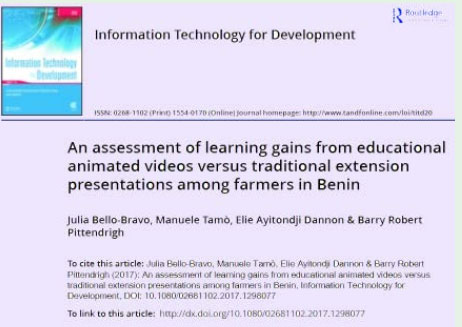
Carried out in Bénin, the study tagged “An assessment of learning gains from educational animated videos versus traditional extension presentations among farmers in Benin” sought to verify the retention of lessons acquired in agriculture and health through SAWBO versus that from traditional learning extension (TLE). The survey was anchored on the premise that farmers in Benin and other developing nations have the potential to access information through mobile phones, and since they constitute the largest proportion of the uneducated population in rural areas, they should be the main target audience of any exploratory ICT training.

SAWBO represents an academically based exploration for connecting global experts in a virtual manner to create educational content for use by low-literate learners—an exploration that aims to produce tangible educational content that is testable, useable, and effective in the field. By design, SAWBO animations use carefully crafted, cross-culturally acceptable visual images amenable to translation and description in potentially any local (or locally accented) language. Each SAWBO educational video addresses specific diseases, value chain limitations, or agricultural challenges and proposes effective and simple techniques that can be adopted in the field.

The videos are provided free of charge and for educational purposes only. SAWBO can be directly downloaded onto a computer from their online library (http://sawbo-animations.org). Additionally, SAWBO’s Deployer Application (App) 1.1 allows anyone with an Android phone and access to the Internet to access SAWBO animations. The animations, in turn, can be downloaded onto an Android device through the Deployer App and then played at any time, including when the device has no access to the Internet.

In this way, an extension agent or aid worker can use such a device as a portable video-viewing device for individuals or groups in the field, easily providing them access to educational animations either on a specific, relevant topic and in a specific, relevant (or locally accented) language as well as the local country accent for that language (where available) or at least the closest useful animation and language/accent.

Additionally, the animation can be shared and transferred onto other devices using Bluetooth technology, allowing the animation to spread “virally” between phones, even those without an Internet connection, thus making it a highly efficient and accessible system of sharing knowledge. The App is available for free download on Google Play (goo.gl/uH7Ggo).

Similarly, it was also discovered that participants who watched a video animation demonstrated greater learning gains compared to those who attended a TLE presentation of the same information, and also that animation viewers more highly recommended them as a form of information sharing.

Based on these findings, the scientists are advocating for a concerted effort in sharing and replaying learning videos because the “authority” of the information in the videos resides in their scientifically developed content. Replaying the video reproduces the original learning environment on the spot and effectively makes each person sharing the video into a kind of teacher.

The study was conducted by Julia Bello-Bravo from Michigan State University, East Lansing, Michigan, USA; Manuele Tamò, and Elie Ayitondji Dannon from IITA, as well as Barry Robert Pittendrigh, also from Michigan State University.


Contributed by

Recent stories

No items found

Leave a Reply

Your email address will not be published. Required fields are marked *

Scroll to Top
Olaosebikan, Olamide

Olamide Deborah Nwanze is a Senior Research Associate specializing in gender mainstreaming research to inform participatory and inclusive breeding, variety development, and seed systems policies regarding root, tuber, and banana (RTB) crops in the International Institute of Tropical Agriculture Headquarters, Ibadan, Nigeria. She is a PhD candidate at the University of Ibadan and holds an MSc and B. Agric in Agricultural Extension and Rural Development. Olamide is a fellow of the African Women in Agricultural Research and Development – Gender Responsive Agricultural Systems Policy (AWARD-GRASP) and the Gender Responsive Researchers Equipped for Agricultural Transformation (GREAT). She seeks to apply her gender-mainstreaming learnings, gender-responsive research, and policy development, and review expertise to facilitate women, youth, children, and vulnerable social group’s access to and adoption of agricultural Innovations that guarantee food, nutrition, income, and livelihood security in Africa. Her current roles include mentoring research fellows, development of guides and training manuals, implementation and adaptation of gender frameworks and tools, value chain actors’ engagement as citizen science partners, policy review and redesign, data management, and analysis. Her current research explores mixed methods and participatory and interdisciplinary approaches to capture and highlight gender dynamics, needs, preferences, and challenges stakeholders face within the agricultural livelihood value chain to prioritize gender-inclusive strategies in breeding programs, policy design, and implementation.

At IITA, she contributes to the implementation of the CGIAR Accelerated Breeding Initiative and Genetic Innovation Programs; participatory and gender research within the NextGen CassavaHarvestPlusRTBFoods, and Tricot-ClimMob 1000Farms Projects; and gender knowledge communication via the G-LENS webinar series, video documentary, policy briefspublications, and blogs.


Recent publications

de Sousa, K., van Etten, J., Manners, R. Bello, A., Teeken, B., Olaosebikan, O., et al. 2024. The tricot approach: an agile framework for decentralized on-farm testing supported by citizen science. A retrospective. Agron. Sustain. Dev. 44, 8. https://doi.org/10.1007/s13593-023-00937-1

Madu, T., Onwuka, S., Nwafor, S., Onyemauwa, N., Ejechi, M., Ofoeze, M., Ukeje, B., Eluagu, C., Olaosebikan, O., Okoye, B., 2024. Gender-Inclusive Consumer Studies Improve Cassava Breeding in Nigeria in: Frontiers in Sociology, volume 9, number: 1224504, doi: 10.3389/fsoc.2024.1224504

Olaosebikan, O.; Bello, A.; Utoblo, O.; Okoye, B.; Olutegbe, N.; Garner, E.; Teeken, B.; Bryan, E.; Forsythe, L.; Cole, S.; Madu, T. 2023.  Stressors and Resilience within the Cassava Value Chain in Nigeria: Preferred Cassava Variety Traits and Response Strategies of Men and Women to Inform Breeding. Sustainability 15, 7837. https://doi.org/10.3390/su15107837

Okoye, B., Ofoeze, M., Ejechi, M., Onwuka, S., Nwafor, S., Onyemauwa, N., Ukeje, B., Eluagu, C., Obidiegwu, J.*, Olaosebikan, O., Madu, T.* 2023. Prioritizing preferred traits in the yam value chain in Nigeria: a gender situation analysis in: Frontiers in Sociology, volume 8, number: 1232626, pages 1 – 9, ISSN 2297-7775, 2023. https://www.frontiersin.org/articles/10.3389/fsoc.2023.1232626/full

Olaosebikan, O., Bello, A. A., de Sousa, K., Ndjouenkeu, R., Adesokan, M., Alamu, E. O., Agbona, A., van Etten, J., Kegah, F. N.*, Dufour, D., Bouniol, A., Teeken, B. 2023. Consumer acceptability of cassava gari-eba food products across cultural and environmental settings using the triadic comparison of technologies approach (tricot) in: Journal of the Science of Food and Agriculture,

Teeken, B., Olaosebikan, O., Bello, A. A., Madu, T.*, Cole, S. M. 2023. Qualitative assessment on the positionality and preferences of dyads in relation to cassava-related activities: working with tricot trial citizen scientists https://hdl.handle.net/10568/138326 Type: Manual

Bouniol, A., Ceballos, H., Bello, A. A., Teeken, B., Olaosebikan, O., Owoade, D., Agbona, A., Fotso Kuate, A., Madu, T.*, Okoye, B.*, Ofoeze, M.*, Nwafor, S.*, Onyemauwa, N.*, Adinsi, L.*, Forsythe, L., Dufour, D. 2023. Varietal impact on women’s labour, workload and related drudgery in processing root, tuber and banana crops: focus on cassava in sub-Saharan Africa in: Journal of the Science of Food and Agriculture, pages 1 – 25, ISSN 0022-5142,

Bello, A. A., Agbona, A., Olaosebikan, O., Edughaen, G., Dufour, D., Bouniol, A., Iluebbey, P., Ndjouenkeu, R.*, Rabbi, I. Y., Teeken, B. 2023. Genetic and environmental effects on processing productivity and food product yield: drudgery of women’s work in: Journal of the Science of Food and Agriculture, pages 1 – 32, ISSN 0022-5142, 5

Cavicchioli, M., Zimbiti, T., Teeken, B., Nwanze, D.O., Liani, M., Parkes, E. & Bello, A. 2023. IITA-Gender Responsive Breeding Training Report. Genetic Resources Center, IITA-HQ, Ibadan, 21-23 September, 2022. Ibadan, Nigeria: IITA, (34 p.).https://hdl.handle.net/10568/131368

Agbona, A. Peteti P., Teeken B., Olaosebikan O. Bello, A. A., Parkes, E., Rabbi, I. Y., Mueller, L., Egesi, C., Kulakow, P. 2022. Data Management in Multi-disciplinary African RTB Crop Breeding Programs. In: Williamson, H.F., Leonelli, S. (eds) Towards Responsible Plant Data Linkage: Data Challenges for Agricultural Research and Development. Springer, Cham. https://doi.org/10.1007/978-3-031-13276-6_5

Lora Forsythe, Pricilla Marimo, Sarah Mayanja, Olamide D. Olaosebikan, Esme Stuart, Bela Teeken, Benjamin Okoye, Tessy Madu, (2021). Cross-product Gender Analysis of RTBfoods Step 2 Gendered Food Mapping on RTB Products. Understanding the Drivers of Trait Preferences and the Development of Multi-user RTB Product Profiles, WP1. London, UK: RTBfoods Field Scientific Report, 30 p.

Teeken, B., Garner, E., Agbona, A., Balogun, I., Olaosebikan, O., Bello, A., Madu, T., Okoye, B., Egesi, C., Kulakow, P. and Tufan, H.A. 2021. Beyond “Women’s Traits”: Exploring How Gender, Social Difference, and Household Characteristics Influence Trait Preferences. Frontiers Sustainable Food Systems 5:740926. https://doi.org/10.3389/fsufs.2021.740926

Teeken, B., Agbona, A., Bello, A., Olaosebikan, O., Alamu, E., Adesokan, M., Awoyale, W., Madu, T., Okoye, B., Chijioke, U., Owoade, D., Okoro, M., Bouniol, A., Dufour, D., Hershey, C., Rabbi, I., Maziya‐Dixon, B., Egesi, C., Tufan, H. and Kulakow, P. (020. Understanding cassava varietal preferences through pairwise ranking of gari‐eba and fufu prepared by local farmer–processors. Int J Food Sci Technol. https://doi.org/10.1111/ijfs.14862

Bela Teeken, Olamide Olaosebikan, Ireti Balogun, Benjamin Okoye, Tessy Madu, Steven Cole, Abolore Bello, Elizabeth Parkes. (2020). Piloting the G+ customer and product profile tools for gender-responsive cassava breeding in Nigeria. Nigeria: International Institute of Tropical Agriculture (IITA). https://hdl.handle.net/20.500.11766/13000