
IITA NEWS

Reducing Postharvest loss project donates equipment to set up mycotoxin testing hubs in Nigeria
December 22, 2022

In a ceremony held on 29 November at IITA-Abuja, IITA Associate Scientist Titilayo Falade and Acting Head of Abuja Station Prakash Kant Silwal handed over mycotoxin testing equipment (Neogen® Raptor) and accessories worth $13,000 to private and public sector partners: Coopetition Forum for Aflatoxin Reduced Agricultural Products (CFARAP) and the National Agency for Food and Drug Administration and Control (NAFDAC). The equipment donation was facilitated with funding from the Global Alliance for Improved Nutrition (GAIN) and HarvestPlus as part of the project, Reducing Post Harvest Loss Across Vitamin A Maize and Cassava Value Chains in Nigeria.
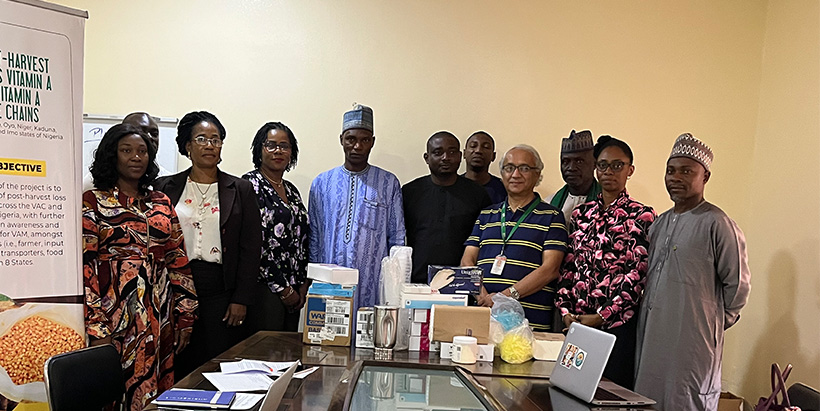
IITA's Titilayo Falade (second right) and Prakash Kant Silwal (fourth right) handing over the mycotoxin testing equipment and accessories to the NAFDAC and CFARAP teams.
IITA’s Titilayo Falade (second right) and Prakash Kant Silwal (fourth right) handing over the mycotoxin testing equipment and accessories to the NAFDAC and CFARAP teams.

While receiving the delegation, Silwal spoke about the innovative work on aflatoxin management by IITA’s team and congratulated Falade for the project’s contribution to addressing food safety needs, especially aflatoxin management in Nigeria. He mentioned that this equipment would complement the activities of CFARAP and NAFDAC and thanked the organizations for their partnership in aflatoxin mitigation. Silwal further appreciated the donors for making funds available to donate the mycotoxin testing equipment to NAFDAC and CFARAP.

In response, CFARAP Chairman Ali Ali, while receiving the testing equipment, expressed delight over the donations and assured the commitment of CFARAP to maximize the testing equipment. He insisted that the equipment would strengthen their capacity as private sector partners for mobile and in-situ testing aflatoxins in multiple food crops. Ali further mentioned that their organization, comprising over 40 private companies nationwide, has been strengthened in meeting aflatoxin regulatory demands since Aflasafe’s introduction under the AgResults project. The new testing equipment would increase their capacity to contribute to aflatoxin management nationwide.

The NAFDAC DG, represented by Food Safety and Applied Nutrition Assistant Director, Adenike Adegbenro, appreciated the timely and laudable initiative by IITA in collaboration with GAIN and HarvestPlus. She stated that, as part of NAFDAC’s regulatory activities, the Agency is committed to “ensuring the availability of safe, quality, and wholesome food products to the populace.” She pledged that the testing equipment would be put to good use nationwide by the well-trained mycotoxin experts in NAFDAC and looked forward to continued collaboration with IITA.

In his remarks, GAIN Country Commercialization Project Manager Tavershima Torhemen lauded IITA for developing different strategies for aflatoxin management, including establishing mobile testing hubs. He commended the project team led by Lateef Sanni and applauded Falade’s impactful work toward managing aflatoxin in the eight project states. “IITA has far exceeded expectations on this project, and we are indeed happy with the progress thus far,” said Torhemen. He also appreciated NAFDAC and CFARAP for attending the ceremony.

Falade thanked GAIN and HarvestPlus for their partnership and funding to provide the testing equipment to partners. She highlighted the Neogen® testing equipment’s ability to test multiple mycotoxins, including aflatoxins, stating that it would contribute to continued food safety efforts in Nigeria. She expressed confidence that, as strong partners, CFARAP and NAFDAC are well placed as private and public sector partners that can contribute towards aflatoxin management and that the testing equipment adds to their capacity to do so. She thanked them for their national contributions and welcomed their continued partnership in strengthening food safety in Nigeria.

As part of the project’s objectives, IITA trained stakeholders on mycotoxin management strategies in eight states from June to July and established a stakeholders’ platform via the Food Convergence Innovation—Nigeria Stakeholders’ Convention—in October for collaborative engagement. The Institute also handed over equipment to establish testing hubs for rapid mycotoxin in-situ analysis.

Contributed by Terngu Abur and Titilayo Falade


Contributed by

Related news

No items found

Leave a Reply

Your email address will not be published. Required fields are marked *

Scroll to Top
Olaosebikan, Olamide

Olamide Deborah Nwanze is a Senior Research Associate specializing in gender mainstreaming research to inform participatory and inclusive breeding, variety development, and seed systems policies regarding root, tuber, and banana (RTB) crops in the International Institute of Tropical Agriculture Headquarters, Ibadan, Nigeria. She is a PhD candidate at the University of Ibadan and holds an MSc and B. Agric in Agricultural Extension and Rural Development. Olamide is a fellow of the African Women in Agricultural Research and Development – Gender Responsive Agricultural Systems Policy (AWARD-GRASP) and the Gender Responsive Researchers Equipped for Agricultural Transformation (GREAT). She seeks to apply her gender-mainstreaming learnings, gender-responsive research, and policy development, and review expertise to facilitate women, youth, children, and vulnerable social group’s access to and adoption of agricultural Innovations that guarantee food, nutrition, income, and livelihood security in Africa. Her current roles include mentoring research fellows, development of guides and training manuals, implementation and adaptation of gender frameworks and tools, value chain actors’ engagement as citizen science partners, policy review and redesign, data management, and analysis. Her current research explores mixed methods and participatory and interdisciplinary approaches to capture and highlight gender dynamics, needs, preferences, and challenges stakeholders face within the agricultural livelihood value chain to prioritize gender-inclusive strategies in breeding programs, policy design, and implementation.

At IITA, she contributes to the implementation of the CGIAR Accelerated Breeding Initiative and Genetic Innovation Programs; participatory and gender research within the NextGen CassavaHarvestPlusRTBFoods, and Tricot-ClimMob 1000Farms Projects; and gender knowledge communication via the G-LENS webinar series, video documentary, policy briefspublications, and blogs.


Recent publications

de Sousa, K., van Etten, J., Manners, R. Bello, A., Teeken, B., Olaosebikan, O., et al. 2024. The tricot approach: an agile framework for decentralized on-farm testing supported by citizen science. A retrospective. Agron. Sustain. Dev. 44, 8. https://doi.org/10.1007/s13593-023-00937-1

Madu, T., Onwuka, S., Nwafor, S., Onyemauwa, N., Ejechi, M., Ofoeze, M., Ukeje, B., Eluagu, C., Olaosebikan, O., Okoye, B., 2024. Gender-Inclusive Consumer Studies Improve Cassava Breeding in Nigeria in: Frontiers in Sociology, volume 9, number: 1224504, doi: 10.3389/fsoc.2024.1224504

Olaosebikan, O.; Bello, A.; Utoblo, O.; Okoye, B.; Olutegbe, N.; Garner, E.; Teeken, B.; Bryan, E.; Forsythe, L.; Cole, S.; Madu, T. 2023.  Stressors and Resilience within the Cassava Value Chain in Nigeria: Preferred Cassava Variety Traits and Response Strategies of Men and Women to Inform Breeding. Sustainability 15, 7837. https://doi.org/10.3390/su15107837

Okoye, B., Ofoeze, M., Ejechi, M., Onwuka, S., Nwafor, S., Onyemauwa, N., Ukeje, B., Eluagu, C., Obidiegwu, J.*, Olaosebikan, O., Madu, T.* 2023. Prioritizing preferred traits in the yam value chain in Nigeria: a gender situation analysis in: Frontiers in Sociology, volume 8, number: 1232626, pages 1 – 9, ISSN 2297-7775, 2023. https://www.frontiersin.org/articles/10.3389/fsoc.2023.1232626/full

Olaosebikan, O., Bello, A. A., de Sousa, K., Ndjouenkeu, R., Adesokan, M., Alamu, E. O., Agbona, A., van Etten, J., Kegah, F. N.*, Dufour, D., Bouniol, A., Teeken, B. 2023. Consumer acceptability of cassava gari-eba food products across cultural and environmental settings using the triadic comparison of technologies approach (tricot) in: Journal of the Science of Food and Agriculture,

Teeken, B., Olaosebikan, O., Bello, A. A., Madu, T.*, Cole, S. M. 2023. Qualitative assessment on the positionality and preferences of dyads in relation to cassava-related activities: working with tricot trial citizen scientists https://hdl.handle.net/10568/138326 Type: Manual

Bouniol, A., Ceballos, H., Bello, A. A., Teeken, B., Olaosebikan, O., Owoade, D., Agbona, A., Fotso Kuate, A., Madu, T.*, Okoye, B.*, Ofoeze, M.*, Nwafor, S.*, Onyemauwa, N.*, Adinsi, L.*, Forsythe, L., Dufour, D. 2023. Varietal impact on women’s labour, workload and related drudgery in processing root, tuber and banana crops: focus on cassava in sub-Saharan Africa in: Journal of the Science of Food and Agriculture, pages 1 – 25, ISSN 0022-5142,

Bello, A. A., Agbona, A., Olaosebikan, O., Edughaen, G., Dufour, D., Bouniol, A., Iluebbey, P., Ndjouenkeu, R.*, Rabbi, I. Y., Teeken, B. 2023. Genetic and environmental effects on processing productivity and food product yield: drudgery of women’s work in: Journal of the Science of Food and Agriculture, pages 1 – 32, ISSN 0022-5142, 5

Cavicchioli, M., Zimbiti, T., Teeken, B., Nwanze, D.O., Liani, M., Parkes, E. & Bello, A. 2023. IITA-Gender Responsive Breeding Training Report. Genetic Resources Center, IITA-HQ, Ibadan, 21-23 September, 2022. Ibadan, Nigeria: IITA, (34 p.).https://hdl.handle.net/10568/131368

Agbona, A. Peteti P., Teeken B., Olaosebikan O. Bello, A. A., Parkes, E., Rabbi, I. Y., Mueller, L., Egesi, C., Kulakow, P. 2022. Data Management in Multi-disciplinary African RTB Crop Breeding Programs. In: Williamson, H.F., Leonelli, S. (eds) Towards Responsible Plant Data Linkage: Data Challenges for Agricultural Research and Development. Springer, Cham. https://doi.org/10.1007/978-3-031-13276-6_5

Lora Forsythe, Pricilla Marimo, Sarah Mayanja, Olamide D. Olaosebikan, Esme Stuart, Bela Teeken, Benjamin Okoye, Tessy Madu, (2021). Cross-product Gender Analysis of RTBfoods Step 2 Gendered Food Mapping on RTB Products. Understanding the Drivers of Trait Preferences and the Development of Multi-user RTB Product Profiles, WP1. London, UK: RTBfoods Field Scientific Report, 30 p.

Teeken, B., Garner, E., Agbona, A., Balogun, I., Olaosebikan, O., Bello, A., Madu, T., Okoye, B., Egesi, C., Kulakow, P. and Tufan, H.A. 2021. Beyond “Women’s Traits”: Exploring How Gender, Social Difference, and Household Characteristics Influence Trait Preferences. Frontiers Sustainable Food Systems 5:740926. https://doi.org/10.3389/fsufs.2021.740926

Teeken, B., Agbona, A., Bello, A., Olaosebikan, O., Alamu, E., Adesokan, M., Awoyale, W., Madu, T., Okoye, B., Chijioke, U., Owoade, D., Okoro, M., Bouniol, A., Dufour, D., Hershey, C., Rabbi, I., Maziya‐Dixon, B., Egesi, C., Tufan, H. and Kulakow, P. (020. Understanding cassava varietal preferences through pairwise ranking of gari‐eba and fufu prepared by local farmer–processors. Int J Food Sci Technol. https://doi.org/10.1111/ijfs.14862

Bela Teeken, Olamide Olaosebikan, Ireti Balogun, Benjamin Okoye, Tessy Madu, Steven Cole, Abolore Bello, Elizabeth Parkes. (2020). Piloting the G+ customer and product profile tools for gender-responsive cassava breeding in Nigeria. Nigeria: International Institute of Tropical Agriculture (IITA). https://hdl.handle.net/20.500.11766/13000