
IITA NEWS

Regional Hub for Fertilizer and Soil Health using data science for nutrition recommendations to boost food productivity in West Africa
July 25, 2025

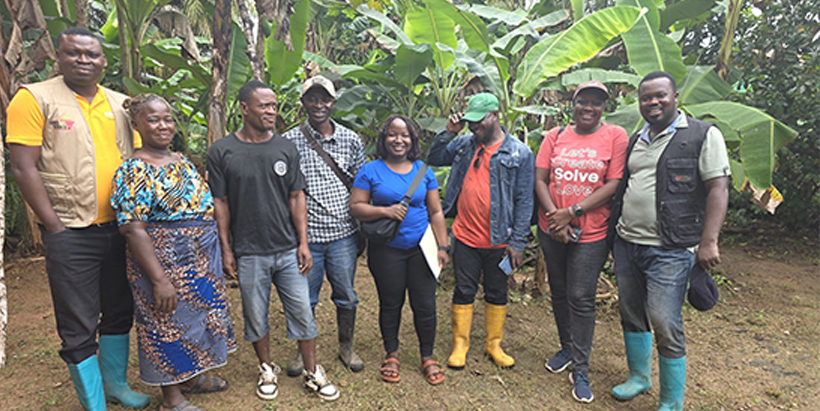
IITA team setting up rice trials in Liberia.

IITACGIAR is deploying advanced data and AI-driven modelling to boost soil nutrient management and soil health and improve farmer productivity in West Africa, a region experiencing recurrent nutrient depletion due to unsustainable farming practices and injudicious fertilizer use.

Crops remove essential nutrients such as Nitrogen, Phosphorus, and Potassium (NPK) from the soil during growth and harvest. These nutrients are vital for crop development and must be replenished through natural decomposition or mineral fertilizers to avoid soil fertility deterioration leading to poor yields.

Nutrient mining and inefficient fertilizer use

Farmers in West Africa and the Sahel region experience poor crop yields as they apply fertilizers inefficiently and without a scientific understanding of their soils’ specific nutrient needs. To address this, the Regional Hub for Fertilizer and Soil Health Hub for West Africa, a collaborative initiative to promote soil health and sustainable fertilizer use in the region, uses data science and advanced modelling to develop site-specific fertilizer recommendations for farmers to improve soil fertility management and productivity.

Launched in 2024 as a sub-program of the Economic Community of West African States (ECOWAS), the Regional Hub brings together diverse stakeholders, including IITA, International Fertilizer Development Center (IFDC), OCP Africa, African Plant Nutrition Institute (APNI), University Mohammed VI Polytechnic (UM6P), and the World Bank, through the Accelerating Impacts of CGIAR Climate Research for Africa (AICCRA) project.

The Regional Hub provides technical assistance for developing and implementing ongoing, new fertilizer and soil health-related investments in Africa. One of its key functions focuses on developing site-specific fertilizer recommendations tailored to local soil conditions and crop needs using high-quality agronomic datasets and cutting-edge data science techniques. The fertilizer recommendations align with the principles of Integrated Soil Fertility Management (ISFM) and the 4Rs of nutrient stewardship; right source, right rate, right time, and right place to support climate-smart, efficient, and sustainable agriculture across the region.
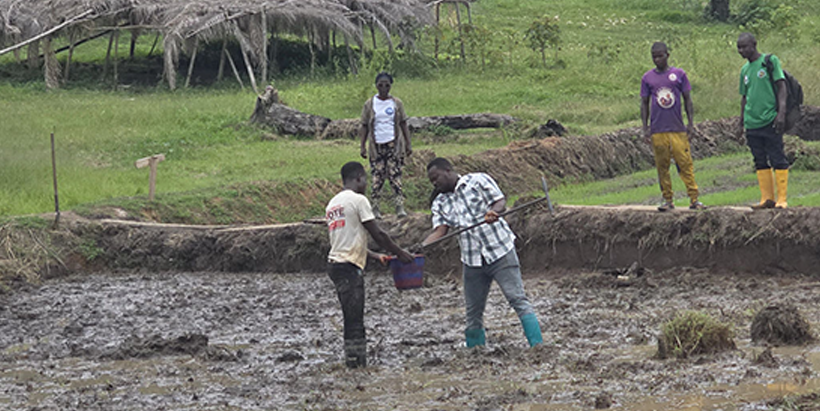
Preparation of rice trial plots in Liberia.

From field trials to farmer recommendations

Dr Siyabusa Mkuhlani, Associate Scientist-Data Science at the IITA, Kenya, highlighted that the Regional Hub is developing site-specific fertilizer recommendations using data and models such as Agwise. AgWise is a freely available, open-source tool that provides data-driven, localized, and climate-specific agronomic recommendations. It combines agronomic and geospatial datasets from field trials, market analyses, and open data sources to deliver tailored advice on optimal planting times, cultivar selection, fertilizer types and quantities, and good agronomic practices.

The Regional Hub has established and manages multi-locational nutrient omission trials to generate data to input into models to develop site-specific fertilizer recommendations. Trials are currently underway in Ghana, Nigeria, Togo, Sierra Leone, and Liberia, where key crops include rice, maize, and cassava.

Data, a development imperative

“We need data,” says Dr Mkuhlani. “This data helps in understanding the current soil limitations, level of productivity, and how much nutrients are available in the soil for crop growth and development. Specifically, such data is in the form of nutrient omission, where N+P without K, or P+K without N or K+ N without the P, enables us to determine the extent of limit and deficiency of specific nutrients”. “Using models, we can determine how much additional nutrients (NPK) to apply for a farmer to attain certain yield targets,” Dr Mkuhlani explained. “This additional NPK needed varies per location and environment. In some locations, soils are already rich and a little NPK can be applied, while others are poor and need more NPK.”

Dr Mkuhlani notes that in developing the site-specific fertilizer recommendation, farmers’ socio-economic information is used to determine how much NPK nutrients are needed for the farmer to achieve a certain yield, but at what cost. For example, the fertilizer recommendations could cost $200 to achieve the potential yield. However, a farmer indicates that if they have $50 to invest, the model can determine the appropriate recommendation suited for the current investment. It can recommend that a farmer buy 20 kgs of Nitrogen, 30 kg of Phosphorus, and 10 kg of potassium, equivalent to $50 fertilizer. In short, the model will determine the target fertilizer application based on the available investment. In the next season, the farmers can increase their investment until they get to maximum potential yield assessed for their soils.
“These recommendations are not recommended as elemental NPK because it is difficult for my grandmother to understand, but instead, the recommendations are made as bags of fertilizer types found in the region.

The Regional Hub will operate for at least ten years, rolling out site-specific fertilizer recommendations in West Africa and the Sahel region. Legacy agronomic data for maize, rice, and cassava in Nigeria, Ghana, Togo, and Sierra Leone have already been gathered from repositories. Therefore, we are currently generating the nutrient management recommendations, and the process is 25% complete.

“Our dream is for farmers in West Africa to be more productive and more profitable because they are more knowledgeable about the right fertilizer applications needed for their soils,” said. Dr Mkuhlani. “We also expect to see an improved and capacitated agricultural extension system in the region as we are giving out these recommendations to extension officers who work directly with farmers, and they should be technically competent to train others.”

About the Regional Hub for Fertilizer and Soil Health for West Africa and the Sahel

The Fertilizer and Soil Health Hub for West Africa and the Sahel is a collaborative initiative to promote soil health and sustainable fertilizer use in the region. Launched in 2024 as a sub-program of the Economic Community of West African States (ECOWAS), the Hub brings together diverse stakeholders who include the International Institute of Tropical Agriculture (IITA), International Fertilizer Development Center (IFDC), OCP Africa, African Plant Nutrition Institute (APNI), University Mohammed VI Polytechnic (UM6P), and the World Bank through the Accelerating Impacts of CGIAR Climate Research for Africa (AICCRA) project.

The Regional Hub, established by a consortium of organizations, aligns directly with the needs outlined in the Roadmap for Fertilizer and Soil Health inscribed by ECOWAS, World Bank (AICCRA project), and IFDC (September 2023). This strategic alignment underscores the Hub’s direct relevance to the summit’s critical discussions on addressing Africa’s soil health challenges and enhancing agricultural productivity.

The Regional Hub headquarters is at the IITA campus in Ibadan, Nigeria.

Contributed by Barbara Muzata


Contributed by

Related news

No items found

Leave a Reply

Your email address will not be published. Required fields are marked *

Scroll to Top
Olaosebikan, Olamide

Olamide Deborah Nwanze is a Senior Research Associate specializing in gender mainstreaming research to inform participatory and inclusive breeding, variety development, and seed systems policies regarding root, tuber, and banana (RTB) crops in the International Institute of Tropical Agriculture Headquarters, Ibadan, Nigeria. She is a PhD candidate at the University of Ibadan and holds an MSc and B. Agric in Agricultural Extension and Rural Development. Olamide is a fellow of the African Women in Agricultural Research and Development – Gender Responsive Agricultural Systems Policy (AWARD-GRASP) and the Gender Responsive Researchers Equipped for Agricultural Transformation (GREAT). She seeks to apply her gender-mainstreaming learnings, gender-responsive research, and policy development, and review expertise to facilitate women, youth, children, and vulnerable social group’s access to and adoption of agricultural Innovations that guarantee food, nutrition, income, and livelihood security in Africa. Her current roles include mentoring research fellows, development of guides and training manuals, implementation and adaptation of gender frameworks and tools, value chain actors’ engagement as citizen science partners, policy review and redesign, data management, and analysis. Her current research explores mixed methods and participatory and interdisciplinary approaches to capture and highlight gender dynamics, needs, preferences, and challenges stakeholders face within the agricultural livelihood value chain to prioritize gender-inclusive strategies in breeding programs, policy design, and implementation.

At IITA, she contributes to the implementation of the CGIAR Accelerated Breeding Initiative and Genetic Innovation Programs; participatory and gender research within the NextGen CassavaHarvestPlusRTBFoods, and Tricot-ClimMob 1000Farms Projects; and gender knowledge communication via the G-LENS webinar series, video documentary, policy briefspublications, and blogs.


Recent publications

de Sousa, K., van Etten, J., Manners, R. Bello, A., Teeken, B., Olaosebikan, O., et al. 2024. The tricot approach: an agile framework for decentralized on-farm testing supported by citizen science. A retrospective. Agron. Sustain. Dev. 44, 8. https://doi.org/10.1007/s13593-023-00937-1

Madu, T., Onwuka, S., Nwafor, S., Onyemauwa, N., Ejechi, M., Ofoeze, M., Ukeje, B., Eluagu, C., Olaosebikan, O., Okoye, B., 2024. Gender-Inclusive Consumer Studies Improve Cassava Breeding in Nigeria in: Frontiers in Sociology, volume 9, number: 1224504, doi: 10.3389/fsoc.2024.1224504

Olaosebikan, O.; Bello, A.; Utoblo, O.; Okoye, B.; Olutegbe, N.; Garner, E.; Teeken, B.; Bryan, E.; Forsythe, L.; Cole, S.; Madu, T. 2023.  Stressors and Resilience within the Cassava Value Chain in Nigeria: Preferred Cassava Variety Traits and Response Strategies of Men and Women to Inform Breeding. Sustainability 15, 7837. https://doi.org/10.3390/su15107837

Okoye, B., Ofoeze, M., Ejechi, M., Onwuka, S., Nwafor, S., Onyemauwa, N., Ukeje, B., Eluagu, C., Obidiegwu, J.*, Olaosebikan, O., Madu, T.* 2023. Prioritizing preferred traits in the yam value chain in Nigeria: a gender situation analysis in: Frontiers in Sociology, volume 8, number: 1232626, pages 1 – 9, ISSN 2297-7775, 2023. https://www.frontiersin.org/articles/10.3389/fsoc.2023.1232626/full

Olaosebikan, O., Bello, A. A., de Sousa, K., Ndjouenkeu, R., Adesokan, M., Alamu, E. O., Agbona, A., van Etten, J., Kegah, F. N.*, Dufour, D., Bouniol, A., Teeken, B. 2023. Consumer acceptability of cassava gari-eba food products across cultural and environmental settings using the triadic comparison of technologies approach (tricot) in: Journal of the Science of Food and Agriculture,

Teeken, B., Olaosebikan, O., Bello, A. A., Madu, T.*, Cole, S. M. 2023. Qualitative assessment on the positionality and preferences of dyads in relation to cassava-related activities: working with tricot trial citizen scientists https://hdl.handle.net/10568/138326 Type: Manual

Bouniol, A., Ceballos, H., Bello, A. A., Teeken, B., Olaosebikan, O., Owoade, D., Agbona, A., Fotso Kuate, A., Madu, T.*, Okoye, B.*, Ofoeze, M.*, Nwafor, S.*, Onyemauwa, N.*, Adinsi, L.*, Forsythe, L., Dufour, D. 2023. Varietal impact on women’s labour, workload and related drudgery in processing root, tuber and banana crops: focus on cassava in sub-Saharan Africa in: Journal of the Science of Food and Agriculture, pages 1 – 25, ISSN 0022-5142,

Bello, A. A., Agbona, A., Olaosebikan, O., Edughaen, G., Dufour, D., Bouniol, A., Iluebbey, P., Ndjouenkeu, R.*, Rabbi, I. Y., Teeken, B. 2023. Genetic and environmental effects on processing productivity and food product yield: drudgery of women’s work in: Journal of the Science of Food and Agriculture, pages 1 – 32, ISSN 0022-5142, 5

Cavicchioli, M., Zimbiti, T., Teeken, B., Nwanze, D.O., Liani, M., Parkes, E. & Bello, A. 2023. IITA-Gender Responsive Breeding Training Report. Genetic Resources Center, IITA-HQ, Ibadan, 21-23 September, 2022. Ibadan, Nigeria: IITA, (34 p.).https://hdl.handle.net/10568/131368

Agbona, A. Peteti P., Teeken B., Olaosebikan O. Bello, A. A., Parkes, E., Rabbi, I. Y., Mueller, L., Egesi, C., Kulakow, P. 2022. Data Management in Multi-disciplinary African RTB Crop Breeding Programs. In: Williamson, H.F., Leonelli, S. (eds) Towards Responsible Plant Data Linkage: Data Challenges for Agricultural Research and Development. Springer, Cham. https://doi.org/10.1007/978-3-031-13276-6_5

Lora Forsythe, Pricilla Marimo, Sarah Mayanja, Olamide D. Olaosebikan, Esme Stuart, Bela Teeken, Benjamin Okoye, Tessy Madu, (2021). Cross-product Gender Analysis of RTBfoods Step 2 Gendered Food Mapping on RTB Products. Understanding the Drivers of Trait Preferences and the Development of Multi-user RTB Product Profiles, WP1. London, UK: RTBfoods Field Scientific Report, 30 p.

Teeken, B., Garner, E., Agbona, A., Balogun, I., Olaosebikan, O., Bello, A., Madu, T., Okoye, B., Egesi, C., Kulakow, P. and Tufan, H.A. 2021. Beyond “Women’s Traits”: Exploring How Gender, Social Difference, and Household Characteristics Influence Trait Preferences. Frontiers Sustainable Food Systems 5:740926. https://doi.org/10.3389/fsufs.2021.740926

Teeken, B., Agbona, A., Bello, A., Olaosebikan, O., Alamu, E., Adesokan, M., Awoyale, W., Madu, T., Okoye, B., Chijioke, U., Owoade, D., Okoro, M., Bouniol, A., Dufour, D., Hershey, C., Rabbi, I., Maziya‐Dixon, B., Egesi, C., Tufan, H. and Kulakow, P. (020. Understanding cassava varietal preferences through pairwise ranking of gari‐eba and fufu prepared by local farmer–processors. Int J Food Sci Technol. https://doi.org/10.1111/ijfs.14862

Bela Teeken, Olamide Olaosebikan, Ireti Balogun, Benjamin Okoye, Tessy Madu, Steven Cole, Abolore Bello, Elizabeth Parkes. (2020). Piloting the G+ customer and product profile tools for gender-responsive cassava breeding in Nigeria. Nigeria: International Institute of Tropical Agriculture (IITA). https://hdl.handle.net/20.500.11766/13000