
Research centers call for innovation and stronger partnerships to scale up Africa’s food systems
July 30, 2021
Science, research, and innovation are essential to accelerate the transformation to healthier, more sustainable, more equitable, and more resilient food systems. What scientific innovations are needed and how they can inform related policies were among the issues discussed at the recent Science Days, a virtual conference organized by the Scientific Group as a prelude to the UN Food Systems Summit.
On 7 July, the Technologies for African Agricultural Transformation (TAAT) organized one of several conference side events, themed “Scaling Up Innovations and Partnerships to Modernize African Food Systems”. Moderator and IITA Director for Advocacy and Country Alignment Function, Kwesi Atta-Krah, highlighted the need for urgent and pragmatic steps to solve shaky food systems and put Africa on the path of self-sustenance and prosperity.
IITA Director of Development and Delivery Office Alfred Dixon commended the organizers for bringing the community together to address food challenges in Africa. He stated that the impact of COVID-19 had demonstrated the need for Africa to fortify its food systems, and TAAT is a classic example of the path that Africa needs to take to address its food challenge. “I urge you to identify partnership models that are effective for the modernization of Africa’s food system,” he advised.
The African Development Bank (AfDB) Director for Agriculture and Agro-Industry, Martin Fregene, gave a keynote address focusing on innovative pathways and partnerships for modernizing African food systems. He said that Africa needs to raise its productivity by putting the best available technology in the hands of farmers. He added that revamping marketing and distribution by introducing wholesale market infrastructure will help African farmers get out of their poverty cycle. Also, modernizing consumption by diversifying the food basket towards foods and vegetables will reduce obesity and malnutrition among African children. “Modernizing food safety is important as it will improve food quality for consumers through investment in laboratory infrastructure for cross-border trade,” he added.
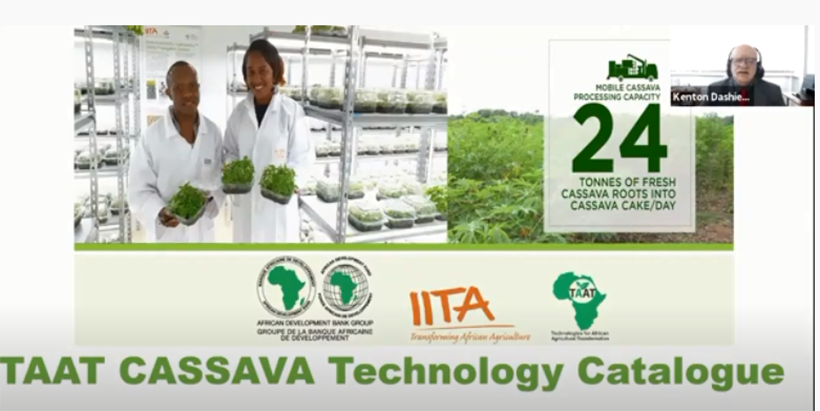 During his keynote, IITA Deputy Director General, Partnerships for Delivery, Kenton Dashiell, spoke on the role of innovation and partnerships to strengthen African food systems. He noted that TAAT is raising agricultural productivity and improving seed systems by deploying proven agricultural technologies to the continent’s farmers. “One of the many ways TAAT has organized to deploy the best technology is developing a Technology Catalogue for different crops and livestock,” he said. He added that the role of the private sector in the TAAT program is to drive long-term sustainable agribusiness growth.
An expert panel highlighted the achievements of different programs in strengthening Africa’s food systems, including building the capacity of over 23,000 aquaculture value chain actors on pond and hatchery management, handling and processing, storage and preservation, and product development for household consumption.
During his keynote, IITA Deputy Director General, Partnerships for Delivery, Kenton Dashiell, spoke on the role of innovation and partnerships to strengthen African food systems. He noted that TAAT is raising agricultural productivity and improving seed systems by deploying proven agricultural technologies to the continent’s farmers. “One of the many ways TAAT has organized to deploy the best technology is developing a Technology Catalogue for different crops and livestock,” he said. He added that the role of the private sector in the TAAT program is to drive long-term sustainable agribusiness growth.
An expert panel highlighted the achievements of different programs in strengthening Africa’s food systems, including building the capacity of over 23,000 aquaculture value chain actors on pond and hatchery management, handling and processing, storage and preservation, and product development for household consumption.
 The Pan Africa Bean Research Alliance (PABRA) Senior Advisor, Dr Robin Buruchara, highlighted their commodity approach to intensify high iron beans (HIB) production, influence the demand of HIB, and market linkages. “This has led to increased productivity of iron bean varieties in Zimbabwe from 0.6 t/ha to 1.4 t/ha. There is now an increase in other countries like Burundi,” he said.
ICRISAT Research Program Director Dr Ramadjita Tabo said they had focused on building farmers’ capacity with proven technologies to address low productivity and production, increase value-chain efficiency, and reduce postharvest losses. Also, they work inclusively with farmers, extension agents, government, and private partners to improve the yield of sorghum and millet by providing them with improved varieties, hybrids, and biofortified seeds.
Head of TAAT Clearing House Innocent Musabyimana appreciated everyone for their contributions. He stated that the TAAT Clearing House is responsible for getting and profiling technologies provided by CG centers and other specialized research institutions and packaging them for farmers’ use. “Achieving this food system in the continent will only happen through a strong partnership,” he said.
Funded by AfDB, TAAT aims to increase agricultural productivity in Africa through the deployment of proven and high-performance agricultural technologies. The program is implemented by IITA in close partnership with other CGIAR Centers and specialized technical centers (e.g., AATF, IFDC), Forum for Agricultural Research in Africa (FARA), national agricultural research and extension systems, and private sector partners.
The Pan Africa Bean Research Alliance (PABRA) Senior Advisor, Dr Robin Buruchara, highlighted their commodity approach to intensify high iron beans (HIB) production, influence the demand of HIB, and market linkages. “This has led to increased productivity of iron bean varieties in Zimbabwe from 0.6 t/ha to 1.4 t/ha. There is now an increase in other countries like Burundi,” he said.
ICRISAT Research Program Director Dr Ramadjita Tabo said they had focused on building farmers’ capacity with proven technologies to address low productivity and production, increase value-chain efficiency, and reduce postharvest losses. Also, they work inclusively with farmers, extension agents, government, and private partners to improve the yield of sorghum and millet by providing them with improved varieties, hybrids, and biofortified seeds.
Head of TAAT Clearing House Innocent Musabyimana appreciated everyone for their contributions. He stated that the TAAT Clearing House is responsible for getting and profiling technologies provided by CG centers and other specialized research institutions and packaging them for farmers’ use. “Achieving this food system in the continent will only happen through a strong partnership,” he said.
Funded by AfDB, TAAT aims to increase agricultural productivity in Africa through the deployment of proven and high-performance agricultural technologies. The program is implemented by IITA in close partnership with other CGIAR Centers and specialized technical centers (e.g., AATF, IFDC), Forum for Agricultural Research in Africa (FARA), national agricultural research and extension systems, and private sector partners.
IITA Deputy Director General, Partnerships for Delivery, Dr Ken Dashiell explaining TAAT’s role in strengthening Africa’s food systems.
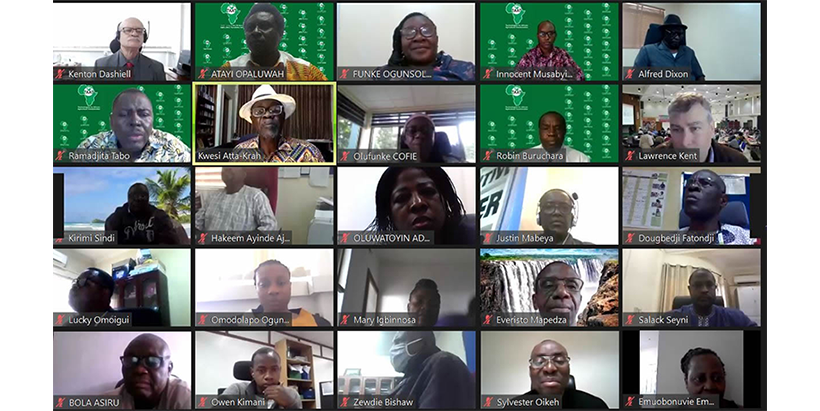
Participants in the virtual Science Days’ side event.
Contributed by
Recent stories
No items found