
IITA NEWS

Researchers support district experts and farmers in Climate Risk Profiling
July 28, 2019

The agriculture sector in Ug anda is largely rain fed; this includes Nwoya District located within the Acholi sub-region, Northern Ug anda. Drought and floods, exacerbated by climate change, present significant and increasing risks to agricultural production in the district, which according to the five-year district development plan employs 98 percent of the population.
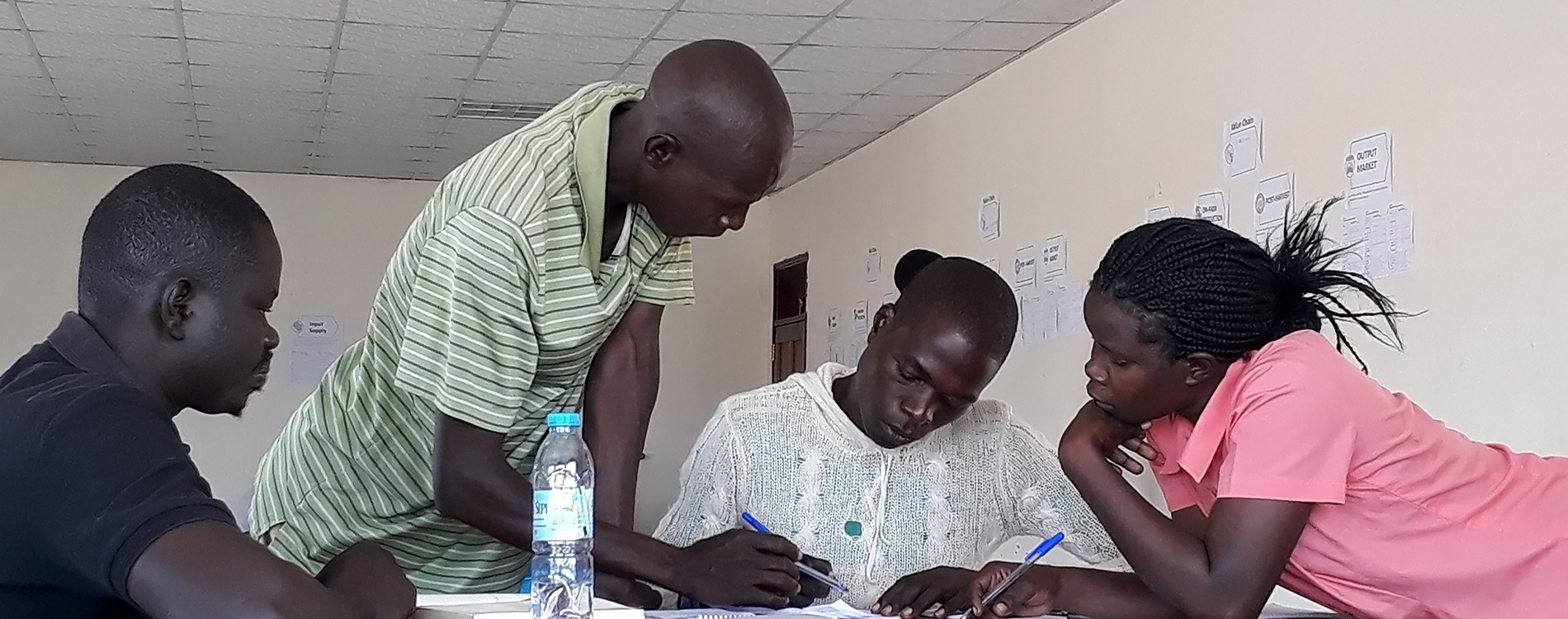
Researchers support district experts and farmers in Climate Risk Profiling
Group discussion during the climate risk profiling workshop. Photo credit: John Francis Okiror

The CGIAR Research Program on Climate Change, Agriculture and Food Security (CCAFS) funds the Policy Action for Climate Change Adaptation (PACCA) project, which has mapped the climate risks of Nwoya District, as part of the situation analysis for the three-year second phase of the project. PACCA is a collaborative effort implemented by IITA, the  International Center for Tropical Agriculture (CIAT), Utrecht University, and local partners in Ug anda and Ethiopia.

The PACCA project team in collaboration with Nwoya District Local Government (NDLG) organized a stakeholder feedback and validation workshop at the District Council Hall from 11 to 13 June 2019. Among other things, the workshop was intended to give feedback and validate findings of the study that mapped gender-differentiated climate risks and vulnerabilities, as well as initiatives in the district (both government and non-government) undertaken to address climate risk and food and nutrition insecurity.

While officiating during the workshop opening, the Assistant Chief Administrative Officer, Ben Okong said, “Climate change has affected us in terms of food production and household income. Once production is affected, food and nutrition security as well as income are also affected.”

IITA researcher Patricia Bamanyaki, gave feedback to workshop participants, who included researchers, district experts, and farmer representatives from Got Apwoyo and Alero sub-counties. She explained that the climate hazards observed during the ten-year period preceding the study included: Prolonged dry spells, which majorly occurred in 2015 and 2016, resulting in huge crop failure, especially of maize, beans, and groundnut; and flooding in Alero, Purongo, and Anaka sub-counties, which submerged gardens and cut off roads. Strange weeds, uncommon in the past, have also emerged and incidences of crop pests, such as the fall armyworm, and diseases like foot and mouth in livestock have increased.

She highlighted some of the strategies employed by farmers to cope with climate change impacts. They include reduction in the amount of seed planted to minimize losses and diversification to the charcoal trade. Additionally, some households planted vegetables near streams and riverbanks to cope with prolonged dry spells. Other coping strategies were formation of groups by youth to collectively purchase seed at better prices, and a reduction in number of meals consumed by households.

Following the validation and discussion of findings, the three-day workshop guided farmers and district experts through the process of prioritizing four value chain commodities. The cassava, bean, chicken, and goat value chain commodities were not just the primary focus of the district but also addressed climate risk, food and nutrition security as well as gender concerns. They were prioritized based on indicators such as importance to district plans and budgets, climate resilience and stability, women and youth involvement, and important source of micronutrients.

They illustrated climate vulnerability and risk to workshop participants by contrasting district experts and farmers’ perceptions with historic and future projected changes in climate. Perceptions of climate change included: delayed onset of rains, unreliable and variable rains, reduced and/or increased amounts of rainfall, and high temperatures during the hot season, and much lower temperatures during the cold season.

While presenting a summary of historical climate changes since 1981, Perez Muchunguzi, a visiting scientist with IITA, explained that both the first and second seasons have registered less annual rainfall. The moderate increase in mean temperature has intensified extremes such as moisture stress and heat stress. Not only has too little rain led to crop failure and livestock loss but too much rain resulted in flooding and erosion in some parts of the district, which consists of a low l andscape with an altitude ranging between 1,000 and 1,200 meters above sea level. Such historical changes in climate underpin the importance of rain for agricultural production in the district.

A detailed schematic tool, replete with activities, climate hazards, and consequences, as well as ongoing and potential adaption options along the value chain (i.e., input supply, on-farm production, postharvest, and output markets), helped drive the climate risk and vulnerability message home for the workshop participants, who mainly spoke in the local Acholi language


Contributed by

Recent stories

No items found

Leave a Reply

Your email address will not be published. Required fields are marked *

Scroll to Top
Olaosebikan, Olamide

Olamide Deborah Nwanze is a Senior Research Associate specializing in gender mainstreaming research to inform participatory and inclusive breeding, variety development, and seed systems policies regarding root, tuber, and banana (RTB) crops in the International Institute of Tropical Agriculture Headquarters, Ibadan, Nigeria. She is a PhD candidate at the University of Ibadan and holds an MSc and B. Agric in Agricultural Extension and Rural Development. Olamide is a fellow of the African Women in Agricultural Research and Development – Gender Responsive Agricultural Systems Policy (AWARD-GRASP) and the Gender Responsive Researchers Equipped for Agricultural Transformation (GREAT). She seeks to apply her gender-mainstreaming learnings, gender-responsive research, and policy development, and review expertise to facilitate women, youth, children, and vulnerable social group’s access to and adoption of agricultural Innovations that guarantee food, nutrition, income, and livelihood security in Africa. Her current roles include mentoring research fellows, development of guides and training manuals, implementation and adaptation of gender frameworks and tools, value chain actors’ engagement as citizen science partners, policy review and redesign, data management, and analysis. Her current research explores mixed methods and participatory and interdisciplinary approaches to capture and highlight gender dynamics, needs, preferences, and challenges stakeholders face within the agricultural livelihood value chain to prioritize gender-inclusive strategies in breeding programs, policy design, and implementation.

At IITA, she contributes to the implementation of the CGIAR Accelerated Breeding Initiative and Genetic Innovation Programs; participatory and gender research within the NextGen CassavaHarvestPlusRTBFoods, and Tricot-ClimMob 1000Farms Projects; and gender knowledge communication via the G-LENS webinar series, video documentary, policy briefspublications, and blogs.


Recent publications

de Sousa, K., van Etten, J., Manners, R. Bello, A., Teeken, B., Olaosebikan, O., et al. 2024. The tricot approach: an agile framework for decentralized on-farm testing supported by citizen science. A retrospective. Agron. Sustain. Dev. 44, 8. https://doi.org/10.1007/s13593-023-00937-1

Madu, T., Onwuka, S., Nwafor, S., Onyemauwa, N., Ejechi, M., Ofoeze, M., Ukeje, B., Eluagu, C., Olaosebikan, O., Okoye, B., 2024. Gender-Inclusive Consumer Studies Improve Cassava Breeding in Nigeria in: Frontiers in Sociology, volume 9, number: 1224504, doi: 10.3389/fsoc.2024.1224504

Olaosebikan, O.; Bello, A.; Utoblo, O.; Okoye, B.; Olutegbe, N.; Garner, E.; Teeken, B.; Bryan, E.; Forsythe, L.; Cole, S.; Madu, T. 2023.  Stressors and Resilience within the Cassava Value Chain in Nigeria: Preferred Cassava Variety Traits and Response Strategies of Men and Women to Inform Breeding. Sustainability 15, 7837. https://doi.org/10.3390/su15107837

Okoye, B., Ofoeze, M., Ejechi, M., Onwuka, S., Nwafor, S., Onyemauwa, N., Ukeje, B., Eluagu, C., Obidiegwu, J.*, Olaosebikan, O., Madu, T.* 2023. Prioritizing preferred traits in the yam value chain in Nigeria: a gender situation analysis in: Frontiers in Sociology, volume 8, number: 1232626, pages 1 – 9, ISSN 2297-7775, 2023. https://www.frontiersin.org/articles/10.3389/fsoc.2023.1232626/full

Olaosebikan, O., Bello, A. A., de Sousa, K., Ndjouenkeu, R., Adesokan, M., Alamu, E. O., Agbona, A., van Etten, J., Kegah, F. N.*, Dufour, D., Bouniol, A., Teeken, B. 2023. Consumer acceptability of cassava gari-eba food products across cultural and environmental settings using the triadic comparison of technologies approach (tricot) in: Journal of the Science of Food and Agriculture,

Teeken, B., Olaosebikan, O., Bello, A. A., Madu, T.*, Cole, S. M. 2023. Qualitative assessment on the positionality and preferences of dyads in relation to cassava-related activities: working with tricot trial citizen scientists https://hdl.handle.net/10568/138326 Type: Manual

Bouniol, A., Ceballos, H., Bello, A. A., Teeken, B., Olaosebikan, O., Owoade, D., Agbona, A., Fotso Kuate, A., Madu, T.*, Okoye, B.*, Ofoeze, M.*, Nwafor, S.*, Onyemauwa, N.*, Adinsi, L.*, Forsythe, L., Dufour, D. 2023. Varietal impact on women’s labour, workload and related drudgery in processing root, tuber and banana crops: focus on cassava in sub-Saharan Africa in: Journal of the Science of Food and Agriculture, pages 1 – 25, ISSN 0022-5142,

Bello, A. A., Agbona, A., Olaosebikan, O., Edughaen, G., Dufour, D., Bouniol, A., Iluebbey, P., Ndjouenkeu, R.*, Rabbi, I. Y., Teeken, B. 2023. Genetic and environmental effects on processing productivity and food product yield: drudgery of women’s work in: Journal of the Science of Food and Agriculture, pages 1 – 32, ISSN 0022-5142, 5

Cavicchioli, M., Zimbiti, T., Teeken, B., Nwanze, D.O., Liani, M., Parkes, E. & Bello, A. 2023. IITA-Gender Responsive Breeding Training Report. Genetic Resources Center, IITA-HQ, Ibadan, 21-23 September, 2022. Ibadan, Nigeria: IITA, (34 p.).https://hdl.handle.net/10568/131368

Agbona, A. Peteti P., Teeken B., Olaosebikan O. Bello, A. A., Parkes, E., Rabbi, I. Y., Mueller, L., Egesi, C., Kulakow, P. 2022. Data Management in Multi-disciplinary African RTB Crop Breeding Programs. In: Williamson, H.F., Leonelli, S. (eds) Towards Responsible Plant Data Linkage: Data Challenges for Agricultural Research and Development. Springer, Cham. https://doi.org/10.1007/978-3-031-13276-6_5

Lora Forsythe, Pricilla Marimo, Sarah Mayanja, Olamide D. Olaosebikan, Esme Stuart, Bela Teeken, Benjamin Okoye, Tessy Madu, (2021). Cross-product Gender Analysis of RTBfoods Step 2 Gendered Food Mapping on RTB Products. Understanding the Drivers of Trait Preferences and the Development of Multi-user RTB Product Profiles, WP1. London, UK: RTBfoods Field Scientific Report, 30 p.

Teeken, B., Garner, E., Agbona, A., Balogun, I., Olaosebikan, O., Bello, A., Madu, T., Okoye, B., Egesi, C., Kulakow, P. and Tufan, H.A. 2021. Beyond “Women’s Traits”: Exploring How Gender, Social Difference, and Household Characteristics Influence Trait Preferences. Frontiers Sustainable Food Systems 5:740926. https://doi.org/10.3389/fsufs.2021.740926

Teeken, B., Agbona, A., Bello, A., Olaosebikan, O., Alamu, E., Adesokan, M., Awoyale, W., Madu, T., Okoye, B., Chijioke, U., Owoade, D., Okoro, M., Bouniol, A., Dufour, D., Hershey, C., Rabbi, I., Maziya‐Dixon, B., Egesi, C., Tufan, H. and Kulakow, P. (020. Understanding cassava varietal preferences through pairwise ranking of gari‐eba and fufu prepared by local farmer–processors. Int J Food Sci Technol. https://doi.org/10.1111/ijfs.14862

Bela Teeken, Olamide Olaosebikan, Ireti Balogun, Benjamin Okoye, Tessy Madu, Steven Cole, Abolore Bello, Elizabeth Parkes. (2020). Piloting the G+ customer and product profile tools for gender-responsive cassava breeding in Nigeria. Nigeria: International Institute of Tropical Agriculture (IITA). https://hdl.handle.net/20.500.11766/13000