
IITA NEWS

Reuniting roots: honoring pioneers and celebrating progress at IITA Forest Center
October 28, 2024


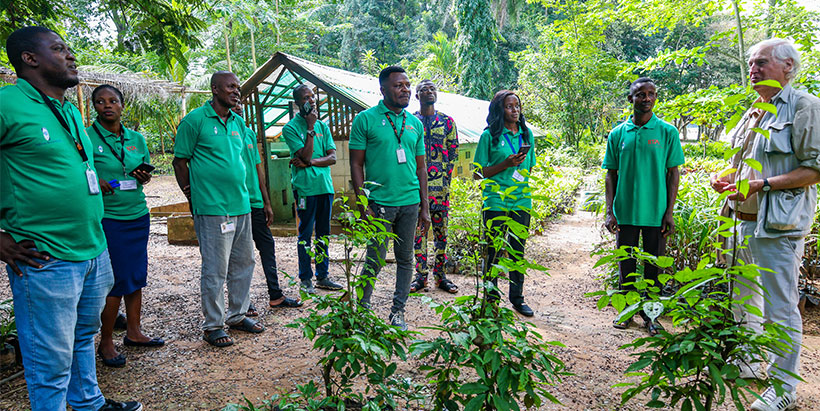
Dr John Peacock with IITA Forest Center staff at the ethnobotanical garden, reliving past moments, successes, and achievemnts.

IITA Forest Center stands proudly today as a leading conservation center in Nigeria. The journey began in 2010 as the IITA-Leventis Forest Project under the leadership of desert ecologist Dr John Peacock, who, out of his love for trees, sought to develop the previous conservation work of other scientists and enthusiasts like Dr David Ladipo and Prof. Shiiwua Manu, who had taken stock of the diversity of birds, butterflies, trees, and other flora and fauna of the IITA Forest Reserve in Ibadan.

His primal desire then was to restore degraded areas on the east bank of the IITA main lake. Now covering about 12 hectares, this mini forest holds over 80 native tree species averaging 20 m in height. On 10 October, Peacock visited after 14 years of his selfless and meritorious service to biodiversity conservation at IITA Forest Center. During an emotional and exciting time, IITA Forest Center staff were pleased to showcase milestones and progress following Peacock’s laid down legacies at IITA Forest Center.

In a heartwarming twist, Prof. Ladipo joined Dr Peacock in this celebratory reception, marking a pleasant reunion of IITA Forest Center’s founders with the current enthusiastic and passionate staff of IITA Forest Center. Peacock, in the company of IITA Forest Center staff, after touring the IITA Forest facilities, planted Pterygota bequaertii by the IITA Main Lake.
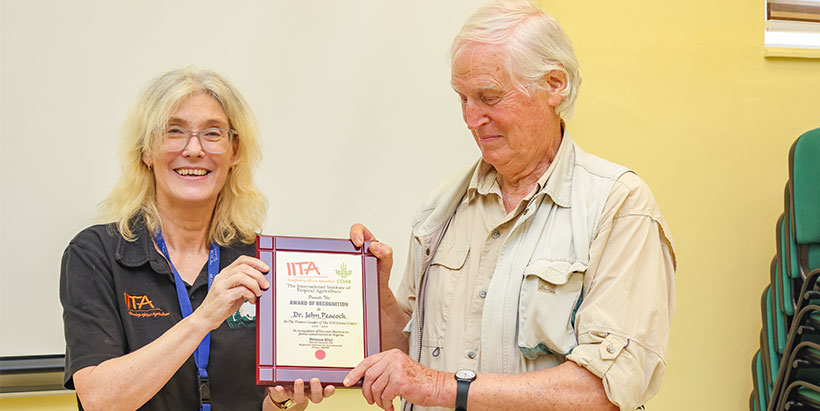
 

Dr John Peacock receiving an award of recognition from IITA DDG Hilde Koper-Limbourg, as pioneer leader of IITA Forest Center, in recognition of his meritorious contributions to forest conservation in Nigeria.

Hilde Koper-Limbourg, IITA Deputy Director General of Corporate Services, and the “forest fathers” installed new tree labels by existing trees at the IITA Forest Center’s Tree Heritage Park (THP) to replace old ones.

Botanic Gardens Conservation International (BGCI) and ArbNet funded the tree labels, which Peter Kulakow, IITA Cassava Breeder and Geneticist, shipped in. The tree labels contain vital information about each tree, including a scannable QRcode that links viewers to the  IITA Forest Center website for more information about each tree. The event coincided with the phasing out of the BGCI Project. Hence, IITA Forest Center took the opportunity to invite and train one BGCI partner from Benin Republic to replicate the same label technology for other tree-planting projects.

Peacock, extremely impressed by the progressive work of the IITA Forest Center team, said, “I am so proud and extremely overwhelmed with what I see here today. In 14 years, you haven’t planted a tree; you have planted a forest. If it could be done here, it could be done all over Nigeria.” He added that one way we could all contribute to carbon sequestration and combat climate change is to plant trees.
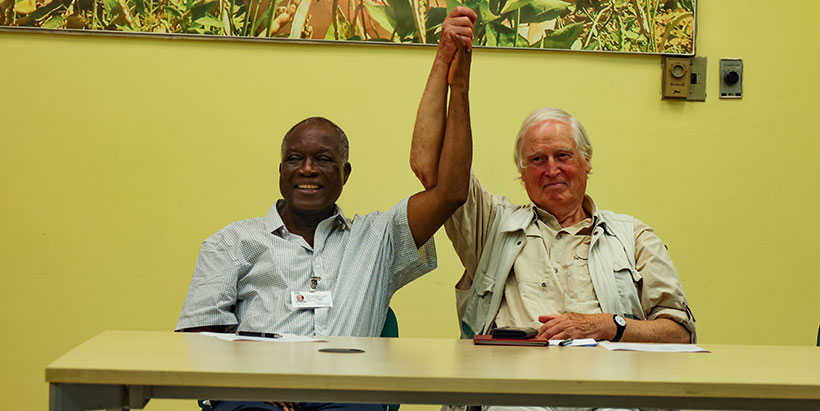
Forest fathers, Prof David Ladipo and Dr John Peacock, celebrating proud moments with IITA Forest Center staff.

In a RadioIITA interview, Dr Peacock passionately shared his thoughts on the issues of biodiversity conservation in Nigeria. He said, “Our planet is on a precipice. I’ve learned in the past few days that it is possible to reforest, not just Nigeria, but the whole of Africa, through the work of IITA Forest Center and even eradicate evasive species.” He continued, “This small group of people at IITA Forest Center, with minimal funding, are making huge impacts in the conservation space. Their work is a beacon of hope, and the information here could be disseminated widely to people around the world.” He stressed the need for other organizations and donors to invest in biodiversity conservation through the IITA Forest Center, inspiring the audience with the potential for positive change.

In closing, Koper-Limbourg took a moment to applaud all IITA Forest Center staff, led by the current Head of the Center, Adewale Awoyemi. She then presented Dr Peacock with a well-deserved award for being the Pioneer Leader of the IITA Forest Center from 2010 – 2012 in recognition of his meritorious and invaluable contribution to forest conservation in Nigeria. This recognition and appreciation resonated with the audience, fostering respect and admiration for Dr Peacock’s dedication and service.


Contributed by Folake Oduntan

Related stories: https://www.iita.org/news-item/conservation-africas-forest-offers-great-benefits/

https://www.iita.org/wp-content/uploads/2017/01/The-Bulletin-8-12-November-2010-No.-2042.pdf


Contributed by

Related news

No items found

Leave a Reply

Your email address will not be published. Required fields are marked *

Scroll to Top
Olaosebikan, Olamide

Olamide Deborah Nwanze is a Senior Research Associate specializing in gender mainstreaming research to inform participatory and inclusive breeding, variety development, and seed systems policies regarding root, tuber, and banana (RTB) crops in the International Institute of Tropical Agriculture Headquarters, Ibadan, Nigeria. She is a PhD candidate at the University of Ibadan and holds an MSc and B. Agric in Agricultural Extension and Rural Development. Olamide is a fellow of the African Women in Agricultural Research and Development – Gender Responsive Agricultural Systems Policy (AWARD-GRASP) and the Gender Responsive Researchers Equipped for Agricultural Transformation (GREAT). She seeks to apply her gender-mainstreaming learnings, gender-responsive research, and policy development, and review expertise to facilitate women, youth, children, and vulnerable social group’s access to and adoption of agricultural Innovations that guarantee food, nutrition, income, and livelihood security in Africa. Her current roles include mentoring research fellows, development of guides and training manuals, implementation and adaptation of gender frameworks and tools, value chain actors’ engagement as citizen science partners, policy review and redesign, data management, and analysis. Her current research explores mixed methods and participatory and interdisciplinary approaches to capture and highlight gender dynamics, needs, preferences, and challenges stakeholders face within the agricultural livelihood value chain to prioritize gender-inclusive strategies in breeding programs, policy design, and implementation.

At IITA, she contributes to the implementation of the CGIAR Accelerated Breeding Initiative and Genetic Innovation Programs; participatory and gender research within the NextGen CassavaHarvestPlusRTBFoods, and Tricot-ClimMob 1000Farms Projects; and gender knowledge communication via the G-LENS webinar series, video documentary, policy briefspublications, and blogs.


Recent publications

de Sousa, K., van Etten, J., Manners, R. Bello, A., Teeken, B., Olaosebikan, O., et al. 2024. The tricot approach: an agile framework for decentralized on-farm testing supported by citizen science. A retrospective. Agron. Sustain. Dev. 44, 8. https://doi.org/10.1007/s13593-023-00937-1

Madu, T., Onwuka, S., Nwafor, S., Onyemauwa, N., Ejechi, M., Ofoeze, M., Ukeje, B., Eluagu, C., Olaosebikan, O., Okoye, B., 2024. Gender-Inclusive Consumer Studies Improve Cassava Breeding in Nigeria in: Frontiers in Sociology, volume 9, number: 1224504, doi: 10.3389/fsoc.2024.1224504

Olaosebikan, O.; Bello, A.; Utoblo, O.; Okoye, B.; Olutegbe, N.; Garner, E.; Teeken, B.; Bryan, E.; Forsythe, L.; Cole, S.; Madu, T. 2023.  Stressors and Resilience within the Cassava Value Chain in Nigeria: Preferred Cassava Variety Traits and Response Strategies of Men and Women to Inform Breeding. Sustainability 15, 7837. https://doi.org/10.3390/su15107837

Okoye, B., Ofoeze, M., Ejechi, M., Onwuka, S., Nwafor, S., Onyemauwa, N., Ukeje, B., Eluagu, C., Obidiegwu, J.*, Olaosebikan, O., Madu, T.* 2023. Prioritizing preferred traits in the yam value chain in Nigeria: a gender situation analysis in: Frontiers in Sociology, volume 8, number: 1232626, pages 1 – 9, ISSN 2297-7775, 2023. https://www.frontiersin.org/articles/10.3389/fsoc.2023.1232626/full

Olaosebikan, O., Bello, A. A., de Sousa, K., Ndjouenkeu, R., Adesokan, M., Alamu, E. O., Agbona, A., van Etten, J., Kegah, F. N.*, Dufour, D., Bouniol, A., Teeken, B. 2023. Consumer acceptability of cassava gari-eba food products across cultural and environmental settings using the triadic comparison of technologies approach (tricot) in: Journal of the Science of Food and Agriculture,

Teeken, B., Olaosebikan, O., Bello, A. A., Madu, T.*, Cole, S. M. 2023. Qualitative assessment on the positionality and preferences of dyads in relation to cassava-related activities: working with tricot trial citizen scientists https://hdl.handle.net/10568/138326 Type: Manual

Bouniol, A., Ceballos, H., Bello, A. A., Teeken, B., Olaosebikan, O., Owoade, D., Agbona, A., Fotso Kuate, A., Madu, T.*, Okoye, B.*, Ofoeze, M.*, Nwafor, S.*, Onyemauwa, N.*, Adinsi, L.*, Forsythe, L., Dufour, D. 2023. Varietal impact on women’s labour, workload and related drudgery in processing root, tuber and banana crops: focus on cassava in sub-Saharan Africa in: Journal of the Science of Food and Agriculture, pages 1 – 25, ISSN 0022-5142,

Bello, A. A., Agbona, A., Olaosebikan, O., Edughaen, G., Dufour, D., Bouniol, A., Iluebbey, P., Ndjouenkeu, R.*, Rabbi, I. Y., Teeken, B. 2023. Genetic and environmental effects on processing productivity and food product yield: drudgery of women’s work in: Journal of the Science of Food and Agriculture, pages 1 – 32, ISSN 0022-5142, 5

Cavicchioli, M., Zimbiti, T., Teeken, B., Nwanze, D.O., Liani, M., Parkes, E. & Bello, A. 2023. IITA-Gender Responsive Breeding Training Report. Genetic Resources Center, IITA-HQ, Ibadan, 21-23 September, 2022. Ibadan, Nigeria: IITA, (34 p.).https://hdl.handle.net/10568/131368

Agbona, A. Peteti P., Teeken B., Olaosebikan O. Bello, A. A., Parkes, E., Rabbi, I. Y., Mueller, L., Egesi, C., Kulakow, P. 2022. Data Management in Multi-disciplinary African RTB Crop Breeding Programs. In: Williamson, H.F., Leonelli, S. (eds) Towards Responsible Plant Data Linkage: Data Challenges for Agricultural Research and Development. Springer, Cham. https://doi.org/10.1007/978-3-031-13276-6_5

Lora Forsythe, Pricilla Marimo, Sarah Mayanja, Olamide D. Olaosebikan, Esme Stuart, Bela Teeken, Benjamin Okoye, Tessy Madu, (2021). Cross-product Gender Analysis of RTBfoods Step 2 Gendered Food Mapping on RTB Products. Understanding the Drivers of Trait Preferences and the Development of Multi-user RTB Product Profiles, WP1. London, UK: RTBfoods Field Scientific Report, 30 p.

Teeken, B., Garner, E., Agbona, A., Balogun, I., Olaosebikan, O., Bello, A., Madu, T., Okoye, B., Egesi, C., Kulakow, P. and Tufan, H.A. 2021. Beyond “Women’s Traits”: Exploring How Gender, Social Difference, and Household Characteristics Influence Trait Preferences. Frontiers Sustainable Food Systems 5:740926. https://doi.org/10.3389/fsufs.2021.740926

Teeken, B., Agbona, A., Bello, A., Olaosebikan, O., Alamu, E., Adesokan, M., Awoyale, W., Madu, T., Okoye, B., Chijioke, U., Owoade, D., Okoro, M., Bouniol, A., Dufour, D., Hershey, C., Rabbi, I., Maziya‐Dixon, B., Egesi, C., Tufan, H. and Kulakow, P. (020. Understanding cassava varietal preferences through pairwise ranking of gari‐eba and fufu prepared by local farmer–processors. Int J Food Sci Technol. https://doi.org/10.1111/ijfs.14862

Bela Teeken, Olamide Olaosebikan, Ireti Balogun, Benjamin Okoye, Tessy Madu, Steven Cole, Abolore Bello, Elizabeth Parkes. (2020). Piloting the G+ customer and product profile tools for gender-responsive cassava breeding in Nigeria. Nigeria: International Institute of Tropical Agriculture (IITA). https://hdl.handle.net/20.500.11766/13000