
IITA NEWS

Root and tuber society strategize on how to fight hunger and poverty in Africa
October 15, 2021

The International Society for Tropical Root Crops (ISTRC) held the 14th edition of its symposium on 20-24 September. Zambia was the host country. The virtual symposium assembled professionals of root and tuber crops to reflect on the progress made over the years in advancing root and tuber crops, despite challenges faced and plan on jointly fighting hunger and poverty. IITA Digital Extension & Advisory Services Specialist Godwin Atser and Mark Muchinga anchored the event.

ISTRC-AB President and IITA Cassava Commodity Specialist, Richardson Okechukwu, welcoming participants.

Richardson Okechukwu, ISTRC-AB President and Cassava Commodity Specialist at IITA, gave the welcome address. He recognized the presence of representatives from the various institutes, students, researchers, and farmers working on root and tuber crops. Okechukwu stated that the theme “Exploring climate-smart nutritious and healthy root and tuber crops for African business solutions” was chosen because of the challenges of climate change and changes in pest and disease dynamics. Hence, the need to present and discuss new ideas to proffer solutions to these challenges and plan for the future.

Director of the Zambia Agricultural Institute, Mr Mukuka Ivor, represented the Minister of Agriculture, Hon Reuben Muntoro and officially opened the conference. He expressed his joy that the theme of the symposium is in line with the Zambian government’s aspirations towards enhanced food and nutrition security and increased income for farmers, “hence this is highly supported,” he said.

Dr Martin Chiona, Chairperson of the Local Organizing Committee (LOC) in Zambia, also gave his address. He mentioned that the value of tropical root and tuber crops in diets and their contributions to uplifting the standard of living of the African people is underestimated. Hence, the LOC hopes that the symposium will change the African people’s perception of these crops and rekindle the passion for creating change in various economies using the root and tuber crops. “Thanks to ISTRC and IITA for selecting Zambia to host this meeting,” he said.

Mr Vincent Akamandisa, a representative of root and tuber farmers from Zambia, in his goodwill message, communicated his hope that the great innovative research and development papers presented at the symposium would find their way to the root and tuber farmers in remote areas so that they could adopt the improved technologies for enhanced productivity. “This will help farmers to supply food to their households and sell their crops to the market,” he said. Representatives of CIP and the National Root Crops Research Institute (NRCRI) also gave their goodwill messages.

Prof. Lateef Sanni, President of ISTRC global and BASICS II Project Manager at IITA, explained that the discussion is focused on the root and tuber crops as a game-changer because of the ways climate change and variability have affected many farms globally. “Let us all work together to achieve sustainable development in the world,” he said.
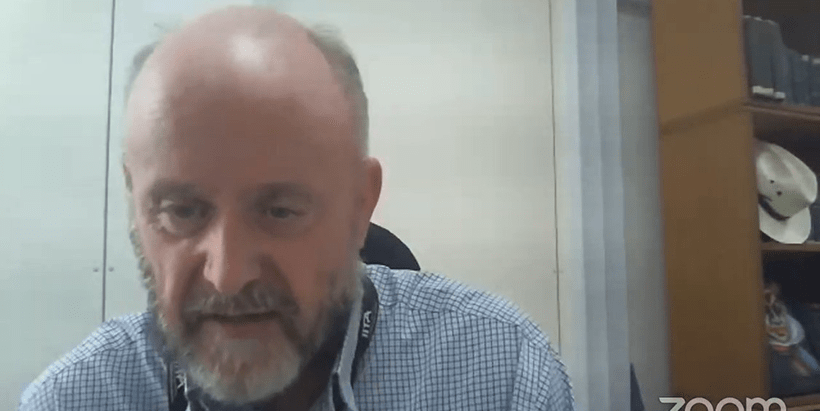
IITA West Africa Hub Director Michael Abberton representing the IITA Director General.

Representing IITA Director General Dr Nteranya Sanginga,  Michael Abberton, Director of IITA West Africa Hub, shared how IITA and ISTRC have been partners for years. IITA has played a major role in root and tuber research in its 54 years of existence. “IITA is leading several new initiatives and we are assuring that there will be a strong presence of root and tuber crops within the work in One CGIAR in Africa,” he said.

Robert Asiedu, Emeritus Director of IITA-West Africa, represented Dr Graham Thiele and Michael Friedmann in presenting the keynote speech. He highlighted areas where the root and tubers program is making an impact, including climate adaptation; gender equality, youth and social inclusion; poverty reduction, livelihood, and job creation; and nutrition, health, and food security. Asiedu also talked about the toolbox known as the RTB golden egg, which was created for the root and tuber seed system. “It houses 11 tools and a glossary and was launched recently,” he said.

Ruth Kambalakoko, a LOC Zambia member, gave the vote of thanks. She summarized the discussion, highlighting the value of roots and tubers to the daily diet and the economic impact on farmers, especially having disposable income. Exhibitions, paper presentations, poster sessions and award presentations wrapped up the event.


Contributed by

Related news

No items found

Leave a Reply

Your email address will not be published. Required fields are marked *

Scroll to Top
Olaosebikan, Olamide

Olamide Deborah Nwanze is a Senior Research Associate specializing in gender mainstreaming research to inform participatory and inclusive breeding, variety development, and seed systems policies regarding root, tuber, and banana (RTB) crops in the International Institute of Tropical Agriculture Headquarters, Ibadan, Nigeria. She is a PhD candidate at the University of Ibadan and holds an MSc and B. Agric in Agricultural Extension and Rural Development. Olamide is a fellow of the African Women in Agricultural Research and Development – Gender Responsive Agricultural Systems Policy (AWARD-GRASP) and the Gender Responsive Researchers Equipped for Agricultural Transformation (GREAT). She seeks to apply her gender-mainstreaming learnings, gender-responsive research, and policy development, and review expertise to facilitate women, youth, children, and vulnerable social group’s access to and adoption of agricultural Innovations that guarantee food, nutrition, income, and livelihood security in Africa. Her current roles include mentoring research fellows, development of guides and training manuals, implementation and adaptation of gender frameworks and tools, value chain actors’ engagement as citizen science partners, policy review and redesign, data management, and analysis. Her current research explores mixed methods and participatory and interdisciplinary approaches to capture and highlight gender dynamics, needs, preferences, and challenges stakeholders face within the agricultural livelihood value chain to prioritize gender-inclusive strategies in breeding programs, policy design, and implementation.

At IITA, she contributes to the implementation of the CGIAR Accelerated Breeding Initiative and Genetic Innovation Programs; participatory and gender research within the NextGen CassavaHarvestPlusRTBFoods, and Tricot-ClimMob 1000Farms Projects; and gender knowledge communication via the G-LENS webinar series, video documentary, policy briefspublications, and blogs.


Recent publications

de Sousa, K., van Etten, J., Manners, R. Bello, A., Teeken, B., Olaosebikan, O., et al. 2024. The tricot approach: an agile framework for decentralized on-farm testing supported by citizen science. A retrospective. Agron. Sustain. Dev. 44, 8. https://doi.org/10.1007/s13593-023-00937-1

Madu, T., Onwuka, S., Nwafor, S., Onyemauwa, N., Ejechi, M., Ofoeze, M., Ukeje, B., Eluagu, C., Olaosebikan, O., Okoye, B., 2024. Gender-Inclusive Consumer Studies Improve Cassava Breeding in Nigeria in: Frontiers in Sociology, volume 9, number: 1224504, doi: 10.3389/fsoc.2024.1224504

Olaosebikan, O.; Bello, A.; Utoblo, O.; Okoye, B.; Olutegbe, N.; Garner, E.; Teeken, B.; Bryan, E.; Forsythe, L.; Cole, S.; Madu, T. 2023.  Stressors and Resilience within the Cassava Value Chain in Nigeria: Preferred Cassava Variety Traits and Response Strategies of Men and Women to Inform Breeding. Sustainability 15, 7837. https://doi.org/10.3390/su15107837

Okoye, B., Ofoeze, M., Ejechi, M., Onwuka, S., Nwafor, S., Onyemauwa, N., Ukeje, B., Eluagu, C., Obidiegwu, J.*, Olaosebikan, O., Madu, T.* 2023. Prioritizing preferred traits in the yam value chain in Nigeria: a gender situation analysis in: Frontiers in Sociology, volume 8, number: 1232626, pages 1 – 9, ISSN 2297-7775, 2023. https://www.frontiersin.org/articles/10.3389/fsoc.2023.1232626/full

Olaosebikan, O., Bello, A. A., de Sousa, K., Ndjouenkeu, R., Adesokan, M., Alamu, E. O., Agbona, A., van Etten, J., Kegah, F. N.*, Dufour, D., Bouniol, A., Teeken, B. 2023. Consumer acceptability of cassava gari-eba food products across cultural and environmental settings using the triadic comparison of technologies approach (tricot) in: Journal of the Science of Food and Agriculture,

Teeken, B., Olaosebikan, O., Bello, A. A., Madu, T.*, Cole, S. M. 2023. Qualitative assessment on the positionality and preferences of dyads in relation to cassava-related activities: working with tricot trial citizen scientists https://hdl.handle.net/10568/138326 Type: Manual

Bouniol, A., Ceballos, H., Bello, A. A., Teeken, B., Olaosebikan, O., Owoade, D., Agbona, A., Fotso Kuate, A., Madu, T.*, Okoye, B.*, Ofoeze, M.*, Nwafor, S.*, Onyemauwa, N.*, Adinsi, L.*, Forsythe, L., Dufour, D. 2023. Varietal impact on women’s labour, workload and related drudgery in processing root, tuber and banana crops: focus on cassava in sub-Saharan Africa in: Journal of the Science of Food and Agriculture, pages 1 – 25, ISSN 0022-5142,

Bello, A. A., Agbona, A., Olaosebikan, O., Edughaen, G., Dufour, D., Bouniol, A., Iluebbey, P., Ndjouenkeu, R.*, Rabbi, I. Y., Teeken, B. 2023. Genetic and environmental effects on processing productivity and food product yield: drudgery of women’s work in: Journal of the Science of Food and Agriculture, pages 1 – 32, ISSN 0022-5142, 5

Cavicchioli, M., Zimbiti, T., Teeken, B., Nwanze, D.O., Liani, M., Parkes, E. & Bello, A. 2023. IITA-Gender Responsive Breeding Training Report. Genetic Resources Center, IITA-HQ, Ibadan, 21-23 September, 2022. Ibadan, Nigeria: IITA, (34 p.).https://hdl.handle.net/10568/131368

Agbona, A. Peteti P., Teeken B., Olaosebikan O. Bello, A. A., Parkes, E., Rabbi, I. Y., Mueller, L., Egesi, C., Kulakow, P. 2022. Data Management in Multi-disciplinary African RTB Crop Breeding Programs. In: Williamson, H.F., Leonelli, S. (eds) Towards Responsible Plant Data Linkage: Data Challenges for Agricultural Research and Development. Springer, Cham. https://doi.org/10.1007/978-3-031-13276-6_5

Lora Forsythe, Pricilla Marimo, Sarah Mayanja, Olamide D. Olaosebikan, Esme Stuart, Bela Teeken, Benjamin Okoye, Tessy Madu, (2021). Cross-product Gender Analysis of RTBfoods Step 2 Gendered Food Mapping on RTB Products. Understanding the Drivers of Trait Preferences and the Development of Multi-user RTB Product Profiles, WP1. London, UK: RTBfoods Field Scientific Report, 30 p.

Teeken, B., Garner, E., Agbona, A., Balogun, I., Olaosebikan, O., Bello, A., Madu, T., Okoye, B., Egesi, C., Kulakow, P. and Tufan, H.A. 2021. Beyond “Women’s Traits”: Exploring How Gender, Social Difference, and Household Characteristics Influence Trait Preferences. Frontiers Sustainable Food Systems 5:740926. https://doi.org/10.3389/fsufs.2021.740926

Teeken, B., Agbona, A., Bello, A., Olaosebikan, O., Alamu, E., Adesokan, M., Awoyale, W., Madu, T., Okoye, B., Chijioke, U., Owoade, D., Okoro, M., Bouniol, A., Dufour, D., Hershey, C., Rabbi, I., Maziya‐Dixon, B., Egesi, C., Tufan, H. and Kulakow, P. (020. Understanding cassava varietal preferences through pairwise ranking of gari‐eba and fufu prepared by local farmer–processors. Int J Food Sci Technol. https://doi.org/10.1111/ijfs.14862

Bela Teeken, Olamide Olaosebikan, Ireti Balogun, Benjamin Okoye, Tessy Madu, Steven Cole, Abolore Bello, Elizabeth Parkes. (2020). Piloting the G+ customer and product profile tools for gender-responsive cassava breeding in Nigeria. Nigeria: International Institute of Tropical Agriculture (IITA). https://hdl.handle.net/20.500.11766/13000