
SARD-SC Maize conducts monitoring and evaluation in Zambia
May 6, 2017
The SARD-SC Maize component carried out its annual monitoring and evaluation exercise for the year in Zambia from 4 to 11 April. The aim was to ensure that activities conducted in the maize value chain were in line with the objectives of the project, and also to establish the effectiveness of the project. The seven-person monitoring team was led by Sam Ajala, SARD-SC project Maize Commodity Specialist. The agenda for meetings and itinerary of site visits were developed and shared by Jeremiah Hantolo, Project Country Coordinator. The monitoring and evaluation exercise took the team to fields in target districts of the country to interact directly with project beneficiaries.
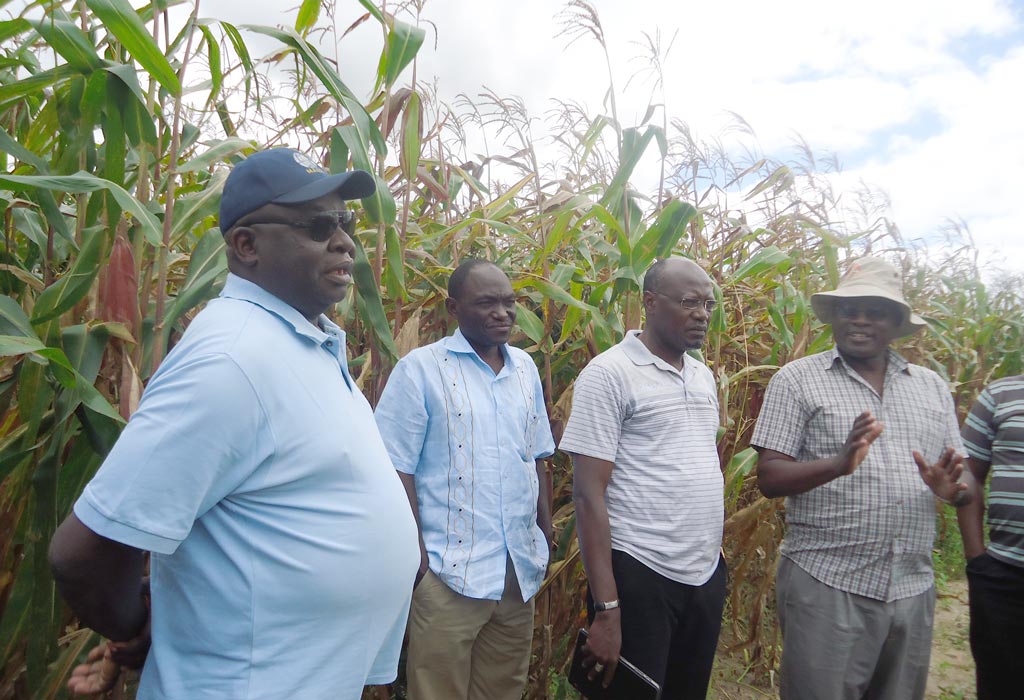 More importantly, the M&E exercise afforded the team an opportunity to assess the success of the various subprojects, including double density under various uses of fertilizers and good crop management options, on improving maize productivity and its rate of adoption among local farmers.
The team visited some large maize farms with double density planting, such as in Nambo Agricultural Camp, in Nkushi District and Kaloso farms, Kabwe, among others. The farmers said this had been very beneficial in terms of robust yield thus leading to increased productivity, and cost-effectiveness in eliminating intense weeding.
What then is the double density method of maize planting? “Double density is increasing plant and fertilizer application on a maize farm. Hand weeding is not needed because this method eliminates weeding on maize farms,” Ajala said. He continues: “Double density and the use of herbicide and other complementary crop management practices are the package that the SARD-SC project is selling to the local farmers. All these help to increase maize yield and reduce drudgery. Once herbicide is applied at the planting stage, the farmer does not need to apply it anymore.”
The “gospel”’ of double density preached by the project is fortunately and rapidly yielding converts. With project demonstration plots all over the country’s districts, there are worthy and inspiring testimonies from farmers who have embraced the method. Samson Mwale, one of the farmers under the supervision of Petronella Hamainda, Camp extension officer, Zambia Ministry of Agriculture, Kapital IP, has this to say: “ I am proud of the double density method of planting, it gives me a good yield and the maize variety Adv637w planted close with spacing of 75 by 25 cm, boosted my yield.”
Issaka Amadou, SARD-SC Monitoring and Evaluation Specialist, concluded that the project has been successful in the country for achieving its set objectives and outcomes. “Last year, we had a low rate of implementation but this has been corrected. There are demo trials all over the place, training of women in new product development for maize has been achieved, farmer training on double density and good crop management have been conducted, and field days have been held. Local farmers have been organized into Innovation Platforms and in many of the places we visited we saw that the farmers are very committed to executing what the project has taught them.” Amadou also said quantity of resources used had been efficient and gave an assurance that the project had higher chances of being sustainable after the project ends because of the involvement of development partners such as ZARI.
More importantly, the M&E exercise afforded the team an opportunity to assess the success of the various subprojects, including double density under various uses of fertilizers and good crop management options, on improving maize productivity and its rate of adoption among local farmers.
The team visited some large maize farms with double density planting, such as in Nambo Agricultural Camp, in Nkushi District and Kaloso farms, Kabwe, among others. The farmers said this had been very beneficial in terms of robust yield thus leading to increased productivity, and cost-effectiveness in eliminating intense weeding.
What then is the double density method of maize planting? “Double density is increasing plant and fertilizer application on a maize farm. Hand weeding is not needed because this method eliminates weeding on maize farms,” Ajala said. He continues: “Double density and the use of herbicide and other complementary crop management practices are the package that the SARD-SC project is selling to the local farmers. All these help to increase maize yield and reduce drudgery. Once herbicide is applied at the planting stage, the farmer does not need to apply it anymore.”
The “gospel”’ of double density preached by the project is fortunately and rapidly yielding converts. With project demonstration plots all over the country’s districts, there are worthy and inspiring testimonies from farmers who have embraced the method. Samson Mwale, one of the farmers under the supervision of Petronella Hamainda, Camp extension officer, Zambia Ministry of Agriculture, Kapital IP, has this to say: “ I am proud of the double density method of planting, it gives me a good yield and the maize variety Adv637w planted close with spacing of 75 by 25 cm, boosted my yield.”
Issaka Amadou, SARD-SC Monitoring and Evaluation Specialist, concluded that the project has been successful in the country for achieving its set objectives and outcomes. “Last year, we had a low rate of implementation but this has been corrected. There are demo trials all over the place, training of women in new product development for maize has been achieved, farmer training on double density and good crop management have been conducted, and field days have been held. Local farmers have been organized into Innovation Platforms and in many of the places we visited we saw that the farmers are very committed to executing what the project has taught them.” Amadou also said quantity of resources used had been efficient and gave an assurance that the project had higher chances of being sustainable after the project ends because of the involvement of development partners such as ZARI.
Researchers discussing in the field during the M&E exercise.
Contributed by
Recent stories
No items found