
IITA NEWS

Scientists’ breakthrough brings hope for banana resistance breeding to deadly bacterial wilt disease
October 4, 2018

4 October 2018 (Dar es Salaam, Tanzania) – A team led by scientists from the International Institute of Tropical Agriculture (IITA) have announced a breakthrough in the search for banana varieties that are resistant to the lethal bacterial banana wilt disease. This debunks the notion that all banana varieties are susceptible to the disease and opens the possibility of breeding resistant varieties.
Scientists’-breakthrough-brings-hope-for-banana-resistance-breeding-to-deadly-bacterial-wilt-disease
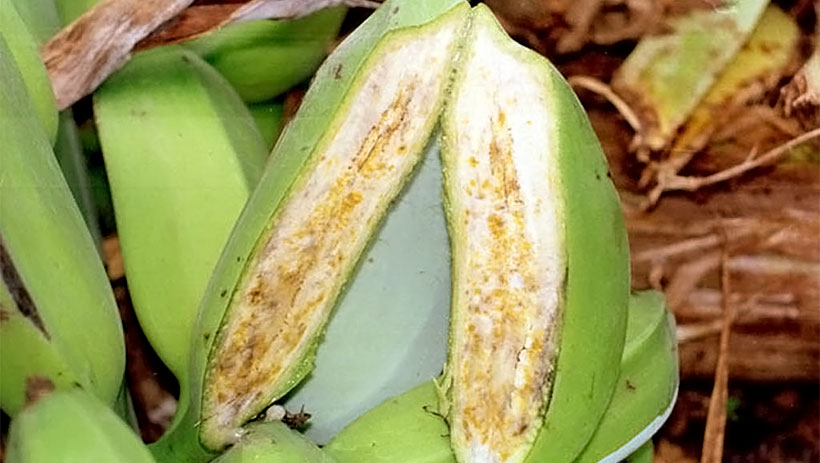
Early ripening and rotting of banana caused by Banana Xanthomonas Wilt.

The disease, which causes premature ripening and rotting of the fruits, wilting, and eventually death of the plant, has drastically affected the highl and cooking banana production in East and Central Africa (ECA) and the food and income of millions of farmers.

Until now, the scientific world believed that all banana varieties in the region, except for a wild-seeded banana called Musa balbisiana, were susceptible to the disease, which originated from Ethiopia and has now invaded all banana growing areas in the highl ands of eastern and central Africa.

The discovery by the team led by Prof Rony Swennen, Head of banana breeding; Dr George Mahuku, Senior Plant Pathologist for Eastern, Southern and Central Africa; and Dr Valentine Nakato, Plant Pathologist, was reported in the Plant Pathology (https://doi.org/10.1111/ppa.12945) journal.

The disease is caused by Xanthomonas campestris pv. musacearum bacteria and its symptoms include yellowing and wilting of leaves, a cream to pale yellow bacteria-laded oozing when the plant is cut, shriveling of the male bud, premature ripening, internal discoloration of fruits, and finally death of infected plants. Transmission is fast and mainly through contaminated tools, insect vectors, and planting material. Therefore, major investments by national programs, donors, and scientists have been geared towards rigorous monitoring of banana fields, removal of diseased plants, and decontaminating farm tools.

“This discovery is very important for the millions of smallholder banana farmers in the region as one of the most effective ways to control any disease is developing resistant varieties,” says Nakato, based in IITA, Ug anda.

Bananas are an indispensable part of life in the region providing up to one-fifth of the total calorie consumption per capita. The average daily per capita energy from banana consumption in ECA is 147 kcal: 15 times the global average and 6 times the African average. The region has over 50% of its permanent cropped area under banana; this is around half of the total area under banana cultivation across Africa. ECA countries (Burundi, DR Congo, Kenya, Rw anda, Tanzania, and Ug anda) produce annually 21 million tons of banana with a value of US$4.3 billion.

The team systematically screened the entire banana collection at IITA, Ug anda, and identified 13 other sources of resistance next to M. balbisiana.  Most importantly, Nakato identified several diploids derived from Musa acuminata—another wild banana— and which are already part of the existing highl and breeding program of IITA and NARO (National Agricultural Research Organisation, Ug anda).

“The findings of this study are very significant for the banana breeding community and we will redouble our efforts in developing banana varieties with resistance to the disease,” says Swennen.

Early ripening  and rotting of banana caused by Banana Xanthomonas Wilt.
Symptom development for representative accessions for different reaction types at 35 days post-inoculation. The varieties are Musa balbisiana (resistant), Pelipita (tolerant), Ilayi Red (moderately susceptible) and Pitu (highly susceptible)”

IITA and NARO have developed superior high-yielding matoke hybrids dubbed NARITA and now those NARITA, which were developed with the resistant banana varieties, will be screened for bacterial wilt resistance and become part of future breeding schemes to develop bacterial wilt resistant matoke varieties.

Other partners in the study included the University of Pretoria, South Africa and Centre of the Region Haná for Biotechnological and Agricultural Research, Institute of Experimental Botany, Academy of Sciences of the Czech Republic.

###

About IITA, www.iita.org

The International Institute of Tropical Agriculture (IITA) is a not-for-profit institution that generates agricultural innovations to meet Africa’s most pressing challenges of hunger, malnutrition, poverty, and natural resource degradation. Working with various partners across sub-Saharan Africa, we improve livelihoods, enhance food and nutrition security, increase employment, and preserve natural resource integrity. IITA is a member of CGIAR, a global agriculture research partnership for a food secure future.

Media contacts:

Katherine Lopez, Head of Communication, k.lopez@cgiar.org

Catherine Njuguna, Corporate Communication Officer, Eastern Africa, c.njuguna@cgiar.org


Contributed by

Recent stories

No items found

Leave a Reply

Your email address will not be published. Required fields are marked *

Scroll to Top
Olaosebikan, Olamide

Olamide Deborah Nwanze is a Senior Research Associate specializing in gender mainstreaming research to inform participatory and inclusive breeding, variety development, and seed systems policies regarding root, tuber, and banana (RTB) crops in the International Institute of Tropical Agriculture Headquarters, Ibadan, Nigeria. She is a PhD candidate at the University of Ibadan and holds an MSc and B. Agric in Agricultural Extension and Rural Development. Olamide is a fellow of the African Women in Agricultural Research and Development – Gender Responsive Agricultural Systems Policy (AWARD-GRASP) and the Gender Responsive Researchers Equipped for Agricultural Transformation (GREAT). She seeks to apply her gender-mainstreaming learnings, gender-responsive research, and policy development, and review expertise to facilitate women, youth, children, and vulnerable social group’s access to and adoption of agricultural Innovations that guarantee food, nutrition, income, and livelihood security in Africa. Her current roles include mentoring research fellows, development of guides and training manuals, implementation and adaptation of gender frameworks and tools, value chain actors’ engagement as citizen science partners, policy review and redesign, data management, and analysis. Her current research explores mixed methods and participatory and interdisciplinary approaches to capture and highlight gender dynamics, needs, preferences, and challenges stakeholders face within the agricultural livelihood value chain to prioritize gender-inclusive strategies in breeding programs, policy design, and implementation.

At IITA, she contributes to the implementation of the CGIAR Accelerated Breeding Initiative and Genetic Innovation Programs; participatory and gender research within the NextGen CassavaHarvestPlusRTBFoods, and Tricot-ClimMob 1000Farms Projects; and gender knowledge communication via the G-LENS webinar series, video documentary, policy briefspublications, and blogs.


Recent publications

de Sousa, K., van Etten, J., Manners, R. Bello, A., Teeken, B., Olaosebikan, O., et al. 2024. The tricot approach: an agile framework for decentralized on-farm testing supported by citizen science. A retrospective. Agron. Sustain. Dev. 44, 8. https://doi.org/10.1007/s13593-023-00937-1

Madu, T., Onwuka, S., Nwafor, S., Onyemauwa, N., Ejechi, M., Ofoeze, M., Ukeje, B., Eluagu, C., Olaosebikan, O., Okoye, B., 2024. Gender-Inclusive Consumer Studies Improve Cassava Breeding in Nigeria in: Frontiers in Sociology, volume 9, number: 1224504, doi: 10.3389/fsoc.2024.1224504

Olaosebikan, O.; Bello, A.; Utoblo, O.; Okoye, B.; Olutegbe, N.; Garner, E.; Teeken, B.; Bryan, E.; Forsythe, L.; Cole, S.; Madu, T. 2023.  Stressors and Resilience within the Cassava Value Chain in Nigeria: Preferred Cassava Variety Traits and Response Strategies of Men and Women to Inform Breeding. Sustainability 15, 7837. https://doi.org/10.3390/su15107837

Okoye, B., Ofoeze, M., Ejechi, M., Onwuka, S., Nwafor, S., Onyemauwa, N., Ukeje, B., Eluagu, C., Obidiegwu, J.*, Olaosebikan, O., Madu, T.* 2023. Prioritizing preferred traits in the yam value chain in Nigeria: a gender situation analysis in: Frontiers in Sociology, volume 8, number: 1232626, pages 1 – 9, ISSN 2297-7775, 2023. https://www.frontiersin.org/articles/10.3389/fsoc.2023.1232626/full

Olaosebikan, O., Bello, A. A., de Sousa, K., Ndjouenkeu, R., Adesokan, M., Alamu, E. O., Agbona, A., van Etten, J., Kegah, F. N.*, Dufour, D., Bouniol, A., Teeken, B. 2023. Consumer acceptability of cassava gari-eba food products across cultural and environmental settings using the triadic comparison of technologies approach (tricot) in: Journal of the Science of Food and Agriculture,

Teeken, B., Olaosebikan, O., Bello, A. A., Madu, T.*, Cole, S. M. 2023. Qualitative assessment on the positionality and preferences of dyads in relation to cassava-related activities: working with tricot trial citizen scientists https://hdl.handle.net/10568/138326 Type: Manual

Bouniol, A., Ceballos, H., Bello, A. A., Teeken, B., Olaosebikan, O., Owoade, D., Agbona, A., Fotso Kuate, A., Madu, T.*, Okoye, B.*, Ofoeze, M.*, Nwafor, S.*, Onyemauwa, N.*, Adinsi, L.*, Forsythe, L., Dufour, D. 2023. Varietal impact on women’s labour, workload and related drudgery in processing root, tuber and banana crops: focus on cassava in sub-Saharan Africa in: Journal of the Science of Food and Agriculture, pages 1 – 25, ISSN 0022-5142,

Bello, A. A., Agbona, A., Olaosebikan, O., Edughaen, G., Dufour, D., Bouniol, A., Iluebbey, P., Ndjouenkeu, R.*, Rabbi, I. Y., Teeken, B. 2023. Genetic and environmental effects on processing productivity and food product yield: drudgery of women’s work in: Journal of the Science of Food and Agriculture, pages 1 – 32, ISSN 0022-5142, 5

Cavicchioli, M., Zimbiti, T., Teeken, B., Nwanze, D.O., Liani, M., Parkes, E. & Bello, A. 2023. IITA-Gender Responsive Breeding Training Report. Genetic Resources Center, IITA-HQ, Ibadan, 21-23 September, 2022. Ibadan, Nigeria: IITA, (34 p.).https://hdl.handle.net/10568/131368

Agbona, A. Peteti P., Teeken B., Olaosebikan O. Bello, A. A., Parkes, E., Rabbi, I. Y., Mueller, L., Egesi, C., Kulakow, P. 2022. Data Management in Multi-disciplinary African RTB Crop Breeding Programs. In: Williamson, H.F., Leonelli, S. (eds) Towards Responsible Plant Data Linkage: Data Challenges for Agricultural Research and Development. Springer, Cham. https://doi.org/10.1007/978-3-031-13276-6_5

Lora Forsythe, Pricilla Marimo, Sarah Mayanja, Olamide D. Olaosebikan, Esme Stuart, Bela Teeken, Benjamin Okoye, Tessy Madu, (2021). Cross-product Gender Analysis of RTBfoods Step 2 Gendered Food Mapping on RTB Products. Understanding the Drivers of Trait Preferences and the Development of Multi-user RTB Product Profiles, WP1. London, UK: RTBfoods Field Scientific Report, 30 p.

Teeken, B., Garner, E., Agbona, A., Balogun, I., Olaosebikan, O., Bello, A., Madu, T., Okoye, B., Egesi, C., Kulakow, P. and Tufan, H.A. 2021. Beyond “Women’s Traits”: Exploring How Gender, Social Difference, and Household Characteristics Influence Trait Preferences. Frontiers Sustainable Food Systems 5:740926. https://doi.org/10.3389/fsufs.2021.740926

Teeken, B., Agbona, A., Bello, A., Olaosebikan, O., Alamu, E., Adesokan, M., Awoyale, W., Madu, T., Okoye, B., Chijioke, U., Owoade, D., Okoro, M., Bouniol, A., Dufour, D., Hershey, C., Rabbi, I., Maziya‐Dixon, B., Egesi, C., Tufan, H. and Kulakow, P. (020. Understanding cassava varietal preferences through pairwise ranking of gari‐eba and fufu prepared by local farmer–processors. Int J Food Sci Technol. https://doi.org/10.1111/ijfs.14862

Bela Teeken, Olamide Olaosebikan, Ireti Balogun, Benjamin Okoye, Tessy Madu, Steven Cole, Abolore Bello, Elizabeth Parkes. (2020). Piloting the G+ customer and product profile tools for gender-responsive cassava breeding in Nigeria. Nigeria: International Institute of Tropical Agriculture (IITA). https://hdl.handle.net/20.500.11766/13000