Scientists Call for Systems Research in Agriculture to Realize the Sustainable Development Goals
March 9, 2015
For one week, the International Institute of Tropical Agriculture (IITA) hosted the global systems research and development community at the International Conference on Integrated Systems Research for Sustainable Intensification in Smallholder Agriculture. Social and agricultural scientists participating in the conference are stressing the importance of agricultural research to be done with a holistic systems perspective, and for better links between research on improvements in specific commodities and natural resources management.
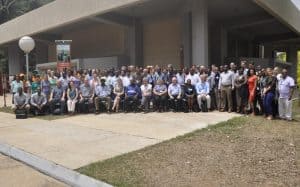
Group photo, Integrated Systems Conference, IITA, Ibadan.Dr. Frank Rijsberman, CEO of the CGIAR Consortium, comments, “The conference focused on one of the trickiest problems in reaching the Sustainable Development Goals (SDGs): it’s not just about coming up with single technologies, but how those can come together to provide livelihood opportunities for farmers, give them access to markets, as well as maintain and improve the ecosystems and the soils that provide the basis for them. A key element of this is research to address yield gaps that exist in several major commodities produced within farming systems.”
Participants advocated for strong partnerships and stakeholder involvement through mechanisms such as Research-for-Development and Innovation Platforms as essential ingredients for enabling the scaling out of systems approaches for the benefit of millions of farmers.
“This gathering of scientists from over 30 nations demonstrates our commitment to help farming families tackle poverty, hunger and environmental degradation by using a fully integrated systems approach that develops and tests, with farming households and development partners, feasible combinations of technical, market, governance and policy options capable of improving agricultural livelihood systems”, says Dr. Kwesi Atta-Krah, Director, Humidtropics, a CGIAR Research Program.
Dr. Nteranya Sanginga, Director General of IITA, says, “In order to build the hunger-free world we want, with its finite natural resources and continuing population growth, the world needs to urgently implement sustainable intensification solutions through integrated systems research for development”. He called on the CGIAR Research Programs, especially those focused on systems research, to work together with partners, for the enhancement of sustainable intensification of agricultural systems.
The conference was organized by the CGIAR Research Program on Integrated Systems for the Humid Tropics (Humidtropics), in partnership with the CGIAR Research Program on Aquatic Agricultural Systems (AAS) and the CGIAR Research Program on Dryl and Systems (Dryl ands). http://humidtropics.cgiar.org/international-conference-integrated-systems/
ENDS
NOTES TO MEDIAAbout Humidtropics
Humidtropics is a CGIAR Research Program led by the International Institute of Tropical Agriculture (IITA). It seeks to transform the lives of the rural poor in tropical America, Asia and Africa, and uses integrated systems research and unique partnership platforms for impact on poverty and ecosystems integrity. Research organizations involved in core partnership with Humidtropics are AVRDC, Bioversity International, CIAT, CIP, FARA, icipe, ICRAF, IITA, ILRI, IWMI, and WUR.humidtropics.cgiar.orgAbout AAS
AAS, the CGIAR Research Program on Aquatic Agricultural Systems is a multi-year research initiative designed to pursue community-based approaches to agricultural research in farming and fishing systems where the annual production dynamics of natural freshwater and/or coastal ecosystems contribute significantly to the household livelihood, including income and food security. At a global level, AAS is led by WorldFish on behalf of CGIAR together with International Water Management Institute (IWMI) and Bioversity International. aas.cgiar.orgAbout Dryl ands
The CGIAR Research Program on Dryl and Systems brings together eight CGIAR Centers and numerous international, regional and national partners to engage in integrated agricultural systems research and unique partnership platforms to ensure improved food security, equitable and sustainable natural resource management and better livelihoods in the world’s dry areas. The program is led by the International Center for Agricultural Research in the Dry Areas (ICARDA), a member of the CGIAR Consortium. Dryl andSystems.cgiar.orgAbout CGIAR
CGIAR is a global agricultural research partnership for a food secure future. Its science is carried out by the 15 research centers who are members of the CGIAR Consortium in collaboration with hundreds of partner organizations. www.cgiar.orgFor more information
Videos of the following speakers and keynotes are available on Vimeo at https://vimeo.com/humidtropics/videos
Dr. Nteranya Sanginga, Director General, International Institute of Tropical Agriculture (IITA): Welcome Address
Dr. Kwesi Atta-Krah, Director, CGIAR Research Program on Integrated Systems for the Humid Tropics (Humidtropics): Welcome Address
Dr. Yemi Akinbamijo, Executive Director, Forum for Agricultural Research in Africa (FARA): Opening Address
Dr. Frank Rijsberman, Chief Executive Officer, CGIAR Consortium: Opening Address
Ann Tutwiler, Director General, Bioversity International: Opening Address
Prof. David W. Norman, Professor Emeritus, Kansas State University: Historical Trajectory of Farming Systems Research: Past, Present and Future
Dr. Bernard Hubert, President, Agropolis International: Systems Thinking toward Institutional Innovation and Change
Cynthia McDougall, Senior Scientist, Gender & Equity Theme Leader, WorldFish and GGIAR Research Program on Aquatic Agricultural Systems (AAS): Gender in Integrated Systems Research
Dr. Marie de Lattre-Gasquet, Senior Foresight Scientist, CGIAR Consortium: Facilitating Changes in Complex Humid Systems: the Role of Foresight
Dr. Dennis Garrity, UN Dryl ands Ambassador & Senior Fellow, World Agroforestry Centre (ICRAF): Underst anding African Farming Systems as a Basis for Sustainable Intensification
Dr. Linley Chiwona Karltun, Swedish University of Agricultural Sciences (SLU): Systemic Nutrition Security Solutions for Transformative Change
Dr. Fergus Sinclair, Systems Science Leader, World Agroforestry Centre (ICRAF): Systems Science at the Scale of Impact: Reconciling Bottom Up Participation with the Production of Widely Applicable Research Outputs
Olamide Deborah Nwanze is a Senior Research Associate specializing in gender mainstreaming research to inform participatory and inclusive breeding, variety development, and seed systems policies regarding root, tuber, and banana (RTB) crops in the International Institute of Tropical Agriculture Headquarters, Ibadan, Nigeria. She is a PhD candidate at the University of Ibadan and holds an MSc and B. Agric in Agricultural Extension and Rural Development. Olamide is a fellow of the African Women in Agricultural Research and Development – Gender Responsive Agricultural Systems Policy (AWARD-GRASP) and the Gender Responsive Researchers Equipped for Agricultural Transformation (GREAT). She seeks to apply her gender-mainstreaming learnings, gender-responsive research, and policy development, and review expertise to facilitate women, youth, children, and vulnerable social group’s access to and adoption of agricultural Innovations that guarantee food, nutrition, income, and livelihood security in Africa. Her current roles include mentoring research fellows, development of guides and training manuals, implementation and adaptation of gender frameworks and tools, value chain actors’ engagement as citizen science partners, policy review and redesign, data management, and analysis. Her current research explores mixed methods and participatory and interdisciplinary approaches to capture and highlight gender dynamics, needs, preferences, and challenges stakeholders face within the agricultural livelihood value chain to prioritize gender-inclusive strategies in breeding programs, policy design, and implementation.
de Sousa, K., van Etten, J., Manners, R. Bello, A., Teeken, B., Olaosebikan, O., et al. 2024. The tricot approach: an agile framework for decentralized on-farm testing supported by citizen science. A retrospective. Agron. Sustain. Dev. 44, 8. https://doi.org/10.1007/s13593-023-00937-1
Madu, T., Onwuka, S., Nwafor, S., Onyemauwa, N., Ejechi, M., Ofoeze, M., Ukeje, B., Eluagu, C., Olaosebikan, O., Okoye, B., 2024. Gender-Inclusive Consumer Studies Improve Cassava Breeding in Nigeria in: Frontiers in Sociology, volume 9, number: 1224504, doi: 10.3389/fsoc.2024.1224504
Olaosebikan, O.; Bello, A.; Utoblo, O.; Okoye, B.; Olutegbe, N.; Garner, E.; Teeken, B.; Bryan, E.; Forsythe, L.; Cole, S.; Madu, T. 2023. Stressors and Resilience within the Cassava Value Chain in Nigeria: Preferred Cassava Variety Traits and Response Strategies of Men and Women to Inform Breeding. Sustainability 15, 7837. https://doi.org/10.3390/su15107837
Okoye, B., Ofoeze, M., Ejechi, M., Onwuka, S., Nwafor, S., Onyemauwa, N., Ukeje, B., Eluagu, C., Obidiegwu, J.*, Olaosebikan, O., Madu, T.* 2023. Prioritizing preferred traits in the yam value chain in Nigeria: a gender situation analysis in: Frontiers in Sociology, volume 8, number: 1232626, pages 1 – 9, ISSN 2297-7775, 2023. https://www.frontiersin.org/articles/10.3389/fsoc.2023.1232626/full
Olaosebikan, O., Bello, A. A., de Sousa, K., Ndjouenkeu, R., Adesokan, M., Alamu, E. O., Agbona, A., van Etten, J., Kegah, F. N.*, Dufour, D., Bouniol, A., Teeken, B. 2023. Consumer acceptability of cassava gari-eba food products across cultural and environmental settings using the triadic comparison of technologies approach (tricot) in: Journal of the Science of Food and Agriculture,
Teeken, B., Olaosebikan, O., Bello, A. A., Madu, T.*, Cole, S. M. 2023. Qualitative assessment on the positionality and preferences of dyads in relation to cassava-related activities: working with tricot trial citizen scientists https://hdl.handle.net/10568/138326 Type: Manual
Bouniol, A., Ceballos, H., Bello, A. A., Teeken, B., Olaosebikan, O., Owoade, D., Agbona, A., Fotso Kuate, A., Madu, T.*, Okoye, B.*, Ofoeze, M.*, Nwafor, S.*, Onyemauwa, N.*, Adinsi, L.*, Forsythe, L., Dufour, D. 2023. Varietal impact on women’s labour, workload and related drudgery in processing root, tuber and banana crops: focus on cassava in sub-Saharan Africa in: Journal of the Science of Food and Agriculture, pages 1 – 25, ISSN 0022-5142,
Bello, A. A., Agbona, A., Olaosebikan, O., Edughaen, G., Dufour, D., Bouniol, A., Iluebbey, P., Ndjouenkeu, R.*, Rabbi, I. Y., Teeken, B. 2023. Genetic and environmental effects on processing productivity and food product yield: drudgery of women’s work in: Journal of the Science of Food and Agriculture, pages 1 – 32, ISSN 0022-5142, 5
Cavicchioli, M., Zimbiti, T., Teeken, B., Nwanze, D.O., Liani, M., Parkes, E. & Bello, A. 2023. IITA-Gender Responsive Breeding Training Report. Genetic Resources Center, IITA-HQ, Ibadan, 21-23 September, 2022. Ibadan, Nigeria: IITA, (34 p.).https://hdl.handle.net/10568/131368
Agbona, A. Peteti P., Teeken B., Olaosebikan O. Bello, A. A., Parkes, E., Rabbi, I. Y., Mueller, L., Egesi, C., Kulakow, P. 2022. Data Management in Multi-disciplinary African RTB Crop Breeding Programs. In: Williamson, H.F., Leonelli, S. (eds) Towards Responsible Plant Data Linkage: Data Challenges for Agricultural Research and Development. Springer, Cham. https://doi.org/10.1007/978-3-031-13276-6_5
Lora Forsythe, Pricilla Marimo, Sarah Mayanja, Olamide D. Olaosebikan, Esme Stuart, Bela Teeken, Benjamin Okoye, Tessy Madu, (2021). Cross-product Gender Analysis of RTBfoods Step 2 Gendered Food Mapping on RTB Products. Understanding the Drivers of Trait Preferences and the Development of Multi-user RTB Product Profiles, WP1. London, UK: RTBfoods Field Scientific Report, 30 p.
Teeken, B., Garner, E., Agbona, A., Balogun, I., Olaosebikan, O., Bello, A., Madu, T., Okoye, B., Egesi, C., Kulakow, P. and Tufan, H.A. 2021. Beyond “Women’s Traits”: Exploring How Gender, Social Difference, and Household Characteristics Influence Trait Preferences. Frontiers Sustainable Food Systems 5:740926. https://doi.org/10.3389/fsufs.2021.740926
Teeken, B., Agbona, A., Bello, A., Olaosebikan, O., Alamu, E., Adesokan, M., Awoyale, W., Madu, T., Okoye, B., Chijioke, U., Owoade, D., Okoro, M., Bouniol, A., Dufour, D., Hershey, C., Rabbi, I., Maziya‐Dixon, B., Egesi, C., Tufan, H. and Kulakow, P. (020. Understanding cassava varietal preferences through pairwise ranking of gari‐eba and fufu prepared by local farmer–processors. Int J Food Sci Technol.https://doi.org/10.1111/ijfs.14862
Bela Teeken, Olamide Olaosebikan, Ireti Balogun, Benjamin Okoye, Tessy Madu, Steven Cole, Abolore Bello, Elizabeth Parkes. (2020). Piloting the G+ customer and product profile tools for gender-responsive cassava breeding in Nigeria. Nigeria: International Institute of Tropical Agriculture (IITA). https://hdl.handle.net/20.500.11766/13000