
IITA NEWS

Southern Armyworm identified in West and Central Africa!
May 30, 2018
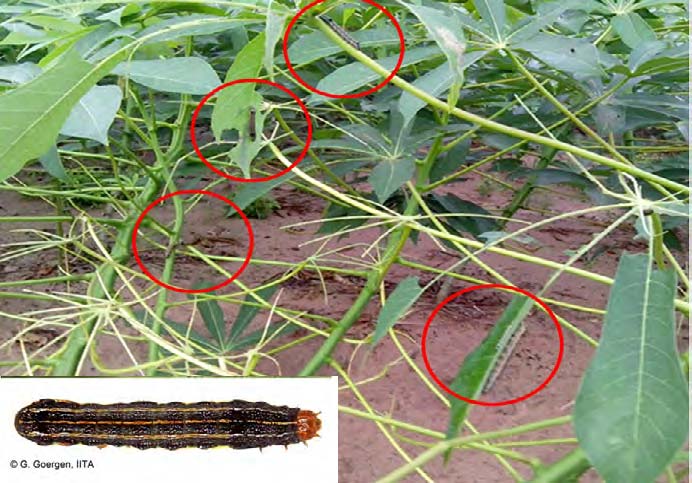
A new pest—southern armyworm, Spodoptera eridania (Stoll)—has been discovered in West and Central Africa! This introduced second armyworm species from the Americas was first found in cassava fields in southeastern Nigeria in December 2016, reported Georg Goergen, Entomologist/Biocontrol Specialist and Head of IITA’s Biodiversity Center in Bénin, but its presence was only recently confirmed by DNA barcode analysis at IITA headquarters in Ibadan. The recent introduction of the fall armyworm (FAW) into the African continent and its growing threat to agriculture and food security have caused great concern in many of the 44 countries of tropical Africa invaded by this pest. Originating from the tropical regions of the Americas the FAW adult has a remarkable capacity for long distance migration and high female fertility. Its crop-destroying caterpillars can cause serious damage to maize but also to other important crops such as sorghum, rice, and vegetables, making the control of FAW a challenging task. The development of management options adapted to Africa has mobilized international experts and the national capacities of affected countries and raised general attention to caterpillar attacks on various crops. Farmers had first observed an outbreak of caterpillars that caused severe defoliation on cassava in a 450-hectare field near Ubiaja in southeastern Nigeria in late 2016. Alcohol-preserved samples of the larvae were sent for diagnosis to the Biodiversity Center at the IITA station in Bénin, which did not match the morphological characteristics of FAW caterpillars. The species, however, appeared to have related origins and resembled closely the African cotton leafworm (S. littoralis [Boisduval]). In the absence of adult moths, it was concluded that the latter species, widespread in tropical Africa and known to feed on various kinds of food, must have attacked some sweet varieties of cassava that are less toxic to potential insect pests. Similar observations were made in early 2017, when farmers submitted alcohol-stored samples of immatures for identification following complaints about dense caterpillar colonies in their cassava fields in the areas surrounding Dasso, southern Bénin. Moths were finally obtained from tomato fields attacked in Yaoundé, Cameroon, and samples of adults were obtained from a scientist-colleague based at the University of Masuku, in Franceville, Gabon. The examination of the outer features of the moths together with the genitalia of both sexes clearly identified the pest as SAW. Larval and adult samples were also collected and sent to IITA headquarters in Ibadan to the germplasm health, virology, and diagnostics unit for DNA barcode analysis. Results confirmed these findings. According to Goergen, SAW belongs to the cosmopolitan genus Spodoptera that encompasses 31 species worldwide including many of the most important agricultural armyworm caterpillars such as FAW. The detection of the new pest adds to the eight species already known to occur on the African continent. Caterpillars, particularly mature instars of the SAW, are extremely variable in their general appearance and can hardly be identified based on physical characters alone. The southern armyworm is native to the Americas, occurring widely from southern USA to Argentina. In Africa, spectacular outbreaks comparable to those caused by FAW have not been observed; however, preliminary data show that the species is present in at least four countries in West and Central Africa, where it can be found on cassava, tomato, amaranth, and maize. It is uncertain how long the SAW has been present in West and Central Africa and its possible pathways of introduction into the continent are also unclear. Since their identification is difficult, populations may have remained latent in the field and only been sporadically noticed especially when young caterpillars aggregate on individual host plants before they disperse upon maturation. An interesting circumstance is that the southern armyworm and the fall armyworm share many important natural enemy species in South America. IITA’s Deputy Director General for Research for Development, May-Guri Saethre, said that while this trait may become a significant stabilizing factor for common natural enemy populations, more research is urgently needed to assess its effective pest status in tropical Africa. From IITA media release: New pest identified in West and Central Africa!
Contributed by

Recent stories

No items found

Leave a Reply

Your email address will not be published. Required fields are marked *

Scroll to Top
Olaosebikan, Olamide

Olamide Deborah Nwanze is a Senior Research Associate specializing in gender mainstreaming research to inform participatory and inclusive breeding, variety development, and seed systems policies regarding root, tuber, and banana (RTB) crops in the International Institute of Tropical Agriculture Headquarters, Ibadan, Nigeria. She is a PhD candidate at the University of Ibadan and holds an MSc and B. Agric in Agricultural Extension and Rural Development. Olamide is a fellow of the African Women in Agricultural Research and Development – Gender Responsive Agricultural Systems Policy (AWARD-GRASP) and the Gender Responsive Researchers Equipped for Agricultural Transformation (GREAT). She seeks to apply her gender-mainstreaming learnings, gender-responsive research, and policy development, and review expertise to facilitate women, youth, children, and vulnerable social group’s access to and adoption of agricultural Innovations that guarantee food, nutrition, income, and livelihood security in Africa. Her current roles include mentoring research fellows, development of guides and training manuals, implementation and adaptation of gender frameworks and tools, value chain actors’ engagement as citizen science partners, policy review and redesign, data management, and analysis. Her current research explores mixed methods and participatory and interdisciplinary approaches to capture and highlight gender dynamics, needs, preferences, and challenges stakeholders face within the agricultural livelihood value chain to prioritize gender-inclusive strategies in breeding programs, policy design, and implementation.

At IITA, she contributes to the implementation of the CGIAR Accelerated Breeding Initiative and Genetic Innovation Programs; participatory and gender research within the NextGen CassavaHarvestPlusRTBFoods, and Tricot-ClimMob 1000Farms Projects; and gender knowledge communication via the G-LENS webinar series, video documentary, policy briefspublications, and blogs.


Recent publications

de Sousa, K., van Etten, J., Manners, R. Bello, A., Teeken, B., Olaosebikan, O., et al. 2024. The tricot approach: an agile framework for decentralized on-farm testing supported by citizen science. A retrospective. Agron. Sustain. Dev. 44, 8. https://doi.org/10.1007/s13593-023-00937-1

Madu, T., Onwuka, S., Nwafor, S., Onyemauwa, N., Ejechi, M., Ofoeze, M., Ukeje, B., Eluagu, C., Olaosebikan, O., Okoye, B., 2024. Gender-Inclusive Consumer Studies Improve Cassava Breeding in Nigeria in: Frontiers in Sociology, volume 9, number: 1224504, doi: 10.3389/fsoc.2024.1224504

Olaosebikan, O.; Bello, A.; Utoblo, O.; Okoye, B.; Olutegbe, N.; Garner, E.; Teeken, B.; Bryan, E.; Forsythe, L.; Cole, S.; Madu, T. 2023.  Stressors and Resilience within the Cassava Value Chain in Nigeria: Preferred Cassava Variety Traits and Response Strategies of Men and Women to Inform Breeding. Sustainability 15, 7837. https://doi.org/10.3390/su15107837

Okoye, B., Ofoeze, M., Ejechi, M., Onwuka, S., Nwafor, S., Onyemauwa, N., Ukeje, B., Eluagu, C., Obidiegwu, J.*, Olaosebikan, O., Madu, T.* 2023. Prioritizing preferred traits in the yam value chain in Nigeria: a gender situation analysis in: Frontiers in Sociology, volume 8, number: 1232626, pages 1 – 9, ISSN 2297-7775, 2023. https://www.frontiersin.org/articles/10.3389/fsoc.2023.1232626/full

Olaosebikan, O., Bello, A. A., de Sousa, K., Ndjouenkeu, R., Adesokan, M., Alamu, E. O., Agbona, A., van Etten, J., Kegah, F. N.*, Dufour, D., Bouniol, A., Teeken, B. 2023. Consumer acceptability of cassava gari-eba food products across cultural and environmental settings using the triadic comparison of technologies approach (tricot) in: Journal of the Science of Food and Agriculture,

Teeken, B., Olaosebikan, O., Bello, A. A., Madu, T.*, Cole, S. M. 2023. Qualitative assessment on the positionality and preferences of dyads in relation to cassava-related activities: working with tricot trial citizen scientists https://hdl.handle.net/10568/138326 Type: Manual

Bouniol, A., Ceballos, H., Bello, A. A., Teeken, B., Olaosebikan, O., Owoade, D., Agbona, A., Fotso Kuate, A., Madu, T.*, Okoye, B.*, Ofoeze, M.*, Nwafor, S.*, Onyemauwa, N.*, Adinsi, L.*, Forsythe, L., Dufour, D. 2023. Varietal impact on women’s labour, workload and related drudgery in processing root, tuber and banana crops: focus on cassava in sub-Saharan Africa in: Journal of the Science of Food and Agriculture, pages 1 – 25, ISSN 0022-5142,

Bello, A. A., Agbona, A., Olaosebikan, O., Edughaen, G., Dufour, D., Bouniol, A., Iluebbey, P., Ndjouenkeu, R.*, Rabbi, I. Y., Teeken, B. 2023. Genetic and environmental effects on processing productivity and food product yield: drudgery of women’s work in: Journal of the Science of Food and Agriculture, pages 1 – 32, ISSN 0022-5142, 5

Cavicchioli, M., Zimbiti, T., Teeken, B., Nwanze, D.O., Liani, M., Parkes, E. & Bello, A. 2023. IITA-Gender Responsive Breeding Training Report. Genetic Resources Center, IITA-HQ, Ibadan, 21-23 September, 2022. Ibadan, Nigeria: IITA, (34 p.).https://hdl.handle.net/10568/131368

Agbona, A. Peteti P., Teeken B., Olaosebikan O. Bello, A. A., Parkes, E., Rabbi, I. Y., Mueller, L., Egesi, C., Kulakow, P. 2022. Data Management in Multi-disciplinary African RTB Crop Breeding Programs. In: Williamson, H.F., Leonelli, S. (eds) Towards Responsible Plant Data Linkage: Data Challenges for Agricultural Research and Development. Springer, Cham. https://doi.org/10.1007/978-3-031-13276-6_5

Lora Forsythe, Pricilla Marimo, Sarah Mayanja, Olamide D. Olaosebikan, Esme Stuart, Bela Teeken, Benjamin Okoye, Tessy Madu, (2021). Cross-product Gender Analysis of RTBfoods Step 2 Gendered Food Mapping on RTB Products. Understanding the Drivers of Trait Preferences and the Development of Multi-user RTB Product Profiles, WP1. London, UK: RTBfoods Field Scientific Report, 30 p.

Teeken, B., Garner, E., Agbona, A., Balogun, I., Olaosebikan, O., Bello, A., Madu, T., Okoye, B., Egesi, C., Kulakow, P. and Tufan, H.A. 2021. Beyond “Women’s Traits”: Exploring How Gender, Social Difference, and Household Characteristics Influence Trait Preferences. Frontiers Sustainable Food Systems 5:740926. https://doi.org/10.3389/fsufs.2021.740926

Teeken, B., Agbona, A., Bello, A., Olaosebikan, O., Alamu, E., Adesokan, M., Awoyale, W., Madu, T., Okoye, B., Chijioke, U., Owoade, D., Okoro, M., Bouniol, A., Dufour, D., Hershey, C., Rabbi, I., Maziya‐Dixon, B., Egesi, C., Tufan, H. and Kulakow, P. (020. Understanding cassava varietal preferences through pairwise ranking of gari‐eba and fufu prepared by local farmer–processors. Int J Food Sci Technol. https://doi.org/10.1111/ijfs.14862

Bela Teeken, Olamide Olaosebikan, Ireti Balogun, Benjamin Okoye, Tessy Madu, Steven Cole, Abolore Bello, Elizabeth Parkes. (2020). Piloting the G+ customer and product profile tools for gender-responsive cassava breeding in Nigeria. Nigeria: International Institute of Tropical Agriculture (IITA). https://hdl.handle.net/20.500.11766/13000