
NEWS

Stable and high-yielding farmer-preferred “Matooke” cooking banana hybrids registered
January 5, 2023

Millions of people around the world depend on banana and plantain (Musa sp.) as vital food staples and sources of income. A unique collection of cultivars known as the East African highland bananas (EAHBs) can only be found in the highlands of the African Great Lakes region. With an estimated yearly per capita consumption of 250 to 600 kg, these bananas are crucial to the food economy of this region’s 2.5 million farming households.
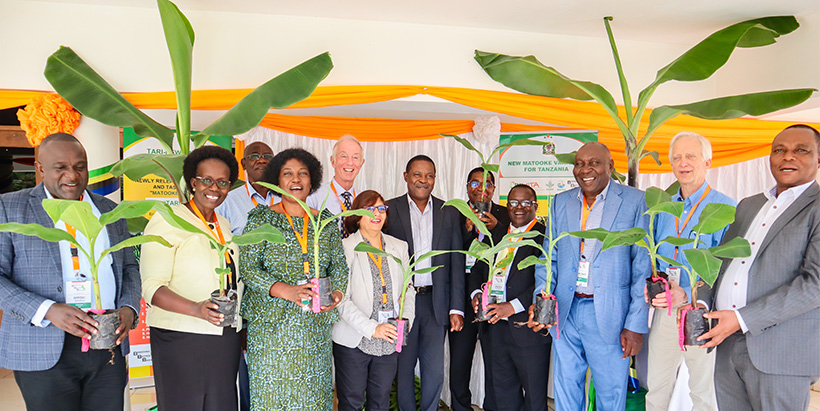
Banana researchers, with Tanzania government officials and a farmer, during the ABBB Annual Meeting and release of TARIBAN hybrids in Arusha, Tanzania. Photo: IITA/G.Ndiblema

The future sustainability of EAHB production across the region is threatened by pests such as the banana weevil Cosmopolites sordidus, the burrowing nematode Radopholus similis, black leaf streak (BLS) pathogen Pseudocercospora fijiensisFusarium wilt caused by Fusarium oxysporum f. sp. cubense, and banana bacterial wilt caused by Xanthomonas campestris pv. musacearum.

A multidisciplinary team involving scientists from IITACGIAR, the National Agricultural Research Organization-Uganda (NARO-Uganda), the Alliance of Bioversity International and CIAT (ABC), the Tanzania Agriculture Research Institute (TARI), the National Agricultural Research Laboratories (NARL-NARO, Uganda),  the Tanzania Official Seed Certification Institute (TOSCI), the University of Wisconsin-Madison, and the Swedish University of Agricultural Sciences recently conducted a study titled “TARIBAN1, TARIBAN2, TARIBAN3, and TARIBAN4 ‘Matooke’ Cooking Banana Cultivars for the Great Lakes Region of Africa”.

“EAHBs are highly susceptible to BLS. The pathogen causes necrotic leaf lesions on the photosynthetic area of the host plant, resulting in fruit yield losses (up to 50%) and poor fruit quality. In addressing the negative effects of BLS, IITA and NARO-Uganda researchers developed the best EAHB hybrids called NARITA to increase crop yields and income of smallholder farmers,” stressed Priver Bwesigye, NARO banana leader.
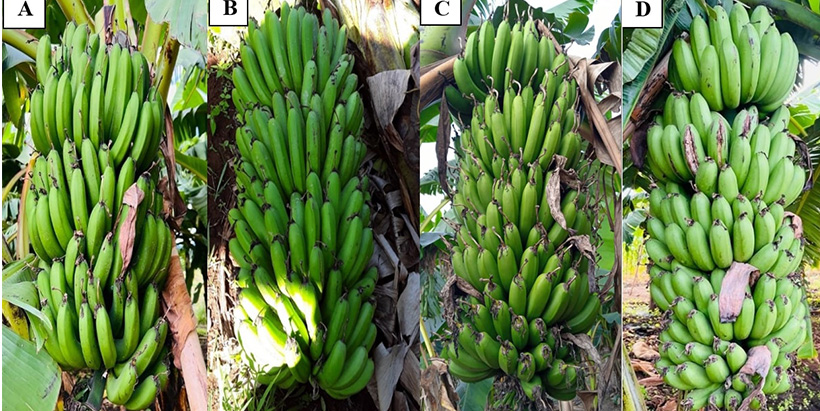
Bunches of the four new ‘Matooke’ cooking banana cultivars released by Tanzania Agriculture Research Institute (TARI) in June 2021: (A) ‘TARIBAN1’, (B) ‘TARIBAN2’, (C) ‘TARIBAN3’, and (D) ‘TARIBAN4’. Photo: TARI/M.Shimwale

Following early evaluation trials in Uganda to select cultivars for multilocational testing, the best hybrids were evaluated at five multi-sites over three cropping cycles in Tanzania and Uganda, which was used to make the release and registration decision. The field trials were conducted by IITA, NARO, TARI, and ABC. “Multi-site trials involving the “Matooke” and other banana cultivars were performed in Tanzania from 2016 to 2019, with the aim of selecting breeding clones that combine BLS resistance with steady high production and other desirable traits and that have the potential for adoption by farmers and consumers,” IITA Banana Breeder Rony Swennen narrated.

TARIBAN1, TARIBAN2, TARIBAN3, and TARIBAN4 were the names of the top four NARITA hybrids released in Tanzania in 2021, as explained by Mpoki Shimwela, the TARI lead banana scientist. They were included in Tanzania’s national cultivar list as TARIBAN, making them available for farmer propagation and distribution. Their average yield potential in Tanzania might reach 20.3 t ha-1 per year, with bunches weighing up to 51.0 kg.

Shimwela said that the findings from the “Yield Stability of East African Highland Cooking Banana ‘Matooke’ Hybrids” study show that the sensory characteristics of the hybrids were closest to those of the most popular traditional, consumer-preferred Matooke cooking banana cultivar, Mbwazirume, in color, aroma, taste, mouthfeel, texture, and overall acceptability. Moreover, farmers choose which cultivar to plant in a field based on the anticipated economic and social benefits, typically defined in terms of maximum yield potential and performance stability. This critical decision determines how long they can continue to produce banana.

ABC Researcher Noel Madalla added that the four hybrids registered had been proven to have high yield, stability, and adaptability, making them suitable for Matooke banana production in the target population of environments in the East African region from which the testing sites were drawn, as well as to be introduced into areas where BLS has a severe impact and threatens farmers’ livelihoods.

For wide scaling up of these TARIBAN varieties, the cultivars are available from TARI at its subcenters of TARI Tengeru, TARI Maruku, and TARI Uyole in Tanzania. Additionally, tissue culture plantlets are available from public laboratories at TARI Tengeru and TARI Mikocheni and designated private tissue culture laboratories in Tanzania. The National Banana Research Program of NARO in Kawanda, Uganda, is responsible for maintaining the TARIBAN (or “KABANA”) in Uganda at on-station fields and in vitro. These cooking banana hybrids are also accessible through NARO and specific domestic private tissue culture enterprises in Uganda.

Contributed by Gloriana Ndibalema


Contributed by

Recent stories

No items found

Leave a Reply

Your email address will not be published. Required fields are marked *

Scroll to Top
Olaosebikan, Olamide

Olamide Deborah Nwanze is a Senior Research Associate specializing in gender mainstreaming research to inform participatory and inclusive breeding, variety development, and seed systems policies regarding root, tuber, and banana (RTB) crops in the International Institute of Tropical Agriculture Headquarters, Ibadan, Nigeria. She is a PhD candidate at the University of Ibadan and holds an MSc and B. Agric in Agricultural Extension and Rural Development. Olamide is a fellow of the African Women in Agricultural Research and Development – Gender Responsive Agricultural Systems Policy (AWARD-GRASP) and the Gender Responsive Researchers Equipped for Agricultural Transformation (GREAT). She seeks to apply her gender-mainstreaming learnings, gender-responsive research, and policy development, and review expertise to facilitate women, youth, children, and vulnerable social group’s access to and adoption of agricultural Innovations that guarantee food, nutrition, income, and livelihood security in Africa. Her current roles include mentoring research fellows, development of guides and training manuals, implementation and adaptation of gender frameworks and tools, value chain actors’ engagement as citizen science partners, policy review and redesign, data management, and analysis. Her current research explores mixed methods and participatory and interdisciplinary approaches to capture and highlight gender dynamics, needs, preferences, and challenges stakeholders face within the agricultural livelihood value chain to prioritize gender-inclusive strategies in breeding programs, policy design, and implementation.

At IITA, she contributes to the implementation of the CGIAR Accelerated Breeding Initiative and Genetic Innovation Programs; participatory and gender research within the NextGen CassavaHarvestPlusRTBFoods, and Tricot-ClimMob 1000Farms Projects; and gender knowledge communication via the G-LENS webinar series, video documentary, policy briefspublications, and blogs.


Recent publications

de Sousa, K., van Etten, J., Manners, R. Bello, A., Teeken, B., Olaosebikan, O., et al. 2024. The tricot approach: an agile framework for decentralized on-farm testing supported by citizen science. A retrospective. Agron. Sustain. Dev. 44, 8. https://doi.org/10.1007/s13593-023-00937-1

Madu, T., Onwuka, S., Nwafor, S., Onyemauwa, N., Ejechi, M., Ofoeze, M., Ukeje, B., Eluagu, C., Olaosebikan, O., Okoye, B., 2024. Gender-Inclusive Consumer Studies Improve Cassava Breeding in Nigeria in: Frontiers in Sociology, volume 9, number: 1224504, doi: 10.3389/fsoc.2024.1224504

Olaosebikan, O.; Bello, A.; Utoblo, O.; Okoye, B.; Olutegbe, N.; Garner, E.; Teeken, B.; Bryan, E.; Forsythe, L.; Cole, S.; Madu, T. 2023.  Stressors and Resilience within the Cassava Value Chain in Nigeria: Preferred Cassava Variety Traits and Response Strategies of Men and Women to Inform Breeding. Sustainability 15, 7837. https://doi.org/10.3390/su15107837

Okoye, B., Ofoeze, M., Ejechi, M., Onwuka, S., Nwafor, S., Onyemauwa, N., Ukeje, B., Eluagu, C., Obidiegwu, J.*, Olaosebikan, O., Madu, T.* 2023. Prioritizing preferred traits in the yam value chain in Nigeria: a gender situation analysis in: Frontiers in Sociology, volume 8, number: 1232626, pages 1 – 9, ISSN 2297-7775, 2023. https://www.frontiersin.org/articles/10.3389/fsoc.2023.1232626/full

Olaosebikan, O., Bello, A. A., de Sousa, K., Ndjouenkeu, R., Adesokan, M., Alamu, E. O., Agbona, A., van Etten, J., Kegah, F. N.*, Dufour, D., Bouniol, A., Teeken, B. 2023. Consumer acceptability of cassava gari-eba food products across cultural and environmental settings using the triadic comparison of technologies approach (tricot) in: Journal of the Science of Food and Agriculture,

Teeken, B., Olaosebikan, O., Bello, A. A., Madu, T.*, Cole, S. M. 2023. Qualitative assessment on the positionality and preferences of dyads in relation to cassava-related activities: working with tricot trial citizen scientists https://hdl.handle.net/10568/138326 Type: Manual

Bouniol, A., Ceballos, H., Bello, A. A., Teeken, B., Olaosebikan, O., Owoade, D., Agbona, A., Fotso Kuate, A., Madu, T.*, Okoye, B.*, Ofoeze, M.*, Nwafor, S.*, Onyemauwa, N.*, Adinsi, L.*, Forsythe, L., Dufour, D. 2023. Varietal impact on women’s labour, workload and related drudgery in processing root, tuber and banana crops: focus on cassava in sub-Saharan Africa in: Journal of the Science of Food and Agriculture, pages 1 – 25, ISSN 0022-5142,

Bello, A. A., Agbona, A., Olaosebikan, O., Edughaen, G., Dufour, D., Bouniol, A., Iluebbey, P., Ndjouenkeu, R.*, Rabbi, I. Y., Teeken, B. 2023. Genetic and environmental effects on processing productivity and food product yield: drudgery of women’s work in: Journal of the Science of Food and Agriculture, pages 1 – 32, ISSN 0022-5142, 5

Cavicchioli, M., Zimbiti, T., Teeken, B., Nwanze, D.O., Liani, M., Parkes, E. & Bello, A. 2023. IITA-Gender Responsive Breeding Training Report. Genetic Resources Center, IITA-HQ, Ibadan, 21-23 September, 2022. Ibadan, Nigeria: IITA, (34 p.).https://hdl.handle.net/10568/131368

Agbona, A. Peteti P., Teeken B., Olaosebikan O. Bello, A. A., Parkes, E., Rabbi, I. Y., Mueller, L., Egesi, C., Kulakow, P. 2022. Data Management in Multi-disciplinary African RTB Crop Breeding Programs. In: Williamson, H.F., Leonelli, S. (eds) Towards Responsible Plant Data Linkage: Data Challenges for Agricultural Research and Development. Springer, Cham. https://doi.org/10.1007/978-3-031-13276-6_5

Lora Forsythe, Pricilla Marimo, Sarah Mayanja, Olamide D. Olaosebikan, Esme Stuart, Bela Teeken, Benjamin Okoye, Tessy Madu, (2021). Cross-product Gender Analysis of RTBfoods Step 2 Gendered Food Mapping on RTB Products. Understanding the Drivers of Trait Preferences and the Development of Multi-user RTB Product Profiles, WP1. London, UK: RTBfoods Field Scientific Report, 30 p.

Teeken, B., Garner, E., Agbona, A., Balogun, I., Olaosebikan, O., Bello, A., Madu, T., Okoye, B., Egesi, C., Kulakow, P. and Tufan, H.A. 2021. Beyond “Women’s Traits”: Exploring How Gender, Social Difference, and Household Characteristics Influence Trait Preferences. Frontiers Sustainable Food Systems 5:740926. https://doi.org/10.3389/fsufs.2021.740926

Teeken, B., Agbona, A., Bello, A., Olaosebikan, O., Alamu, E., Adesokan, M., Awoyale, W., Madu, T., Okoye, B., Chijioke, U., Owoade, D., Okoro, M., Bouniol, A., Dufour, D., Hershey, C., Rabbi, I., Maziya‐Dixon, B., Egesi, C., Tufan, H. and Kulakow, P. (020. Understanding cassava varietal preferences through pairwise ranking of gari‐eba and fufu prepared by local farmer–processors. Int J Food Sci Technol. https://doi.org/10.1111/ijfs.14862

Bela Teeken, Olamide Olaosebikan, Ireti Balogun, Benjamin Okoye, Tessy Madu, Steven Cole, Abolore Bello, Elizabeth Parkes. (2020). Piloting the G+ customer and product profile tools for gender-responsive cassava breeding in Nigeria. Nigeria: International Institute of Tropical Agriculture (IITA). https://hdl.handle.net/20.500.11766/13000