
The Reducing Post-harvest loss across Vitamin A Maize and Cassava Value Chain project of IITA–CGIAR organized a virtual seminar on 26 August. The seminar featured private sector and government speakers highlighting the impact of and solution to aflatoxin contamination on Nigeria’s export market.
Aflatoxins are poisons produced naturally by toxin-producing Aspergillus fungi in several food crops, including staple grains like maize, groundnut, and spices like chilies and ginger. Chronic exposure may result in liver cancer and immune system suppression.
IITA’s Godwin Atser, Project Manager and Advocacy, Promotion and Outreach Lead, who moderated the event, mentioned that the seminar’s purpose was to look into the issue of aflatoxin and how it is affecting the import market in Nigeria.
Titilayo Falade, Associate Scientist at IITA Pathology/Aflasafe Unit, stated that the seminar would highlight pitfalls of the export market and how to avoid them. She mentioned that representatives from the private sector and the government would speak on the theme from the perspective of their institutions.
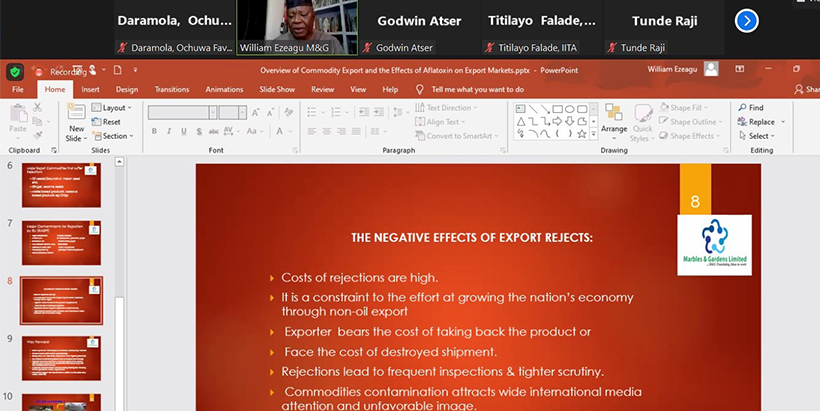
Williams Ezeagu, Former Director of Product Development Department, Nigeria Export Promotion Council (NEPC), gave an overview of commodity export in Nigeria with particular reference to the issues of aflatoxin. He said major export products like cocoa, sesame seed, cashew seed, and groundnuts cover about 70% of Nigeria’s export. However, these products now experience export rejection resulting in loss of money due to aflatoxin contamination. “Aflasafe, introduced by IITA, is a game changer for us, and this seminar is one of the ways to create awareness for food safety in the country,” he added.
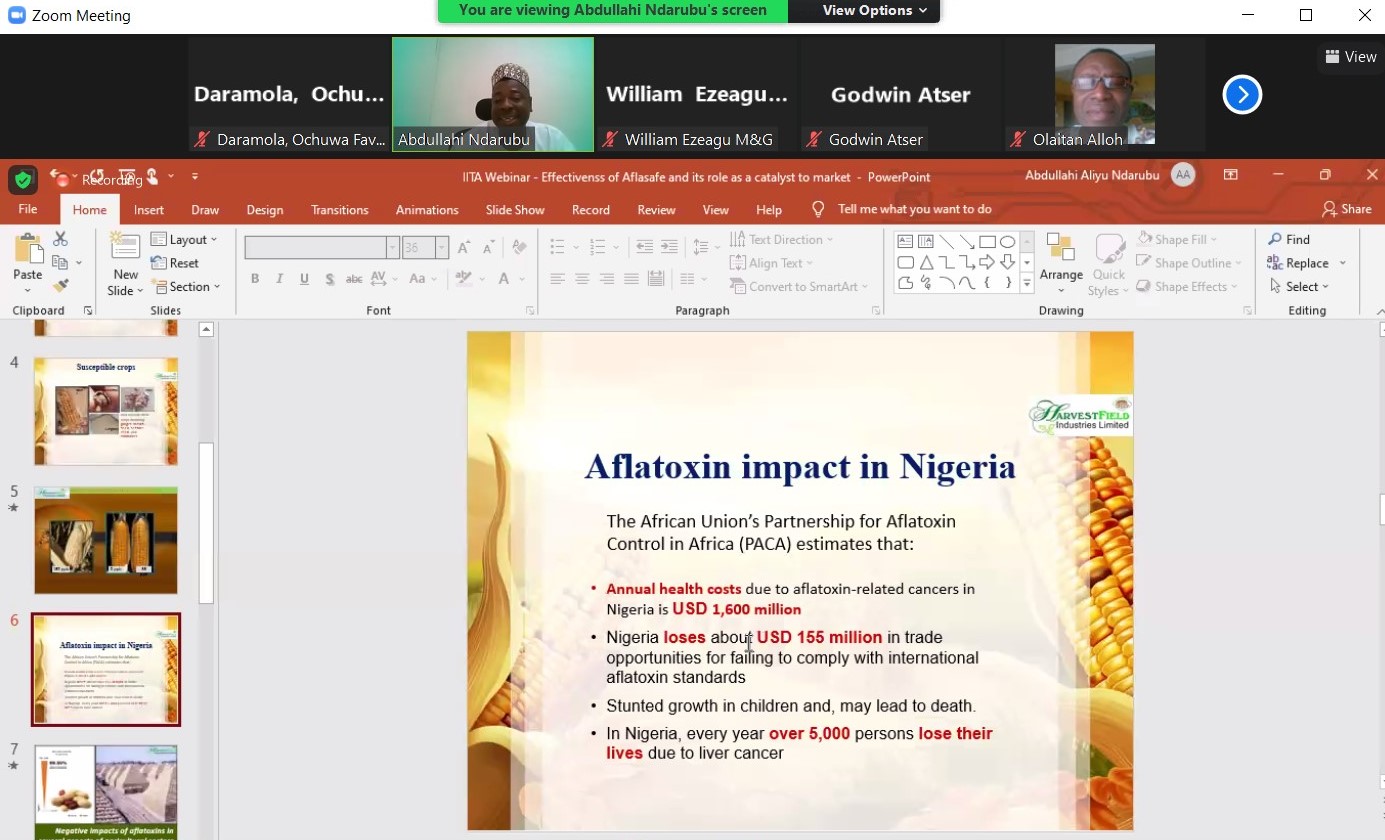
Dr Abdullah Ndarubu, Harvestfield Industries Limited (HIL) Chief Operating Officer, spoke about aflatoxin from the private sector’s perspective. He mentioned that over 20% of maize and groundnut produced in Africa are affected by aflatoxin. He also shared the effectiveness of Aflasafe and its role as a catalyst for export. “We appreciate IITA for selecting Harvestfield in 2018 to be a manufacturer of Aflasafe in Nigeria,” he said.
Dr Oyeleke Rasaq, Deputy Director and Head of Nutrition at the Federal Ministry of Agriculture and Rural Development (FMARD), shared the government’s effort in curtailing aflatoxin spread in grains and improving export. He highlighted various initiatives that have been created, including Agro-zero Reject Initiative, which was inaugurated in 2021 to ensure zero export rejection and ease export business. “We have a national program on aflatoxin control in Oyo, Kano, Kaduna, and Abuja. We need the support of IITA in suggesting ideas and accessing funding partners so we can extend this project to all states in Nigeria,” he said. He also spoke of the importation of groundnuts for RUTF (ready-to-eat-therapeutic foods) because Nigerian groundnuts do not meet the safety requirements due to aflatoxin contamination. He stressed that government agencies need to move from working in “siloes” to working collaboratively.

Participants at the workshop emphasized the need for Nigeria to work towards reducing aflatoxins for the safety of domestic consumers and the opportunity to access quality-sensitive international markets.
Rounding off the seminar, Falade added that IITA is working collaboratively with partners to organize a convention that will converge stakeholders via a Food Convergence Innovation with partners in McGill university and with support from FAO, GAIN, and Harvestplus. The convention aims to create traction towards actionable steps for collaborative, sustainable aflatoxin management nationwide.
Contributed by Ochuwa Favour Daramola
Contributed by
Recent stories