IITA NEWS

Stakeholders strategize ways to strengthen breeding pipelines in West Africa
April 9, 2018

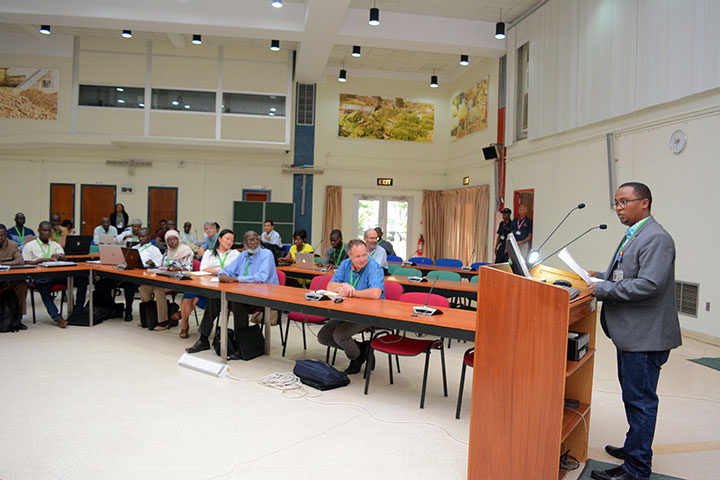
Ismail Rabbi, IITA Molecular Geneticist and workshop coordinator, welcomes participants to the workshop.

An array of institutes and lead specialists on breeding across West Africa convened at IITA-Ibadan for a workshop on 12–15 March, to discuss and exchange ideas on how they can work together to bring best practices and tools that can help them achieve their objectives more effectively, efficiently, and within a relatively shorter time scale. The 4-day workshop themed “West Africa Transforming Breeding,” aims to look at ways to modernize and transform breeding strategies, increase efficiencies, and develop the capacity to increase the rates of genetic gain in West Africa. Breeders and associated researchers as well as program leaders from the International Maize and Wheat Improvement Center (CIMMYT), International Crops Research Institute for the Semi-Arid Tropics (ICRISAT), AfricaRice, and IITA, attended the workshop with a shared vision of pulling together national, regional, and international partners to synergize efforts to increase agricultural productivity levels, farmers’ yield and income, establish a rationale of sustainable improvement, and also highlight the scientific innovations being deployed by breeders, as a starting point for building a globally unified community of practice around modern breeding techniques. The workshop was jointly sponsored by the Excellence in Breeding (EIB) platform, Genomic Open-source Breeding Informatics Initiative (GOBii), Integrated Genotyping Service and Support (IGSS), the High-Throughput Genotyping (HTPG) platform, and the Next Generation Cassava Breeding program. The call for transformation in agriculture is now being embraced by breeders, who, in discussion with public and private sector investors, are working to redefine and transform breeding. This is because plant breeding is a long-time investment, which can succeed if it is sustained. African agriculture is changing, and central to this transformation is identifying the market demands and developing agricultural products that meet this demand. In his welcome address, IITA Director General Nteranya Sanginga applauded the spirit of enthusiasm and cooperation among participants, and acknowledged their collaborative effort. “IITA is 50, and we are proud of the tremendous impact the Institute has made globally. I am certain that with this set of experts, we can continuously transform breeding in West Africa, but we cannot transform breeding without addressing the issues of agronomy. I urge all participants to seize the opportunity to come out with new proposals as we aim to combine the science of discovery with the science of delivery, to ensure full sustainability of improved crop varieties and their related value chains within the region,” he added. Agreeing with DG Sanginga’s address, Ismail Rabbi, IITA Molecular Geneticist, encouraged the participants to learn, interact, and discuss practical issues on how to engineer and harmonize breeding programs to make them more resourceful and sustainable. During the plenary session, topical presentations were made by stakeholders that cut across the various breeding pipelines, ranging from breeding strategy, and process optimization, data management and systems integration, sample tracking, genomic selection and analysis pipeline, genotyping data management, and marker application tools. A way forward in subsequent years was also deliberated upon. The session incorporated the presentations of two keynote speakers titled “The components of a modern breeding program; sharing an industry perspective to genetic gain” by Stella Salvo, Precision Breeder for Asia- Africa, Monsanto, and “Entering the age of genomic breeding: Big steps for a small program” by Clay Sneller, co-Leader of the Integrated genotyping and support platform (IGSS) platform, both directed towards redefining, strengthening, and transforming breeding with the objective of making significant impact among smallholder farmers in Africa. This change in attitude and practice of breeders aims to increase productivity and profitability of crops in Africa, and to meet the ever-increasing food demand across the population due to changes in diets and standards of living. The breeders also emphasized that new plant varieties need to be developed and adapted to meet these varied market needs. West Africa Transforming Breeding workshop participants receive field data collection equipment
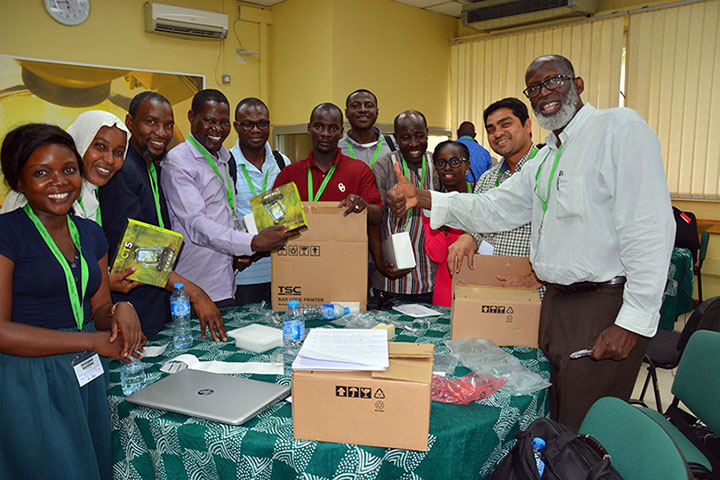
Participating CGIAR and NARS breeding programs empowered to increase data collection throughput and accuracy through barcoding and electronic data entering equipment courtesy of the HTPG project. Photo by I. Rabbi, IITA

Participating CGIAR and NARS breeding programs empowered to increase data collection throughput and accuracy through barcoding and electronic data entering equipment courtesy of the HTPG project. Photo by I. Rabbi, IITA


Contributed by

Related news

No items found

Leave a Reply

Your email address will not be published. Required fields are marked *

Scroll to Top
Olaosebikan, Olamide

Olamide Deborah Nwanze is a Senior Research Associate specializing in gender mainstreaming research to inform participatory and inclusive breeding, variety development, and seed systems policies regarding root, tuber, and banana (RTB) crops in the International Institute of Tropical Agriculture Headquarters, Ibadan, Nigeria. She is a PhD candidate at the University of Ibadan and holds an MSc and B. Agric in Agricultural Extension and Rural Development. Olamide is a fellow of the African Women in Agricultural Research and Development – Gender Responsive Agricultural Systems Policy (AWARD-GRASP) and the Gender Responsive Researchers Equipped for Agricultural Transformation (GREAT). She seeks to apply her gender-mainstreaming learnings, gender-responsive research, and policy development, and review expertise to facilitate women, youth, children, and vulnerable social group’s access to and adoption of agricultural Innovations that guarantee food, nutrition, income, and livelihood security in Africa. Her current roles include mentoring research fellows, development of guides and training manuals, implementation and adaptation of gender frameworks and tools, value chain actors’ engagement as citizen science partners, policy review and redesign, data management, and analysis. Her current research explores mixed methods and participatory and interdisciplinary approaches to capture and highlight gender dynamics, needs, preferences, and challenges stakeholders face within the agricultural livelihood value chain to prioritize gender-inclusive strategies in breeding programs, policy design, and implementation.

At IITA, she contributes to the implementation of the CGIAR Accelerated Breeding Initiative and Genetic Innovation Programs; participatory and gender research within the NextGen CassavaHarvestPlusRTBFoods, and Tricot-ClimMob 1000Farms Projects; and gender knowledge communication via the G-LENS webinar series, video documentary, policy briefspublications, and blogs.


Recent publications

de Sousa, K., van Etten, J., Manners, R. Bello, A., Teeken, B., Olaosebikan, O., et al. 2024. The tricot approach: an agile framework for decentralized on-farm testing supported by citizen science. A retrospective. Agron. Sustain. Dev. 44, 8. https://doi.org/10.1007/s13593-023-00937-1

Madu, T., Onwuka, S., Nwafor, S., Onyemauwa, N., Ejechi, M., Ofoeze, M., Ukeje, B., Eluagu, C., Olaosebikan, O., Okoye, B., 2024. Gender-Inclusive Consumer Studies Improve Cassava Breeding in Nigeria in: Frontiers in Sociology, volume 9, number: 1224504, doi: 10.3389/fsoc.2024.1224504

Olaosebikan, O.; Bello, A.; Utoblo, O.; Okoye, B.; Olutegbe, N.; Garner, E.; Teeken, B.; Bryan, E.; Forsythe, L.; Cole, S.; Madu, T. 2023.  Stressors and Resilience within the Cassava Value Chain in Nigeria: Preferred Cassava Variety Traits and Response Strategies of Men and Women to Inform Breeding. Sustainability 15, 7837. https://doi.org/10.3390/su15107837

Okoye, B., Ofoeze, M., Ejechi, M., Onwuka, S., Nwafor, S., Onyemauwa, N., Ukeje, B., Eluagu, C., Obidiegwu, J.*, Olaosebikan, O., Madu, T.* 2023. Prioritizing preferred traits in the yam value chain in Nigeria: a gender situation analysis in: Frontiers in Sociology, volume 8, number: 1232626, pages 1 – 9, ISSN 2297-7775, 2023. https://www.frontiersin.org/articles/10.3389/fsoc.2023.1232626/full

Olaosebikan, O., Bello, A. A., de Sousa, K., Ndjouenkeu, R., Adesokan, M., Alamu, E. O., Agbona, A., van Etten, J., Kegah, F. N.*, Dufour, D., Bouniol, A., Teeken, B. 2023. Consumer acceptability of cassava gari-eba food products across cultural and environmental settings using the triadic comparison of technologies approach (tricot) in: Journal of the Science of Food and Agriculture,

Teeken, B., Olaosebikan, O., Bello, A. A., Madu, T.*, Cole, S. M. 2023. Qualitative assessment on the positionality and preferences of dyads in relation to cassava-related activities: working with tricot trial citizen scientists https://hdl.handle.net/10568/138326 Type: Manual

Bouniol, A., Ceballos, H., Bello, A. A., Teeken, B., Olaosebikan, O., Owoade, D., Agbona, A., Fotso Kuate, A., Madu, T.*, Okoye, B.*, Ofoeze, M.*, Nwafor, S.*, Onyemauwa, N.*, Adinsi, L.*, Forsythe, L., Dufour, D. 2023. Varietal impact on women’s labour, workload and related drudgery in processing root, tuber and banana crops: focus on cassava in sub-Saharan Africa in: Journal of the Science of Food and Agriculture, pages 1 – 25, ISSN 0022-5142,

Bello, A. A., Agbona, A., Olaosebikan, O., Edughaen, G., Dufour, D., Bouniol, A., Iluebbey, P., Ndjouenkeu, R.*, Rabbi, I. Y., Teeken, B. 2023. Genetic and environmental effects on processing productivity and food product yield: drudgery of women’s work in: Journal of the Science of Food and Agriculture, pages 1 – 32, ISSN 0022-5142, 5

Cavicchioli, M., Zimbiti, T., Teeken, B., Nwanze, D.O., Liani, M., Parkes, E. & Bello, A. 2023. IITA-Gender Responsive Breeding Training Report. Genetic Resources Center, IITA-HQ, Ibadan, 21-23 September, 2022. Ibadan, Nigeria: IITA, (34 p.).https://hdl.handle.net/10568/131368

Agbona, A. Peteti P., Teeken B., Olaosebikan O. Bello, A. A., Parkes, E., Rabbi, I. Y., Mueller, L., Egesi, C., Kulakow, P. 2022. Data Management in Multi-disciplinary African RTB Crop Breeding Programs. In: Williamson, H.F., Leonelli, S. (eds) Towards Responsible Plant Data Linkage: Data Challenges for Agricultural Research and Development. Springer, Cham. https://doi.org/10.1007/978-3-031-13276-6_5

Lora Forsythe, Pricilla Marimo, Sarah Mayanja, Olamide D. Olaosebikan, Esme Stuart, Bela Teeken, Benjamin Okoye, Tessy Madu, (2021). Cross-product Gender Analysis of RTBfoods Step 2 Gendered Food Mapping on RTB Products. Understanding the Drivers of Trait Preferences and the Development of Multi-user RTB Product Profiles, WP1. London, UK: RTBfoods Field Scientific Report, 30 p.

Teeken, B., Garner, E., Agbona, A., Balogun, I., Olaosebikan, O., Bello, A., Madu, T., Okoye, B., Egesi, C., Kulakow, P. and Tufan, H.A. 2021. Beyond “Women’s Traits”: Exploring How Gender, Social Difference, and Household Characteristics Influence Trait Preferences. Frontiers Sustainable Food Systems 5:740926. https://doi.org/10.3389/fsufs.2021.740926

Teeken, B., Agbona, A., Bello, A., Olaosebikan, O., Alamu, E., Adesokan, M., Awoyale, W., Madu, T., Okoye, B., Chijioke, U., Owoade, D., Okoro, M., Bouniol, A., Dufour, D., Hershey, C., Rabbi, I., Maziya‐Dixon, B., Egesi, C., Tufan, H. and Kulakow, P. (020. Understanding cassava varietal preferences through pairwise ranking of gari‐eba and fufu prepared by local farmer–processors. Int J Food Sci Technol. https://doi.org/10.1111/ijfs.14862

Bela Teeken, Olamide Olaosebikan, Ireti Balogun, Benjamin Okoye, Tessy Madu, Steven Cole, Abolore Bello, Elizabeth Parkes. (2020). Piloting the G+ customer and product profile tools for gender-responsive cassava breeding in Nigeria. Nigeria: International Institute of Tropical Agriculture (IITA). https://hdl.handle.net/20.500.11766/13000